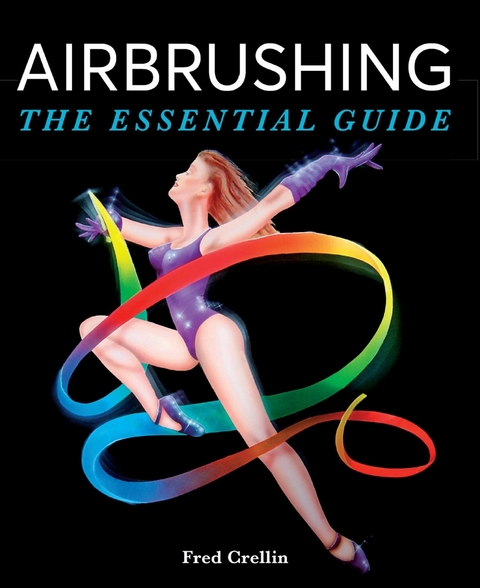
Airbrushing (eBook)
144 Seiten
Crowood (Verlag)
978-1-84797-632-1 (ISBN)

Fred Crellin learnt how to airbrush while studying Industrial Design and Modelling at Wolverhampton University. In subsequent years, he honed his airbrush skills before establishing his own company specializing in custom painting, portraits and cartoons. He qualified as a teacher and runs the Artimagination Airbrush School from his own classroom studio. Fred regularly shows his work at local art galleries and exhibitions.
Airbrushing is a versatile and exciting art. The technique has been used for some 150 years, and is now finding ever more applications. This beautiful book, now in paperback for 2022, explains how to use an airbrush. It looks at the fundamentals of how to get started, advises on maintenance of the tool and then gives step-by-step examples of a range of projects. Topics covered include: technical illustration; watercolour landscapes; portraits; painting scale models; cake decorating; T-shirts and leather and finally, custom painting vehicles. With troubleshooting tips throughout, it enables you to get the most from your airbrush and create beautiful pieces with a professional finish. 'To those who airbrush the joys are well known, as well of course, the trials and tribulations of managing the instrument itself. The airbrush student has to learn significant new skills - to master not only colour and shade, but also air pressure, paint consistency and the diverse ways of masking and shading that can help to achieve such wonderful results.' Prof Andy Penaluna
1
Chapter 1
The history and development of the airbrush
For many years the history of the airbrush consisted of a series of muddled and incorrect bits of factual information, put together to make some kind of coherent sense. It was not until the 1990s that the true history of the airbrush was properly researched and verified. This extensive research was conducted by my friend Professor Andy Penaluna, to whom I owe much of the credit and thanks in being able to write this chapter. This is the first time, I believe, that the correct information and unabridged history has been published.
Andy Penaluna created this image of an early forerunner of the airbrush using the actual tool depicted, as living proof that this odd-looking ‘airbrush’ actually works. It was created using a combination of needle, rubber and brass tubes, screwdriver and a bent spoon. (© Andy Penaluna)
The origins of paint spraying
Paint spraying, in all its many forms, has been around for thousands of years. Examples of the very earliest forms of this can be found in the caves of Lascaux in France. It is believed that ‘cavemen’ from the Palaeolithic era used hollowed out bones filled with animal blood to create some of the images seen on the cave walls, created over 17,000 years ago. Physically blowing the blood out from the centre of the bone onto the wall, using their own hand as a template, was a rudimentary but effective method of signing their work.
A hand print created over 17,000 years ago. (Photo: John Berry)
However, further caves were discovered in Spain and Portugal that showed an advance in the techniques used. At caves discovered in Altamira in Spain and Côa in Portugal, paintings were uncovered that showed greater definition and detail in the pigmentation being used. Added to this, remains of the actual tools used to create them were also discovered, and have been dated to around 13,000 BC. The technique is still in existence today and used in schools with the aid of what is referred to as a diffuser.
Palaeolithic man used hollowed out bones filled with blood to create wall art in caves.
A more sophisticated method of atomizing pigment, from around 13,000 BC. (www.visioninconsciousness.org)
Two smaller hollowed out bones are used like a diffuser. (http://flickrhivemind.net/Tags/art,rupestre/Interesting)
The results shows greater detail through creating a finer mist of pigment.
This method of applying dye or paint may have existed in numerous forms for various applications until the nineteenth century. It was the advent of photography that got things going in the right direction. At around this time, portraits became very popular, as quick photos could be taken, prints enlarged and then reproduced by artists using the photo as a guide to the likeness of the client. Many worked directly on top of this print, often using chalks and pastels. However, with the development of paint spraying tools, this was to change significantly.
Even after extensive research, there is still some debate as to who can be credited with designing the first ‘airbrush’ tool. This is primarily to do with the exact definition of an airbrush: is it a tool that has to be physically blown into, have a squeezable ball where a puff of air is emitted, or a constant flow of compressed air?
In 1876 Frank E. Stanley patented a ‘paint atomization’ device. His device did not use a regular, compressed form of air, but instead relied on a squeezable ‘puff’ blower. Frank E. Stanley was an award-winning American artist from Kingfield, Maine. His invention was for a device that was able to ‘spray water colours, India-ink and also for all kinds of shading in which colour can be used in a liquid state.’ Today, its basic design is not dissimilar to the mechanism found in perfume bottles, but at the time his design had a perfect application in photo retouching. His additional design features allowed the user greater control over volume and quality. Because it was ‘powered’ by a puff blower, it can be argued that in the true sense of the definition of what an airbrush is, this should not be regarded as an airbrush, but as its immediate forerunner. However, within three years (and 1,500 miles away), Abner Peeler was inventing a completely different way of atomizing paint, in conjunction with an air compressor device that powered the tool with a constant source of compressed air.
A design for a paint atomizer from around 1876, which used a squeezable ‘puff’ ball as its air source. (Courtesy Stanley Museum, Kingfield, Maine, USA ©)
Frank E. Stanley. (www.mainememory.net)
The dawn of airbrushing
It was around 1879 that Abner Peeler, an eccentric jeweller from Iowa in the USA, conducted various experiments. Using compressed air that was pumped by hand (or more specifically foot), jam spoons and needles, he came up with the design for a ‘paint distributor’, and began on a journey that was to develop into the tool we use today.
Abner Peeler. (Courtesy Stanley Museum, Kingfield, Maine, USA ©)
Peeler is regarded by many as the creative genius behind the initial development of the airbrush. His initial paint distributing device was just one of his many patented inventions. However, being an eccentric jeweller and part-time inventor, his motive lay in the designing of new devices; making money and spending time developing an idea were never really motivating factors to him. He was no businessman and sold his first design prototype of the paint distributor for a mere $10, but later sold the patent for $700 to the Walkup brothers – quite a lot of money back in 1882. Peeler can also be credited with the invention of a form of typewriter, twenty years prior to the recognized patented design, as well as dozens of other designs, including a form of foot-operated compressor.
In the three years from 1882, Charles and Liberty Walkup invested in the development of the tool, which culminated in the manufacture and sale of a small number of these new paint distributors at a Philadelphia Photographic convention. Eventually the Walkup Brothers set up the aptly named Airbrush Manufacturing Company, which began worldwide distribution of the tool.
The first patented airbrush paint atomizing device from 1884. (© Andy Penaluna)
The birth of the airbrush
The Airbrush Manufacturing Company developed into a business that would distribute worldwide. At precisely 7pm on 6 October 1883 a meeting was called in the offices of local attorney William Lathrop. Following a vote the Rockford Manufacturing Company changed its name to the Airbrush Manufacturing Company and the name ‘airbrush’ was officially born. When the company was formed, $35,000 of stock was raised in the first half hour and a further $15,000 by the second day! With this level of financial business support Liberty Walkup was able to start developing and seriously marketing the airbrush.
Unlike Abner Peeler, Liberty Walkup saw the potential of the paint distributor. With his brother Charles’ money, his wife Phoebe’s artistic skills, and his own ability to promote, he was able to develop the tool into a highly profitable and marketable product. Peeler signed over the invention to them in April 1882 after further development and it was then marketed by himself and his wife at various shows including a photography convention in Indianapolis in August 1882. There they sold sixty-three paint distributors.
By 1885 production of the airbrush was at its peak and Liberty Walkup was able to start marketing and selling his new and much refined single trigger design.
Small classes were set up to teach people how to use this new art tool but demand became so great that within three years the Illinois Art School was formed to accommodate all the interested students.
However, it was at Chicago’s Columbian Exposition in 1893 that there were suddenly two different types of airbrushes being exhibited. Charles Burdick had seized upon the Walkup ‘Airbrush’, and through successive developments that initially simply encased Walkup’s design within a pen-shaped case, he re-designed it to be more like a pen, lighter and sleeker in design. Unlike the Walkup model, which had an oscillating needle driven by air, Burdick’s design consisted of a needle and nozzle housed within a metal tube.
Charles Burdick came from a family of designers and inventors, and over his life filed many patents. However, he is widely regarded as the man who invented the airbrush, especially the form that we are familiar with today. His design, born over 120 years ago, in collaboration with his friend Dr Allen DeVilbiss who patented medical throat sprays, included a centralized needle control system. It is believed that he studied the use of atomizers, such as that by Frank E. Stanley, while developing his airbrush. Shortly after designing the tool, Burdick moved to England and set up The Fountain Brush Company in London, which shortly changed its name to the Aerograph Company. Not long after that, Burdick joined forces with Allen DeVilbiss to become DeVilbiss Aerograph, which existed for nearly the whole of the twentieth century.
At this point in history, the airbrush was now being taken up and...
| Erscheint lt. Verlag | 31.8.2013 |
|---|---|
| Verlagsort | London |
| Sprache | englisch |
| Themenwelt | Kunst / Musik / Theater ► Allgemeines / Lexika |
| Kunst / Musik / Theater ► Design / Innenarchitektur / Mode | |
| Kunst / Musik / Theater ► Malerei / Plastik | |
| Sachbuch/Ratgeber ► Freizeit / Hobby ► Heimwerken / Do it yourself | |
| Sachbuch/Ratgeber ► Freizeit / Hobby ► Malen / Zeichnen | |
| Schlagworte | Airbrush • air pressure • Custom Painting • fine line tape • frisket film • Masking • multi-layered stencils • paint atomizer • paint consistency • paint spraying • Shading • vinyl stencils |
| ISBN-10 | 1-84797-632-8 / 1847976328 |
| ISBN-13 | 978-1-84797-632-1 / 9781847976321 |
| Informationen gemäß Produktsicherheitsverordnung (GPSR) | |
| Haben Sie eine Frage zum Produkt? |
 EPUB (Wasserzeichen)
DRM: Digitales Wasserzeichen
Dieses eBook enthält ein digitales Wasserzeichen und ist damit für Sie personalisiert. Bei einer missbräuchlichen Weitergabe des eBooks an Dritte ist eine Rückverfolgung an die Quelle möglich.
Dateiformat: EPUB (Electronic Publication)
EPUB ist ein offener Standard für eBooks und eignet sich besonders zur Darstellung von Belletristik und Sachbüchern. Der Fließtext wird dynamisch an die Display- und Schriftgröße angepasst. Auch für mobile Lesegeräte ist EPUB daher gut geeignet.
Systemvoraussetzungen:
PC/Mac: Mit einem PC oder Mac können Sie dieses eBook lesen. Sie benötigen dafür die kostenlose Software Adobe Digital Editions.
eReader: Dieses eBook kann mit (fast) allen eBook-Readern gelesen werden. Mit dem amazon-Kindle ist es aber nicht kompatibel.
Smartphone/Tablet: Egal ob Apple oder Android, dieses eBook können Sie lesen. Sie benötigen dafür eine kostenlose App.
Geräteliste und zusätzliche Hinweise
Buying eBooks from abroad
For tax law reasons we can sell eBooks just within Germany and Switzerland. Regrettably we cannot fulfill eBook-orders from other countries.
aus dem Bereich