


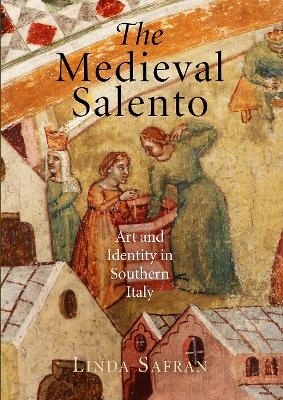
The Medieval Salento
Art and Identity in Southern Italy
Seiten
2014
University of Pennsylvania Press (Verlag)
978-0-8122-4554-7 (ISBN)
University of Pennsylvania Press (Verlag)
978-0-8122-4554-7 (ISBN)
- Titel z.Zt. nicht lieferbar
- Versandkostenfrei
- Auch auf Rechnung
- Artikel merken
The Medieval Salento explores the visual and material culture of people who lived and died in this region between the ninth and fifteenth centuries, showing the ways Jews, Orthodox Christians, and Roman-rite Christians used images, artifacts, and texts in Hebrew, Greek, and Latin to construct both independent and intersecting identities.
Located in the heel of the Italian boot, the Salento region was home to a diverse population between the ninth and fifteenth centuries. Inhabitants spoke Latin, Greek, and various vernaculars, and their houses of worship served sizable congregations of Jews as well as Roman-rite and Orthodox Christians. Yet the Salentines of this period laid claim to a definable local identity that transcended linguistic and religious boundaries. The evidence of their collective culture is embedded in the traces they left behind: wall paintings and inscriptions, graffiti, carved tombstone decorations, belt fittings from graves, and other artifacts reveal a wide range of religious, civic, and domestic practices that helped inhabitants construct and maintain personal, group, and regional identities.
The Medieval Salento allows the reader to explore the visual and material culture of a people using a database of over three hundred texts and images, indexed by site. Linda Safran draws from art history, archaeology, anthropology, and ethnohistory to reconstruct medieval Salentine customs of naming, language, appearance, and status. She pays particular attention to Jewish and nonelite residents, whose lives in southern Italy have historically received little scholarly attention. This extraordinarily detailed visual analysis reveals how ethnic and religious identities can remain distinct even as they mingle to become a regional culture.
Located in the heel of the Italian boot, the Salento region was home to a diverse population between the ninth and fifteenth centuries. Inhabitants spoke Latin, Greek, and various vernaculars, and their houses of worship served sizable congregations of Jews as well as Roman-rite and Orthodox Christians. Yet the Salentines of this period laid claim to a definable local identity that transcended linguistic and religious boundaries. The evidence of their collective culture is embedded in the traces they left behind: wall paintings and inscriptions, graffiti, carved tombstone decorations, belt fittings from graves, and other artifacts reveal a wide range of religious, civic, and domestic practices that helped inhabitants construct and maintain personal, group, and regional identities.
The Medieval Salento allows the reader to explore the visual and material culture of a people using a database of over three hundred texts and images, indexed by site. Linda Safran draws from art history, archaeology, anthropology, and ethnohistory to reconstruct medieval Salentine customs of naming, language, appearance, and status. She pays particular attention to Jewish and nonelite residents, whose lives in southern Italy have historically received little scholarly attention. This extraordinarily detailed visual analysis reveals how ethnic and religious identities can remain distinct even as they mingle to become a regional culture.
Linda Safran is a Research Fellow at the Pontifical Institute of Mediaeval Studies, Toronto, and editor of the journal Gesta.
Note
Introduction
Chapter 1. Names
Chapter 2. Languages
Chapter 3. Appearance
Chapter 4. Status
Chapter 5. The Life Cycle
Chapter 6. Rituals and Other Practices in Places of Worship
Chapter 7. Rituals and Practices at Home and in the Community
Chapter 8. Theorizing Salentine Identity
Database: Sites in the Salento with Texts and Images Informative
About Identity
Notes
Works Cited
Index
Acknowledgments
| Erscheint lt. Verlag | 18.4.2014 |
|---|---|
| Reihe/Serie | The Middle Ages Series |
| Zusatzinfo | 2 color 149 b/w illus. |
| Verlagsort | Pennsylvania |
| Sprache | englisch |
| Maße | 178 x 254 mm |
| Themenwelt | Kunst / Musik / Theater ► Kunstgeschichte / Kunststile |
| Geschichte ► Allgemeine Geschichte ► Mittelalter | |
| Geisteswissenschaften ► Geschichte ► Regional- / Ländergeschichte | |
| ISBN-10 | 0-8122-4554-7 / 0812245547 |
| ISBN-13 | 978-0-8122-4554-7 / 9780812245547 |
| Zustand | Neuware |
| Informationen gemäß Produktsicherheitsverordnung (GPSR) | |
| Haben Sie eine Frage zum Produkt? |
Mehr entdecken
aus dem Bereich


aus dem Bereich
Geschichte einer Augsburger Familie (1367-1650)
Buch | Softcover (2024)
Kohlhammer (Verlag)
CHF 47,60


