Zum Hauptinhalt springen
Nicht aus der Schweiz? Besuchen Sie lehmanns.de
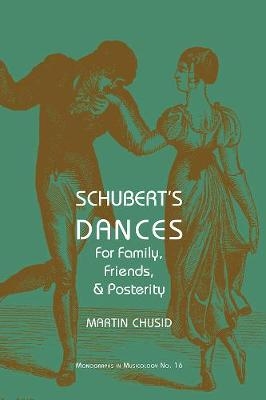
Schubert's Dances - Martin Chusid

Schubert's Dances

For Family, Friends and Posterity

(Autor)

Buch | Softcover
294 Seiten
2013
Pendragon Press (Verlag)
978-1-57647-239-2 (ISBN)
CHF 91,90 inkl. MwSt
  • Keine Verlagsinformationen verfügbar
  • Artikel merken
Of the several genres comprising Schubert's prodigious compositional output, the one that has attracted the least attention from scholars has been his approximately 500 dances. Of these, more than 200 were published during his lifetime, twice as many as his songs; and they were received enthusiastically by the public. Yet, strangely enough, there has been only one slim volume devoted to the subject and it is in German, Schubert und das Tanzvergnügen (Schubert and the Enjoyment of the Dance). A translation of the opening section of that book forms the Introduction to our volume where it is entitled "Dancing in Vienna in the Early 19th Century." Although the composer's dances have been enjoyed in the United States and England by pianists and their pupils for generations, the current book is the first in English about them. Furthermore, there are relatively few articles or commentaries of substance thattreat them seriously. Our publication begins with chapters on the minuets, all of which were written for members of his family, and his ecosaisses, primarily itended for his friends. Later another section is devoted to the polonaises and his other four hand dances, works that Schubert composed mainly for his only serious students, the Countesses Marie and Caroline Esterhazy. But by far the largest portion of the volume is devoted to the quick, triple-meter compositions Schubert labeled German dances or ländler, although his publishers most often gave them the title of Waltzes. The composer, however, used the term Walzer just once in his lifetime; and he did so in the course ofa humorous poem to rhyme with the word Pfalzer, an inhabitant of the Rhine region of Germany, at the conclusion of a dance he in fact called a Deutscher (German dance). In the course of studying the dances a number of points insufficientally, or not at all, discussed in the Schubert literature has emerged. For one thing forty, approximatel 8% of these relatively short compositions-most are only 16 or 24 measures in length-begin and end in different keys. This is and aspect of Schubert's fremarkable harmonic imagination also visible in some 75 of his well over 600 songs. Another aspect of interest is that, despite their similarity in meter and tempo, there is a considerable diffence in musical character between the dances Schubert called German dances and those he labeled ländler. A third noteworthy feature of the composer's dances is the manner in which all of his later published

Martin Chusid was born Aug. 19, 1925 and began studying piano at age 8. After serving in the U. S. army during WW II, he began studying music theory with Mark Brunswick at CCNY. He continued studying music theory at the University of California, Berkeley, with William Denny and Charles Cushing taking additional courses with Andrew Imbrie and Roger Sessions while continuing his piano studies with Marjorie Gear Petray. During his years of graduate work he studied musicology with Manfred Bukofzer (primarily), Edgar Sparks, Joseph Kerman and Edward Lowinsky. His MasterпїЅs thesis was on The Sonata Rondos of Mozart and his Doctoral dissertation was devoted to The Chamber Music of Schubert. He taught full-time at the University of Southern California (1959-1963) and New York University (1963-2007) where he was Chairman of the Music Department (1967-1970), Acting Chairman several times, Associate Dean of the Graduate School of Arts and Science (1970-72), and Director of the American Institute for Verdi Studies (1976-2007). He has been Visiting Professor of Music at Boston University, University of British Columbia, Southern Methodist University, Princeton University, and Brigham Young University. He was Reviews Editor for the College Music Symposium (1967-71) and edited the Verdi Newsletter (1977-98). In addition to editing Rigoletto, the first volume of The Works of Giuseppe Verdi (1983), he has been a member of their editorial board since that date. He has organized, or helped organize, International Verdi Congresses at Danville, Kentucky (1977), Irvine, California (1980), Belfast, Northern Ireland (1992), and Parma-New York-New Haven (2001), with two Verdi Conferences at Sarasota, Florida (1994 and 1996). He has written numerous articles on the music of Verdi, others about the instrumental music of Schubert, a few concerned with the operas of Mozart, and on the late masses of Haydn and the late operas of Dvorak.

Reihe/Serie Monographs in Musicology
Zusatzinfo 5 b/w. 7 line.
Verlagsort Hillsdale
Sprache englisch
Maße 60 x 90 mm
Themenwelt Kunst / Musik / Theater Musik
ISBN-10 1-57647-239-6 / 1576472396
ISBN-13 978-1-57647-239-2 / 9781576472392
Zustand Neuware
Informationen gemäß Produktsicherheitsverordnung (GPSR)
Haben Sie eine Frage zum Produkt?
Mehr entdecken
aus dem Bereich