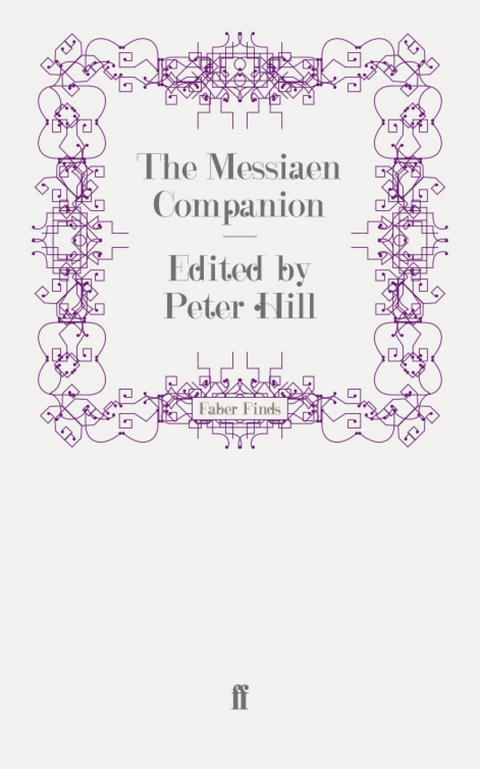
Messiaen Companion (eBook)
200 Seiten
Faber & Faber (Verlag)
978-0-571-28104-6 (ISBN)
Russell Hoban was born in Pennsylvania in 1925. He went to art school before serving in World War II and was a freelance illustrator for eight years before taking up full-time writing. His many works of fiction and poetry for both adults and children have won him numerous awards. The Mouse and His Child has been hailed as one of the great classics of the twentieth century.
Re-issued to coincide with the centenary of Messiaen's birth, The Messiaen Companion was the first major study to appear after the composer's death in April 1992. It was the first book to offer both a complete survey of Messiaen's extraordinary achievements and a comprehensive guide to his music, also examining in detail the enduring inspiration which Messiaen derived from his religious faith and from his lifelong passion for ornithology and the natural world. The contributors, all of whom have made a special study of the composer, include two biographers of Messiaen and a number of the foremost interpreters of his music. Messiaen's influential teaching is recalled in essays by three of his pupils (Pierre Boulez, George Benjamin, and Peter Hill), and the composer is also remembered in a remarkable and moving contribution from his widow and devoted musical companion, the pianist Yvonne Loriod.
Olivier Messiaen’s life is remarkable for its scale. With a composing career spanning seven decades, only Stravinsky, of the major figures of the twentieth century, is his equal. Unlike Stravinsky, however, and unlike either Tippett or Carter (both, like Messiaen, composers active in their eighties) Messiaen was astonishingly precocious, still only in his teens when he reached a first maturity, if by that one means the discovery of a voice uniquely and unmistakably his own. Indeed Messiaen’s life is best described as a series of maturities, his achievements coming in waves, given impetus by periods of self-renewal, undertaken either in response to circumstance or as conscious experiment. By far the most significant occurred around 1950, a sea-change reflected in the design of this book, which divides the music before and after this date with an interlude, a group of essays exploring facets of Messiaen’s work. But although it is possible to separate Messiaen’s life into sections, to do so is, in his case, especially artificial; for perhaps Messiaen’s most remarkable trait was the firmness with which he kept faith with a basic set of principles, so that the language (and to a very great degree the technique) of Messiaen’s earliest music is still apparent in the music composed sixty or so years later.
This unity was important to Messiaen as the means by which he kept to his course through the artistic upheavals of his time; yet it was not bought at the price of sealing off the outside world. On the contrary, Messiaen’s life (from his mid-thirties) was increasingly a public one: he was active as organist, teacher and performer (and for the last three decades in worldwide demand at concerts of his music), with only the precious summer break reserved for privacy and composing. More than this, one of Messiaen’s most engaging qualities, remarked on by all his pupils, was his curiosity. He seemed constantly alert to new experiences, renewing his art through researches into a vast range of music – ancient, exotic and ultra-modern – besides the collecting of birdsongs, which in later years took him to ever more remote parts of the world (so much so that even Yvonne Loriod, his wife and devoted musical companion, could be driven to exasperation: see Interview with Yvonne Loriod).
Although Messiaen cast his net widely, certain fundamentals were ever-present. The main sources of inspiration are reflected on the bookshelves of his study in Paris. Prominent are the volumes of Shakespeare in the translation by his father, Pierre. The lower shelves are occupied by musical scores, while above space is equally divided between books on birds (in Messiaen’s own view he was as much ornithologist as musician) and works of theology. This modest room, left exactly as it was at the time of Messiaen’s death, is symbolic of the anomaly which struck all who met him: that the composer of music so transcendent in ambition and scale should have lived life so simply. Quietly spoken, Messiaen explained himself with the calm lucidity of the practised teacher. He possessed exceptional clarity of mind, and applied the same methodical care to all aspects of his life. His attention to detail was legendary, and in the more mundane duties of a composer he led his pupils by example, prescribing in his scores every detail of fingering or registration, and taking immense pains to eliminate all trace of ambiguity, let alone error. His students were amazed that so eminent a musician should devote so much time to teaching; and he was similarly punctilious over his duties at La Trinité, where neither age nor infirmity would deter him from climbing the sixty or so steps to the organ loft in order to accompany Sunday services.
The image of Messiaen as in some way a reincarnation of the medieval artist-craftsman has contributed to a misconceived view of him as standing outside the main preoccupations of twentieth-century music. It is true that, in an age which has invented restrictions for itself as fast as it has knocked them down, Messiaen’s imperviousness in the face of the artistic dogma of the moment frequently irritated his critics. Like all people who swim against the tide of sophisticated opinion he found himself classified as naive, too gifted to be ignored, but eccentric and peripheral. At a time when to do so was deeply unfashionable Messiaen retained an unshakable faith in music’s power to describe or symbolize. Even to some of his pupils this seemed perverse, or perhaps endearingly quaint, although arguably it is this fearless lack of all inhibition which is the greatest contribution Messiaen made to the music of his era. Almost single-handedly he embodied a kind of musical counter-reformation, in revolt against austerity, engaging in his music with the central issue of existence at a time when many composers have confined themselves to the margins of experience.
Not that Messiaen was unaware of his isolated position; indeed he was abnormally sensitive to adverse criticism, and the same sensitivity made him fanatically secretive about work in progress (concerning which any enquiry would receive a polite but unmistakable snub). Rather he seems to have developed at an early age a quite exceptional independence of mind. Even the Catholicism which was central to his life seems not to have been acquired from his parents,1 while his formative musical experiences came through exploring operatic scores at the piano by himself – all before the age of ten,2 a testimony to the early development of his consummate musical skills. Nonetheless in childhood the artistic stimulus was as much literary as musical – from his mother, the poetess Cécile Sauvage, as well as from his father; and Messiaen retained a vast knowledge of poetry which he could quote freely and accurately, including the English Romantics, from whom came the inspiration for his first known composition, La dame du Shalott. Messiaen was fond, also, of recalling the performances of Shakespeare that he enacted with his younger brother, and the toy theatre he constructed with lighting improvised by means of transparent coloured sweet papers; no doubt it was the pageantry and the magical which appealed, though the evidence is that Messiaen’s literary gifts were at least as precocious as his music.
Messiaen might have been a writer, not musician, had it not been for the decisive impact of a score of Debussy’s Pelléas, a gift on his tenth birthday; even before this, if one gives credence to the story recounted by Yvonne Loriod (see Interview with Yvonne Loriod)3 came a discovery which appealed to the latent musician – the love of birds, and the beginnings of Messiaen’s belief, adhered to with increasing conviction, that their song is neither twittering ornament nor merely signals of defence and recognition, but music. Another prophetic revelation, combining the architecture of the Middle Ages with the sensuous shock of colour, came when his father and mother took him to the Ste Chapelle; the marvel of this early experience remained so vivid that Messiaen repeatedly used the example of stained glass to explain his music, citing the ways in which the details of the multicoloured mosaic, when viewed from a distance, fuse into a single entity, whose purpose (again as in Messiaen’s music) is not only to represent or instruct, but to ‘dazzle’.
Stained glass is one of the most wonderful creations of man. You are overwhelmed. And I think this is the beginning of Paradise, because in Paradise we are overwhelmed. We won’t understand God, but we will begin to see Him a little … Real music, beautiful music – you can listen to it without understanding it: you don’t need to have studied harmony or orchestration. You must feel it. And here, also, one is overwhelmed – by the shock of the sound.4
Faith, as Messiaen repeatedly emphasized, was his sole reason for composing; yet this side of Messiaen has in the past created difficulties – as much for Catholic as non-Catholic listeners, although today it may seem less of an obstacle to a generation which values the visionary and numinous in the music of Pärt, Tavener, Harvey or Górecki. One does not have to share an artist’s beliefs in order to respond to his art. And the experience of Messiaen’s music is so all-consuming, and so completely overrides mundane critical responses, that it is difficult to see how one can (as some claim) choose what appeals from Messiaen’s menu and ignore the rest. Even the structure of the music seems permeated by his faith, with complexity of detail embracing truths of great simplicity (a combination which has traditionally given Catholicism its appeal to sophisticated minds, and which, similarly, may go some way to explain the potency of Messiaen’s music).
Religion leads also to a central paradox whereby music, an art which exists in the here-and-now, in measured time, is used by Messiaen to convey mysteries which lie beyond time. This expression of what Paul Griffiths calls ‘the eternal within the temporal’5 causes Messiaen to stand apart from the Western tradition (since the Renaissance, at least) in which musical events are ordered into a directional sequence or ‘narrative’. Messiaen’s music accumulates, but it does not develop (in the accepted sense) or argue. In part this is because Messiaen’s acceptance of his faith is so complete that he is simply not concerned with the strains...
| Erscheint lt. Verlag | 17.11.2011 |
|---|---|
| Verlagsort | London |
| Sprache | englisch |
| Themenwelt | Literatur |
| Kunst / Musik / Theater ► Musik ► Klassik / Oper / Musical | |
| Kunst / Musik / Theater ► Musik ► Musikgeschichte | |
| Kinder- / Jugendbuch | |
| Schlagworte | Composers • Faber Finds • musicology • Nature |
| ISBN-10 | 0-571-28104-4 / 0571281044 |
| ISBN-13 | 978-0-571-28104-6 / 9780571281046 |
| Informationen gemäß Produktsicherheitsverordnung (GPSR) | |
| Haben Sie eine Frage zum Produkt? |
 EPUB (Adobe DRM)
Kopierschutz: Adobe-DRM
Adobe-DRM ist ein Kopierschutz, der das eBook vor Mißbrauch schützen soll. Dabei wird das eBook bereits beim Download auf Ihre persönliche Adobe-ID autorisiert. Lesen können Sie das eBook dann nur auf den Geräten, welche ebenfalls auf Ihre Adobe-ID registriert sind.
Details zum Adobe-DRM
Dateiformat: EPUB (Electronic Publication)
EPUB ist ein offener Standard für eBooks und eignet sich besonders zur Darstellung von Belletristik und Sachbüchern. Der Fließtext wird dynamisch an die Display- und Schriftgröße angepasst. Auch für mobile Lesegeräte ist EPUB daher gut geeignet.
Systemvoraussetzungen:
PC/Mac: Mit einem PC oder Mac können Sie dieses eBook lesen. Sie benötigen eine
eReader: Dieses eBook kann mit (fast) allen eBook-Readern gelesen werden. Mit dem amazon-Kindle ist es aber nicht kompatibel.
Smartphone/Tablet: Egal ob Apple oder Android, dieses eBook können Sie lesen. Sie benötigen eine
Geräteliste und zusätzliche Hinweise
Buying eBooks from abroad
For tax law reasons we can sell eBooks just within Germany and Switzerland. Regrettably we cannot fulfill eBook-orders from other countries.
aus dem Bereich