Illuminating in Micrography
Brill (Verlag)
978-90-04-24443-6 (ISBN)
- Keine Verlagsinformationen verfügbar
- Artikel merken
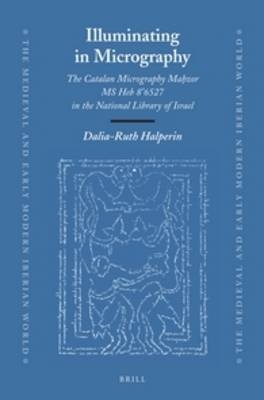
In Illuminating in Micrography, Dalia-Ruth Halperin analyzes the Catalan Micrography Maḥzor, a fourteenth-century Barcelonan manuscript in Israel’s National Library. Decorated with micrography, the Jewish scribal art typical of Bible manuscripts, this maḥzor, which includes a rich full-page panel micrography cycle, is unique.
Along with the codicological and paleographical analysis, essential for understanding the scribe’s thought and working processes, the author’s meticulous reading of the micrography text reveals the scribe’s textual editing and manipulations. Decoding his writing flow and sequences revealed a close association between the penned text and the images formed, which reflect a Jewish theosophical-theurgical cycle. Evidence of the scribe’s association with the renowned Bassa atelier enhances our knowledge of the cultural, economic, and ethnic realities of the time.
Dalia-Ruth Halperin, Ph.D. (2008), Hebrew University of Jerusalem, has published articles on the unique Jewish art of micrography, on the complex ties between the penned texts and the images formed, and on the eschatological and kabbalistic content of such images.
Abbreviations ... ix
List of Illustrations and Photo Credits ... xi
A Note on Transliterations and Translations ... xxiii
Manuscripts Cited and Their Abbreviations ... xxv
Piyyuṭ: Terms, Translations, and Short Explanations ... xxxv
Preface ... xli
Introduction ... 1
1 The Art of Micrography and Its Research Methodology ... 5
The Masorah ... 5
The Decoration’s Forming Text ... 7
The Artistic Development of Micrography ... 9
Micrography in the Middle Ages ... 14
Research Survey ... 16
Micrography Research Methodology ... 18
2 The Manuscript’s Material Evidence ... 23
Codicology ... 23
Writing Materials and Quire Structure ... 23
Perforation and Ruling Layout ... 26
Structural Transparency and Line Management Methods ... 30
Paleography ... 35
The Scripts Used in the Maḥzor ... 35
Characteristics of the Scripts ... 37
Scribe and Micrographer ... 43
The Characteristics of the Scribe’s Writing ... 46
The Semicursive Script and Its Role in Dating the Maḥzor ... 48
3 The Text ... 51
The Liturgical Structure ... 52
The Decoration Program for the Piyyuṭim ... 56
Initial Word Panels ... 57
Prayer Instructions ... 57
Captions ... 57
Marginal Decorations ... 57
Text Analysis: Rite and Branches ... 60
Indications of the Maḥzor’s Place and Date of Production ... 70
4 Within the Cultural Milieu: The Scribe’s Artistic Sources ... 79
The Decoration Plan ... 79
The Scribe’s Artistic Sources ... 80
Artistic Sources from Jewish Art ... 81
Artistic Sources from Islamic Art ... 105
Artistic Sources from Latin Art ... 111
5 Every Word Counts: Deciphering the Micrography’s
Text Flow ... 127
Scribal Copying Snares ... 128
The “Choreography” of the Micrography ... 129
Un tour de force: The Virtuosic Choreography of the Micrography ... 134
The Scribe’s Selection of Psalms: Associations between the Text and the Iconography ... 139
6 Reading the Image: Envisioning the Word ... 149
The Marginal Decorations ... 149
The Full-Page Panels ... 164
First Quire, First Opening—fols. 2r/1v (pl. I) ... 182
First Quire, Second Opening—fols. 3r/2v (pl. II) ... 191
First Quire, Third and Fourth Opening—fols. 4r/3v and 5r/4v (pl. III and IV) ... 202
First Quire, Fifth Opening—fols. 6r/5v (pl. V) ... 212
Second Quire, First and Second Opening (Sixth and Seventh in the Cycle)—fols. 8r/7v and fols. 9r/8v (pls. VI and VII) ... 218
Second Quire, Third Opening (Eighth in the Cycle)—fols. 10r/9v (pl. VIII) ... 230
Second Quire, Fourth Opening (Ninth in the Cycle)—fols. 11r/10v (pl. IX) ... 234
Second Quire, Fifth Opening (Tenth in the Cycle)—fols. 12r/11v (pl. X) ... 242
Second Quire, Sixth Opening (Eleventh in the Cycle)—fols. 13r/12v (pl. XI) ... 244
Second Quire, Seventh Opening (Twelfth in the Cycle)—fols. 14r/13v (pl. XII) ... 246
7 The Manuscript’s Tumultuous Journey through History ... 253
The Bindings ... 253
Owners’ Hands ... 258
The First Hand ... 259
The Second Hand ... 263
The Third Hand ... 263
The Fourth Hand ... 265
The Fifth Hand ... 267
The Sixth Hand ... 268
Conclusion ... 271
Appendix 1. Index of Piyyuṭim Used in the Book ... 277
Appendix 2. The Micrography Panels: Text Flow Tables and Diagrams ... 287
Bibliography ... 517
Index ... 541
Plates and Illustrations
| Erscheint lt. Verlag | 21.6.2013 |
|---|---|
| Reihe/Serie | The Medieval and Early Modern Iberian World ; 51 |
| Verlagsort | Leiden |
| Sprache | englisch |
| Maße | 155 x 235 mm |
| Gewicht | 1322 g |
| Themenwelt | Kunst / Musik / Theater ► Kunstgeschichte / Kunststile |
| Geisteswissenschaften ► Geschichte | |
| ISBN-10 | 90-04-24443-3 / 9004244433 |
| ISBN-13 | 978-90-04-24443-6 / 9789004244436 |
| Zustand | Neuware |
| Informationen gemäß Produktsicherheitsverordnung (GPSR) | |
| Haben Sie eine Frage zum Produkt? |
aus dem Bereich