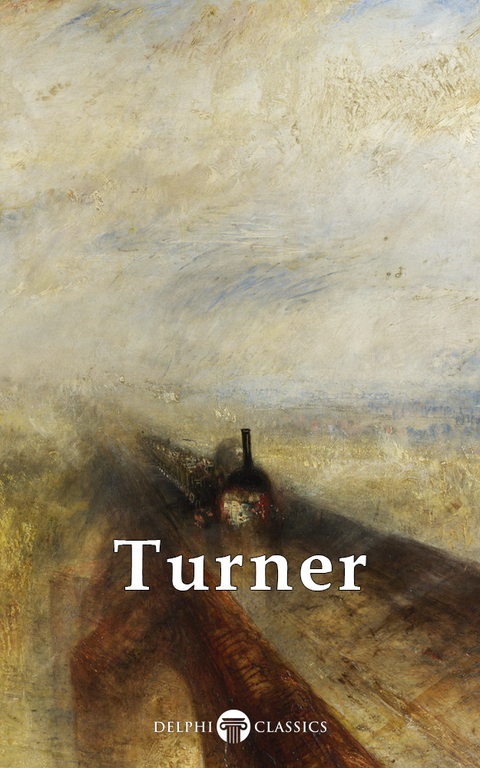
Delphi Collected Works of J. M. W. Turner (Illustrated) (eBook)
8945 Seiten
Delphi Publishing Limited (Verlag)
978-1-908909-62-6 (ISBN)
<strong>Renowned as 'the painter of light', the English Romanticist landscape painter J. M. W. Turner is now regarded as the artist that elevated landscape painting to an eminence rivalling history painting, as well as raising the reputation of watercolour landscape painting. Delphi's Masters of Art Series presents the world's first digital e-Art books, allowing readers to explore the works of great artists in comprehensive detail. This volume presents over 360 oil paintings of Britain's most celebrated artist J. M. W. Turner. For all art lovers, this stunning collection presents a beautiful feast of images by the great Romantic Master. (Version 1)</strong> </p>Features:<br>* Over 360 oil paintings, indexed and arranged in chronological order<br>* A selection of over 190 watercolours, indexed and arranged in chronological order<br>* Special 'Highlights' section, with concise introductions to the masterpieces, giving valuable contextual information<br>* Learn about the history of 'The Fighting Temeraire' and other famous works in concise detail.<br>* Numerous images relating to Turner's life, places and works<br>* Learn about the great artist's life in William Cosmo Monkhouse's famous biography<br>* Enlarged 'Detail' images, allowing you to explore Turner's celebrated works as featured in traditional art books<br>* Hundreds of images in stunning colour - highly recommended for viewing on tablets and smart phones or as a valuable reference tool on more conventional eReaders <br>* Easily locate the paintings you want to view <br>* Scholarly ordering of plates into chronological order</p>CONTENTS:</p>The Highlights<br>FISHERMEN AT SEA<br>BUTTERMERE LAKE, WITH PART OF CROMACKWATER, A SHOWER<br>SELF PORTRAIT, 1799<br>THE FALL OF AN AVALANCHE IN THE GRISONS<br>SNOW STORM: HANNIBAL AND HIS ARMY CROSSING THE ALPS<br>BONNEVILLE, SAVOY WITH MONT BLANC<br>THE SHIPWRECK<br>DIDO BUILDING CARTHAGE<br>THE BURNING OF THE HOUSES OF LORDS AND COMMONS<br>ULYSSES DERIDING POLYPHEMUS<br>PEACE - BURIAL AT SEA<br>THE FIGHTING TEMERAIRE<br>SHADE AND DARKNESS - THE EVENING OF THE DELUGE<br>THE SLAVE SHIP<br>RAIN, STEAM AND SPEED - THE GREAT WESTERN RAILWAY<br>SNOWSTORM - STEAM-BOAT OFF A HARBOUR'S MOUTH<br>LANDSCAPE WITH DISTANT RIVER AND BAY<br>A DISASTER AT SEA<br>NORHAM CASTLE SUNRISE</p>The Oil Paintings<br>THE OIL PAINTINGS<br>ALPHABETICAL LIST OF OIL PAINTINGS</p>The Watercolour Paintings<br>THE WATERCOLOUR PAINTINGS<br>ALPHABETICAL LIST OF WATERCOLOURS</p>The Biography<br>TURNER by William Cosmo Monkhouse</p><br></p>Please visit www.delphiclassics.com to browse through our range of exciting titles or to buy the whole Art series as a Super Set
<strong>Renowned as 'the painter of light', the English Romanticist landscape painter J. M. W. Turner is now regarded as the artist that elevated landscape painting to an eminence rivalling history painting, as well as raising the reputation of watercolour landscape painting. Delphi's Masters of Art Series presents the world's first digital e-Art books, allowing readers to explore the works of great artists in comprehensive detail. This volume presents over 360 oil paintings of Britain's most celebrated artist J. M. W. Turner. For all art lovers, this stunning collection presents a beautiful feast of images by the great Romantic Master. (Version 1)</strong> </p>Features:<br>* Over 360 oil paintings, indexed and arranged in chronological order<br>* A selection of over 190 watercolours, indexed and arranged in chronological order<br>* Special 'Highlights' section, with concise introductions to the masterpieces, giving valuable contextual information<br>* Learn about the history of 'The Fighting Temeraire' and other famous works in concise detail.<br>* Numerous images relating to Turner's life, places and works<br>* Learn about the great artist's life in William Cosmo Monkhouse's famous biography<br>* Enlarged 'Detail' images, allowing you to explore Turner's celebrated works as featured in traditional art books<br>* Hundreds of images in stunning colour - highly recommended for viewing on tablets and smart phones or as a valuable reference tool on more conventional eReaders <br>* Easily locate the paintings you want to view <br>* Scholarly ordering of plates into chronological order</p>CONTENTS:</p>The Highlights<br>FISHERMEN AT SEA<br>BUTTERMERE LAKE, WITH PART OF CROMACKWATER, A SHOWER<br>SELF PORTRAIT, 1799<br>THE FALL OF AN AVALANCHE IN THE GRISONS<br>SNOW STORM: HANNIBAL AND HIS ARMY CROSSING THE ALPS<br>BONNEVILLE, SAVOY WITH MONT BLANC<br>THE SHIPWRECK<br>DIDO BUILDING CARTHAGE<br>THE BURNING OF THE HOUSES OF LORDS AND COMMONS<br>ULYSSES DERIDING POLYPHEMUS<br>PEACE - BURIAL AT SEA<br>THE FIGHTING TEMERAIRE<br>SHADE AND DARKNESS - THE EVENING OF THE DELUGE<br>THE SLAVE SHIP<br>RAIN, STEAM AND SPEED - THE GREAT WESTERN RAILWAY<br>SNOWSTORM - STEAM-BOAT OFF A HARBOUR'S MOUTH<br>LANDSCAPE WITH DISTANT RIVER AND BAY<br>A DISASTER AT SEA<br>NORHAM CASTLE SUNRISE</p>The Oil Paintings<br>THE OIL PAINTINGS<br>ALPHABETICAL LIST OF OIL PAINTINGS</p>The Watercolour Paintings<br>THE WATERCOLOUR PAINTINGS<br>ALPHABETICAL LIST OF WATERCOLOURS</p>The Biography<br>TURNER by William Cosmo Monkhouse</p><br></p>Please visit www.delphiclassics.com to browse through our range of exciting titles or to buy the whole Art series as a Super Set
CHAPTER II. EARLY DAYS.
1775 to 1789.
THE appearance of Turner’s genius in this world is not to be accounted for by any known facts. Given his father and his mother, his grandfather and grandmother, on the father’s side, which is all we know of his ancestry, given the date of his birth, even though that was the 23rd April (St. George’s day, as has been so childishly insisted on), 1775, there seems to be positively no reason why “William Turner, barber, of 26, Maiden Lane, opposite the Cider Cellar, in the parish of St. Paul’s, Covent Garden, and Mary Turner, nee Marshall, his wife, should have produced an artist, still less, one of the greatest artists that the world has yet seen. There is only one fact, and that a very sad one, which might be held to have some connection with his genius.” Great wits are sure to madness near allied,” sang Dryden and poor Mrs. Turner became insane “towards the end of her days.” This, however, will in no way account for the special quality of Turner’s genius. He arose like many other great men in those days to help in opening the eyes of England to the beauties of nature, one of the large and illustrious constellation of men of genius that lit the end of the last and the beginning of the present century, and with that truth we must be content.
The earliest fact that we have on record which had any influence on Turner is that his paternal grandfather and grandmother spent all their lives at South Molton in Devonshire. Although he is not known to have visited Devonshire till he was thirty-seven years of age he appears to have been proud of his connection with the county, and to have asserted that he was a Devonshire man. This is, as far as we know, the solitary effect of Turner’s ancestry upon him. Of his father and mother the influence was necessarily great. From his father he undoubtedly obtained his extraordinary habits of economy, that spirit of a petty tradesman, which was one of his most unlovely characteristics, and, be it added, his honesty and industry also. Of his father we have several descriptions by persons who knew him; of his mother, one only, and that, unfortunately, not so authentic. We will give the lady the first place, and it must be remembered that this unfavourable picture is drawn by Mr. Thornbury from information derived from the Rev. Henry Syer Trimmer, the son of Turner’s old friend and executor, the Rev. Henry Scott Trimmer, of Heston, who obtained it from Hannah Danby, Turner’s housekeeper in Queen Anne Street, who got it from Turner’s father.
“In an unfinished portrait of her by her son, which was one of his first attempts, my informant perceived no mark of promise; and he extended the same remark to Turner’s first essays at landscape. The portrait was not wanting in force or decision of touch, but the drawing was defective. There was a strong likeness to Turner about the nose and eyes; her eyes being represented as blue, of a lighter hue than her son’s; her nose aquiline, and the nether lip having a slight fall. Her hair was well frizzed — for which she might have been indebted to her husband’s professional skill — and it was surmounted by a cap with large flappers. Her posture therein (sic) was erect, and her aspect masculine, not to say fierce; and this impression of her character was confirmed by report, which proclaimed her to have been a person of ungovernable temper, and to have led her husband a sad life. Like her son, her stature was below the average.”
This as the result of a painted portrait by her son, and verbal description by her husband, is not too flattering, and it is all we know of the character and appearance of poor Mary Turner. Of her belongings we know still less. She is said to have been sister to Mr. Marshall, a butcher, of Brentford, and first cousin to the grandmother of Dr. Shaw, author of “Gallops in the Antipodes,” and to have been related to the Marshalls, formerly of Shelford Manor House, near Nottingham. We are able to add to this scanty information that she was the younger sister of Mrs. Harpur, the wife of the curate of Islington, who was grandfather of Mr. Henry Harpur, one of Turner’s executors. He (the grandfather) fell in love with his future wife when at Oxford, and their marriage brought her sister to London. We are also informed that the hard-featured woman crooning over the smoke, in an early drawing by Turner in the National Gallery (An Interior, No. 15), is Turner’s mother, and the kitchen in which she is sitting, the kitchen in Maiden Lane. We have also ascertained that one Mary Turner, from St. Paul’s, Covent Garden, was admitted into Bethlehem Hospital on Dec. 27th, 1800, one of whose sponsors for removal was “Richard Twenlow, Peruke Maker.” This unfortunate lady, whether Turner’s mother or not, was discharged uncured in the following year. Altogether what we know about Turner’s mother does not inspire curiosity, and we fear that she was never destined to figure in an edition of “The Mothers of Great Men.” The “sad life” which she is said to have led her husband could scarcely have been sadder than her own.
Of his father we have fuller information.
“Mr. Trimmer’s description of the painter’s parent, the result of close knowledge of him, is that he was about the height of his son, spare and muscular, with a head below the average standards” (whatever that may mean) “small blue eyes, parrot nose, projecting chin, and a fresh complexion indicative of health, which he apparently enjoyed to the full. He was a chatty old fellow, and talked fast, and his words acquired a peculiar transatlantic twang from his nasal enunciation. His cheerfulness was greater than that of his son, and a smile was always on his countenance.”
This description is of him when an old man, but he must have been not very different from this when about one year and eighteen months after his marriage, which took place on August 29th, 1773, the little William was born. He was not a man likely to alter much in habit or appearance. He was always stingy, if we may judge by the story of his following a customer down Maiden Lane to recover a halfpenny which he omitted to charge for soap, and from his son’s statement that his “Dad” never praised him for anything but saving a halfpenny. As barbers are proverbially talkative, and as persons do not generally develop cheerfulness in later life, we may consider Mr. Trimmer’s portrait of the old man to be essentially correct of him when young, especially as we find that Turner the younger was always “old looking,” a peculiarity which is generally hereditary.
The house (now pulled down) in which Turner was born, and in which, for at least some time after, father, mother, and son resided together, is thus described by Mr. Ruskin: “Near the south-west corner of Covent Garden, a square brick pit or well is formed by a close-set block of houses, to the back windows of which it admits a few rays of light. Access to the bottom of it is obtained out of Maiden Lane, through a low archway and an iron gate; and if you stand long enough under the archway to accustom your eyes to the darkness, you may see, on the left hand, a narrow door, which formerly gave access to a respectable barber’s shop, of which the front window, looking into Maiden Lane, is still extant.” Maiden Lane is not a very brilliant thoroughfare, and was still narrower and darker at this time, but still this picture, though doubtless accurate, seems to make it still darker, and in the engraving of the house in Thornbury’s life of Turner, even the front window that looked into Maiden Lane is rendered ominously black by the shadow of a watchman thrown up by his low-held lantern. To us it seems that there is plenty of dark in Turner’s life without thus unduly heightening the gloom of his first dwelling-place. A barber cannot do his work without light, and we have no doubt that whatever sorrow fell upon Turner in his life was in no way deepened by his having to pass through a low archway and an iron gate in order to get to his father’s shop.
The house in Maiden Lane would have been a cheerful enough and a wholesome enough nest for little William if it had contained a happy family presided over by a sweetly smiling mother. This want is the real dark porch and iron gateway of his life, the want which could never be supplied. In that wonderful memory of his, so faithful, by all accounts, to all places where he had once been happy, there was no chamber stored with sweet pictures of the home of his youth; no exhaustless reservoir of tender, healthy sentiment, such as most of us have, however poor. Here is a note of pathos on which we might dwell long and strongly without fear of dispute or charge of false sentiment. Children, indeed, do not miss what they have not: present sorrows did not probably affect his appetite, future forebodings did not dim his hopes; but then, and for ever afterwards, he was terribly handicapped in the struggle for peace and happiness on earth, in his desire after right thinking and right doing, in his aims at self-development, in his chance of wholesome fellowship with his kind, in his capacity for understanding others and making himself understood, for all these things are more difficult of attainment to one who never has known by personal experience the charm of what we mean by “home.”
This want in his life runs through his art, full as it is of feeling for his fellow-creatures, their daily labour, their...
| Erscheint lt. Verlag | 11.8.2015 |
|---|---|
| Reihe/Serie | Masters of Art | Masters of Art |
| Sprache | englisch |
| Themenwelt | Kunst / Musik / Theater ► Kunstgeschichte / Kunststile |
| Kunst / Musik / Theater ► Malerei / Plastik | |
| Geisteswissenschaften ► Sprach- / Literaturwissenschaft ► Literaturwissenschaft | |
| ISBN-10 | 1-908909-62-5 / 1908909625 |
| ISBN-13 | 978-1-908909-62-6 / 9781908909626 |
| Informationen gemäß Produktsicherheitsverordnung (GPSR) | |
| Haben Sie eine Frage zum Produkt? |
 EPUB (Ohne DRM)
Größe: 48,8 MB
Digital Rights Management: ohne DRM
Dieses eBook enthält kein DRM oder Kopierschutz. Eine Weitergabe an Dritte ist jedoch rechtlich nicht zulässig, weil Sie beim Kauf nur die Rechte an der persönlichen Nutzung erwerben.
Dateiformat: EPUB (Electronic Publication)
EPUB ist ein offener Standard für eBooks und eignet sich besonders zur Darstellung von Belletristik und Sachbüchern. Der Fließtext wird dynamisch an die Display- und Schriftgröße angepasst. Auch für mobile Lesegeräte ist EPUB daher gut geeignet.
Systemvoraussetzungen:
PC/Mac: Mit einem PC oder Mac können Sie dieses eBook lesen. Sie benötigen dafür die kostenlose Software Adobe Digital Editions.
eReader: Dieses eBook kann mit (fast) allen eBook-Readern gelesen werden. Mit dem amazon-Kindle ist es aber nicht kompatibel.
Smartphone/Tablet: Egal ob Apple oder Android, dieses eBook können Sie lesen. Sie benötigen dafür eine kostenlose App.
Geräteliste und zusätzliche Hinweise
Buying eBooks from abroad
For tax law reasons we can sell eBooks just within Germany and Switzerland. Regrettably we cannot fulfill eBook-orders from other countries.
aus dem Bereich