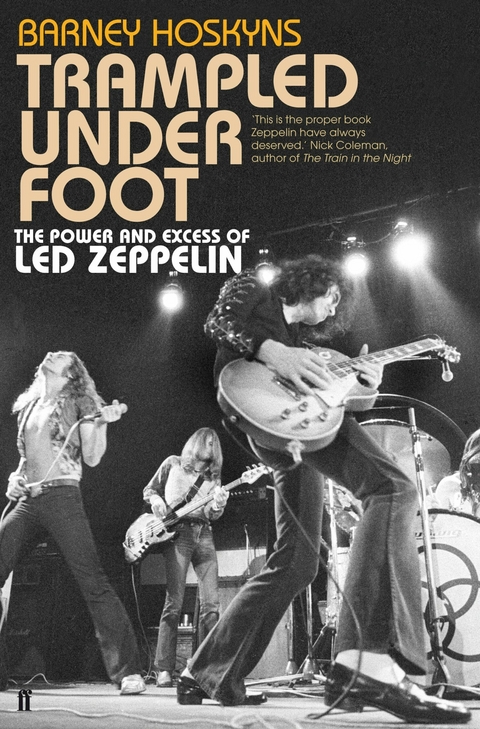
Trampled Under Foot (eBook)
624 Seiten
Faber & Faber (Verlag)
978-0-571-25936-6 (ISBN)
Barney Hoskyns is the co-founder and editorial director of online rock-journalism library Rock's Backpages (www.rocksbackpages.com), and author of several books including Across the Great Divide: The Band & America (1993), Waiting for the Sun: Strange Days, Weird Scenes, & the Sound of Los Angeles (1996), Hotel California: Singer-Songwriters & Cocaine Cowboys in the LA Canyons (2005), Lowside of the Road: A Life of Tom Waits (2009) and Trampled Under Foot: The Power and Excess of Led Zeppelin. A former US correspondent for MOJO, Hoskyns writes for Uncut and other UK publications, and has contributed to Vogue, Rolling Stone and GQ.
A unique look at the history, adventures, myths and realities of this most legendary and powerful of bands, it is a labour of love based on hours of first-hand and original interviews. What emerges is a compelling portrait of the four musicians themselves, as well as a fresh insight into the close-knit entourage that protected them, from Peter Grant to Richard Cole to Ahmet Ertegun, giant figures from the long-vanished world of 1970s rock. Featuring many rare and never before seen photographs, it is also the first book on Led Zeppelin to cover such recent events as their triumphant 2007 O2 Arena gig and Robert Plant's Grammy-winning resurgence of recent years.
Barney Hoskyns is the co-founder and editorial director of online rock-journalism library Rock's Backpages (www.rocksbackpages.com), and author of several books including Across the Great Divide: The Band & America (1993), Waiting for the Sun: Strange Days, Weird Scenes, & the Sound of Los Angeles (1996), Hotel California: Singer-Songwriters & Cocaine Cowboys in the LA Canyons (2005) and Lowside of the Road: A Life of Tom Waits (2009). A former US correspondent for MOJO, Hoskyns writes for Uncut and other UK publications, and has contributed to Vogue, Rolling Stone and GQ.
Led Zeppelin was unobtainable and unattainable and we very seldom talked about it. Basically, the myth propagated itself.
ROBERT PLANT TO THE AUTHOR, MAY 2003
ON A WHITE-HOT MORNING in Twentynine Palms – the Mojave desert town namechecked on Robert Plant’s 1993 album Fate of Nations – I can see a number of the strangely shaped Joshua trees that lend their name to the nearby national park; the same place where, on Cap Rock in 1969, Gram Parsons dropped acid with Keith Richards and Anita Pallenberg.
Ever since Parsons OD’d and died in Joshua Tree itself – twenty-five miles east along Route 62 – the whole area has become one of California’s holy rock sites. So it’s fitting that, as I fill up my rental compact in a Twentynine Palms gas station, I hear the booming strains of a rock song approaching. Within seconds I know it as a staple of classic-rock radio – an evergreen of easy-riding highway rock – and the pop snob in me groans. Pulling up next to me is a mirror-shaded dude astride a black beast of a motorcycle, its wheels flanked by vast speaker bins that punch out the song I know so well: “Babe babe babe babe babe babe ’m bayeebee I’m gonna LEEEEAVE you …”
The owner of the song’s strangulated male voice ain’t joking, woman, he’s really got to ramble – rather like this man in his sunglasses. The voice soundtracks the guy’s chrome-horse freedom on a song recorded almost four decades ago, and he is making sure we all know it. I look at him and want to dismiss him as an idiot. He’s at least as old as the song, and if he took the shades off he might be old enough to have seen Led Zeppelin in their pomp, maybe at the LA Forum, possibly at the Long Beach Arena or the San Diego Sports Arena – the huge venues where the west was won. Perhaps he saw Zep’s last US show, which remains shrouded in mystery, at the Oakland Coliseum in the summer of ’77. Or he may only have seen the band in his mind, back when he was a beer-chuggin’ adolescent spellbound by their satanic limey majesty, one of the vast legion of disciples who worshipped them as “your overlords”.
It doesn’t really matter which it is, because I understand the mythic potency of the music that’s blasting from his speakers. And slowly I start to see him, in all his delusions, as oddly heroic. Like Robert Plant on “Babe, I’m Gonna Leave You”, he’s gotta keep moving, hitting the highway again, on to the next town and the next chick. Maybe he’s heading east, further into the empty Mojave where he can “feel the heat of your desert heart” (“29 Palms”), and then on to Arizona or New Mexico or just some place he can hole up and be free. Alternatively he could be heading west to gaze out on the infinite Pacific and leave terra firma behind him. He could be a gung-ho libertarian, a man for whom “Babe, I’m Gonna Leave You” says, simply, “I have no responsibility to anyone except me.” Or he could just be a weekend warrior, escaping the deep dreariness of his nine-to-five life.
As the song’s frenziedly descending chords fade over Plant’s frayed larynx, I silently bond with Mr “Get the Led Out” as I recall my own first exposure to the second track on Zeppelin’s astounding debut album. (When I asked John Paul Jones which album he would play to someone who had never heard the band, he said, “The first one … it’s all there, right from the word go.” I’m not sure he wasn’t right.) I understand why this and other songs became battle cries for a lost generation of disowned teenagers searching for dark magic in their suburban shopping-mall lives. I understand how Zeppelin became a new Fab Four for the younger siblings who missed out on Beatlemania – and for whom the Rolling Stones were just too Côte d’Azur for their own good.
For what you hear on “Babe, I’m Gonna Leave You” and every great Zeppelin track is not just power – amplified aggression matched by priapic swagger – but yearning, journeying, questing for an ideal.
“There is a point in your life,” Chuck Klosterman wrote in Killing Yourself to Live, “when you hear songs like ‘The Ocean’ and ‘Out on the Tiles’ and ‘Kashmir’, and you suddenly find yourself feeling like these songs are actively making you into the person you want to be. It does not matter if you’ve heard those songs a hundred times and felt nothing in the past, and it does not matter if you don’t normally like rock ’n’ roll and just happened to overhear it in somebody else’s dorm room. We all still meet at the same vortex: for whatever the reason, there is a point in the male maturation process when the music of Led Zeppelin sounds like the perfect actualisation of the perfectly cool you.”*
For the scurrilous svengali Kim Fowley, who consorted with them in their Hyatt House heyday, Led Zeppelin were both “dangerous” and “spiritual” – and you could not have one without the other. Another way of saying that is to resort to hoary metaphors of light and dark, good and evil. Certainly it’s difficult to talk of Zeppelin and not speak of evil; many of those interviewed for this oral history do just that. And while it’s too easy to identify Robert Plant and John Paul Jones with “the light” and Jimmy Page and John Bonham (and Peter Grant and Richard Cole et al.) with “the dark”, the occult image of Page as a guitar magus steeped in the nefarious teachings of Aleister Crowley remains central to Zeppelin’s appeal to adolescents as they strive to create identities for themselves in a world that never recovered from the failure of America’s hippie dream.
“Led Zeppelin always drew a difficult element,” reflected the late Bill Graham, the pugnacious San Francisco promoter who became their inadvertent nemesis in Oakland. “A lot of male aggression came along with their shows. This was during the warp of the Seventies, which was a very strange era. It was anarchy without a cause.”†
“By 1975, ZoSo was painted or carved on every static thing rocker kids could find,” wrote the sociologist Dr Donna Gaines. “It had become a unifying symbol for America’s suburban adolescents. The children of ZoSo are Zep’s legacy. Mostly white males, nonaffluent American kids mixing up the old-school prole(tariat) values of their parents, mass culture, pagan yearnings and Sixties hedonism.”‡
Yet the resonance of Zeppelin’s music goes way beyond acned initiation rites, otherwise we’d be talking about them today as we talk about (or don’t talk about) Kiss or Peter Frampton or Grand Funk Railroad. The reason my biker in Twentynine Palms is blasting “Babe, I’m Gonna Leave You” from his roadhog bins after all those years is because Led Zeppelin still speak to him of danger and spirituality, darkness and light, power and beauty; because their albums – at least, up to and including 1975’s Physical Graffiti – still sound so mighty and so sensual. Because they locked together tighter than any other rock unit in history. Because Jimmy Page wrote the most crunchingly powerful riffs ever fashioned by an electric guitarist. Because encoded within their metal blitzkrieg lies a deep funk that gives even James Brown a run for his money. Because their beauteous acoustic music is as sublime as their amplified anthems. Because live – as the countless Zep bootlegs attest – they took “How Many More Times”, “Dazed and Confused”, “No Quarter” and “In My Time of Dying” into new dimensions of giddy improvisation. Because John Bonham did things on his drum kit that confound the ear to this day. Because – even when his lyrics smacked of ethereal piffle – Robert Plant possessed the most frighteningly exciting hard-rock voice ever captured on tape, a blood-curdling fusion of Janis Joplin and Family’s Roger Chapman.
Also because of the dizzying diversity of styles and moods the band mastered: Dense Chicago Blues (“You Shook Me”, “I Can’t Quit You, Baby”, “The Lemon Song”, “The Girl I Love She Got Long Black Wavy Hair”); Metallic Funk (“Whole Lotta Love”, “Bring It On Home”, “Immigrant Song”, “The Ocean”, “Custard Pie”, “The Wanton Song”, “Nobody’s Fault But Mine”, “For Your Life”); Kinetic Folk-Rock (“Babe, I’m Gonna Leave You”, “Ramble On”, “Gallows Pole”, “The Battle of Evermore”, “Over the Hills and Far Away”, “Poor Tom”); Hyper-Prog Bombast (“The Song Remains the Same”, “No Quarter”, “In the Light”, “Ten Years Gone”, “Achilles’ Last Stand”, “Carouselambra”); Unplugged Pastoral (“That’s the Way”, “Bron-yr-Aur”, “Going to California”, “Black Country Woman”, the first half of “Stairway to Heaven”); Headbanger Raunch (“Heartbreaker”, “Sick Again”); Trebly Big Star Swagger (“Dancing Days”, “Houses of the Holy”); Swampy Delta Dread (“Hats off to Harper”, “Black Dog”, “When the Levee Breaks”, “In My Time of Dying”); Motor City Protopunk (“Communication Breakdown”); Eerie Orientalism (“Friends”, “Four Sticks”, “Kashmir”); Searing Blues Balladry (“Since I”ve Been Loving You”, “Tea for One”) and Retro Rock ’n’ Roll (“Rock ’n’ Roll”, “Boogie with Stu”, the numerous live covers of Elvis, Eddie Cochran et al.) … almost all of which I’d put up there with the best of...
| Erscheint lt. Verlag | 4.9.2012 |
|---|---|
| Verlagsort | London |
| Sprache | englisch |
| Themenwelt | Kunst / Musik / Theater ► Musik ► Pop / Rock |
| Schlagworte | 1960s • 1970s • Jimmy Page • John Bonham • John Paul Jones • Peter Grant • Robert Plant |
| ISBN-10 | 0-571-25936-7 / 0571259367 |
| ISBN-13 | 978-0-571-25936-6 / 9780571259366 |
| Informationen gemäß Produktsicherheitsverordnung (GPSR) | |
| Haben Sie eine Frage zum Produkt? |
 EPUB (Adobe DRM)
Kopierschutz: Adobe-DRM
Adobe-DRM ist ein Kopierschutz, der das eBook vor Mißbrauch schützen soll. Dabei wird das eBook bereits beim Download auf Ihre persönliche Adobe-ID autorisiert. Lesen können Sie das eBook dann nur auf den Geräten, welche ebenfalls auf Ihre Adobe-ID registriert sind.
Details zum Adobe-DRM
Dateiformat: EPUB (Electronic Publication)
EPUB ist ein offener Standard für eBooks und eignet sich besonders zur Darstellung von Belletristik und Sachbüchern. Der Fließtext wird dynamisch an die Display- und Schriftgröße angepasst. Auch für mobile Lesegeräte ist EPUB daher gut geeignet.
Systemvoraussetzungen:
PC/Mac: Mit einem PC oder Mac können Sie dieses eBook lesen. Sie benötigen eine
eReader: Dieses eBook kann mit (fast) allen eBook-Readern gelesen werden. Mit dem amazon-Kindle ist es aber nicht kompatibel.
Smartphone/Tablet: Egal ob Apple oder Android, dieses eBook können Sie lesen. Sie benötigen eine
Geräteliste und zusätzliche Hinweise
Buying eBooks from abroad
For tax law reasons we can sell eBooks just within Germany and Switzerland. Regrettably we cannot fulfill eBook-orders from other countries.
aus dem Bereich