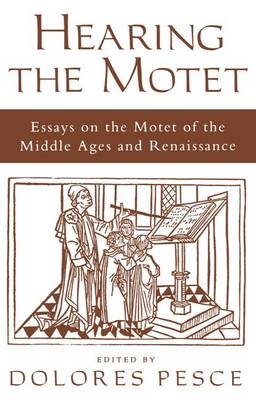
The motet was unquestionably one of the most important vocal genres from its inception in late twelfth-century Paris through the Counter-Reformation and beyond. Heard in both sacred and secular contexts, the motet of the Middle Ages and Renaissance incorporated a striking wealth of meaning, its verbal textures dense with literary, social, philosophic, and religious reference. In Hearing the Motet, top scholars in the field provide the fullest picture yet of the motet's "e;music-poetic"e; nature, investigating the virtuosic interplay of music and text that distinguished some of the genre's finest work and reading individual motets and motet repertories in ways that illuminate their historical and cultural backgrounds.L^ L^ How were motets heard in their own time? Did the same motet mean different things to different audiences? To explore these questions, the contributors go beyond traditional musicological methods, at times invoking approaches used in recent literary criticism. Providing as well a cutting-edge look at performance questions and works by composers such as Josquin, Willaert, Obrecht, Byrd, and Palestrina, the book draws a valuable new portrait of the motet composer. Here, intriguingly, the motet composer emerges as a "e;reader"e; of the surrounding culture--a musician who knew liturgical practice as well as biblical literature and its exegetical traditions, who moved in social contexts such as humanist gatherings, who understood numerical symbolism and classical allusion, who wrote subtle memorie for patrons, and who found musical models to emulate and distort.L L^ Fresh, broad-ranging, and unique, Hearing the Motet makes vital reading for scholars, performers, and students of medieval and Renaissance music, and anyone else with an interest in the musical culture of these periods. Contributors include Rebecca A. Baltzer, Margaret Bent, M. Jennifer Bloxam, David Crook, James Haar, Paula Higgins, Joseph Kerman, Patrick Macey, Craig Monson, Robert Nosow, Jessie Ann Owens, Dolores Pesce, Joshua Rifkin, Anne Walters Robertson, Richard Sherr, Rob C. Wegman.
 PDF (Adobe DRM)
Kopierschutz: Adobe-DRM
Adobe-DRM ist ein Kopierschutz, der das eBook vor Mißbrauch schützen soll. Dabei wird das eBook bereits beim Download auf Ihre persönliche Adobe-ID autorisiert. Lesen können Sie das eBook dann nur auf den Geräten, welche ebenfalls auf Ihre Adobe-ID registriert sind.
Details zum Adobe-DRM
Dateiformat: PDF (Portable Document Format)
Mit einem festen Seitenlayout eignet sich die PDF besonders für Fachbücher mit Spalten, Tabellen und Abbildungen. Eine PDF kann auf fast allen Geräten angezeigt werden, ist aber für kleine Displays (Smartphone, eReader) nur eingeschränkt geeignet.
Systemvoraussetzungen:
PC/Mac: Mit einem PC oder Mac können Sie dieses eBook lesen. Sie benötigen eine Adobe-ID und die Software Adobe Digital Editions (kostenlos). Von der Benutzung der OverDrive Media Console raten wir Ihnen ab. Erfahrungsgemäß treten hier gehäuft Probleme mit dem Adobe DRM auf.
eReader: Dieses eBook kann mit (fast) allen eBook-Readern gelesen werden. Mit dem amazon-Kindle ist es aber nicht kompatibel.
Smartphone/Tablet: Egal ob Apple oder Android, dieses eBook können Sie lesen. Sie benötigen eine Adobe-ID sowie eine kostenlose App.
Geräteliste und zusätzliche Hinweise
Buying eBooks from abroad
For tax law reasons we can sell eBooks just within Germany and Switzerland. Regrettably we cannot fulfill eBook-orders from other countries.