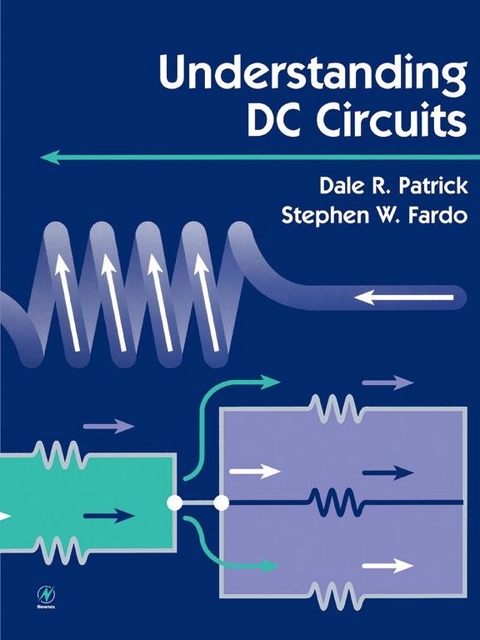
Understanding DC Circuits (eBook)
255 Seiten
Elsevier Science (Verlag)
978-0-08-051994-4 (ISBN)
Understanding DC Circuits covers the first half of a basic electronic circuits theory course, integrating theory and laboratory practice into a single text. Several key features in each unit make this an excellent teaching tool: objectives, key terms, self-tests, lab experiments, and a unit exam. Understanding DC Circuits is designed with the electronics beginner and student in mind. The authors use a practical approach, exposing the reader to the systems that are built with DC circuits, making it easy for beginners to master even complex concepts in electronics while gradually building their knowledge base of both theory and applications. Each chapter includes easy-to-read text accompanied by clear and concise graphics fully explaining each concept before moving onto the next. The authors have provided section quizzes and chapter tests so the readers can monitor their progress and review any sections before moving onto the next chapter. Each chapter also includes several electronics experiments, allowing the reader to build small circuits and low-cost projects for the added bonus of hands-on experience in DC electronics. Understanding DC Circuits fully covers dozens of topics including energy and matter; static electricity; electrical current; conductors; insulators; voltage; resistance; schematic diagrams and symbols; wiring diagrams; block diagrams; batteries; tools and equipment; test and measurement; series circuits; parallel circuits; magnetism; electromagnetism; inductance; capacitance; soldering techniques; circuit troubleshooting; basic electrical safety; plus much more. - Integrates theory and lab experiments- Contains course and learning objectives and self-quizzes- Heavily illustrated
Front Cover 1
Understanding DC Circuits 4
Copyright Page 5
Table of Contents 6
PREFACE 12
COURSE OBJECTIVES 14
PARTS LIST FOR EXPERIMENTS 16
UNIT 1: BASICS OF DC ELECTRONICS
18
Unit Introduction 18
Unit Objectives 18
Important Terms 19
Electronic Systems 21
Energy, Work, and Power 23
Structure of Matter 24
Self-Examination 28
Electrostatic Charges 29
Static Electricity 30
Self-Examination 30
Electric Current 31
Conductors 32
Insulators 32
Semiconductors 32
Current Flow 33
Electric Force (Voltage) 35
Resistance 36
Voltage, Current, and Resistance 37
Volts, Ohms, and Amperes 38
Self-Examination 39
Components, Symbols, and Diagrams 40
Resistors 42
Schematics 45
Block Diagrams 46
Wiring Diagrams 46
Self-Examination 46
Electric Units 48
Scientific Notation 51
Self-Examination 52
Batteries 53
Self-Examination 57
Experimental Activities for DC Circuits 58
Tools and Equipment 59
Important Information 59
Lab Activity Troubleshooting and Testing 59
Experiment 1-1—Components, Equipment, and Symbols
65
Experiment 1-2—Resistor Color Code
70
Unit 1 Examination: Basics of DC Electronics 73
UNIT 2: MEASURING VOLTAGE, CURRENT, AND RESISTANCE 76
Unit Introduction 76
Unit Objectives 76
Important Terms 77
Measuring Resistance 77
Self-Examination 81
Measuring Voltage 82
Measuring Current 84
Self-Examination 87
Parallel Circuit Measurements 89
Combination Circuit Measurements 89
Digital Meters 90
Self-Examination 91
Experiment 2-1—Measuring Resistance
93
Experiment 2-2—Measuring Voltage
97
Experiment 2-3—Measuring Current
102
Experiment 2-4—Familiarization with Power Supply
106
Unit 2 Examination: Measuring Voltage, Current, and Resistance 108
UNIT 3: OHM'S LAW AND ELECTRIC CIRCUITS 110
Unit Introduction 110
Unit Objectives 110
Important Terms 111
Use of Calculators 112
Ohm's Law 113
Self-Examination 115
Series Electric Circuits 116
Summary of Series Circuits 118
Examples of Series Circuits 118
Self-Examination 119
Parallel Electric Circuits 121
Summary of Parallel Circuits 123
Examples of Parallel Circuits 124
Self-Examination 126
Combination Electrical Circuits 127
Examples of Combination Circuits 128
Kirchhoff's Laws 130
Self-Examination 131
Power in Electric Circuits 132
Voltage Divider Circuits 134
Self-Examination 137
Maximum Power Transfer 138
Kirchhoff's Voltage Law Problems 139
Equivalent Circuits 142
Self-Examination 147
Experiment 3-1—Application of Ohm's Law
151
Experiment 3-2—Series DC Circuits
154
Experiment 3-3—Parallel DC Circuits
157
Experiment 3-4—Combination DC Circuits
160
Experiment 3-5—Power in DC Circuits
164
Experiment 3-6—Voltage Divider Circuits
167
Experiment 3-7—Kirchhoff's Voltage Law
170
Experiment 3-8—Kirchhoff's Current Law
172
Experiment 3-9—Superposition Method
174
Experiment 3-10—Thevinin Equivalent Circuits
176
Experiment 3-11—Norton Equivalent Circuits
179
Experiment 3-12—Maximum Power Transfer
181
Experiment 3-13—Bridge Circuits
183
Unit 3 Examination: Ohm's Law and Electric Circuits 186
UNIT 4: MAGNETISM AND ELECTROMAGNETISM 190
Unit Introduction 190
Unit Objectives 190
Important Terms 191
Permanent Magnets 192
Magnetic Field Around Conductors 194
Magnetic Field Around a Coil 195
Self-Examination 196
Electromagnets 196
Ohm's Law for Magnetic Circuits 198
Domain Theory of Magnetism 198
Electricity Produced by Magnetism 199
Magnetic Effects 201
Self-Examination 202
Experiment 4-1—The Nature of Magnetism
203
Experiment 4-2—Electromagnetic Relays
205
Unit 4 Examination: Magnetism and Electromagnetism 207
UNIT 5: ELECTRONIC INSTRUMENTS 210
Unit Introduction 210
Unit Objectives 210
Important Terms 211
Analog Instruments 212
Self-Examination 216
Comparison Instruments 223
CRT Instruments 223
Numerical Readout Instruments 225
Chart-Recording Instruments 225
Self-Examination 226
Unit 5 Examination: Electronic Instruments 227
UNIT 6: INDUCTANCE AND CAPACITANCE 230
Unit Introduction 230
Unit Objectives 230
Important Terms 231
Inductance 232
Capacitance 232
Time-Constant Circuits 238
Self-Examination 241
Experiment 6-1—Time-Constant Circuits
245
Unit 6 Examination: Inductance and Capacitance 249
APPENDIX A: ELECTRONICS SYMBOLS 252
APPENDIX B: ELECTRIC SAFETY 256
APPENDIX C: ELECTRONIC EQUIPMENT AND PARTS SALES 260
APPENDIX D: SOLDERING TECHNIQUES 262
APPENDIX E: TROUBLESHOOTING 264
INDEX 268
Measuring Voltage, Current, and Resistance
Another important activity in the study of electronics is measurement. Measurements are made in many types of electronic circuits. The proper ways of measuring resistance, voltage, and current should be learned. These are the three most common electric measurements.
UNIT OBJECTIVES
Upon completing this unit, you will be able to do the following:
1. Connect an ammeter in a circuit and measure current.
2. Demonstrate how the voltmeter, ammeter, and ohmmeter are connected to a circuit.
3. Measure current, voltage, and resistance of basic electronic circuits.
4. Compare calculated and measured values of a circuit.
5. Demonstrate safety while making electric measurements.
6. Demonstrate proper, safe use of an ohmmeter to measure resistance.
Important Terms
Before reading this unit, review the following terms for a basic understanding of terms associated with electronic measurement.
Ammeter A meter used to measure current (amperes).
Continuity check A test to see whether a circuit is an open or closed path.
Multimeter A meter used to measure two or more electric quantities, such as a volt-ohm-milliammeter (VOM), which measures voltage, resistance, and current, or a digital voltmeter (DVM).
Multirange meter A meter that has two or more ranges to measure an electric quantity.
Ohmmeter A meter used to measure resistance (ohms).
Polarity The direction of an electric potential (– or +) or a magnetic charge (north or south).
Schematic A diagram used to show how the components of electric circuits are wired together.
Voltmeter A meter used to measure voltage.
Volt-ohm-milliammeter (VOM) A multifunction, multirange meter that usually is designed to measure voltage, current, and resistance; also called a multimeter.
Measuring Resistance
Many important electric tests may be made by means of measuring resistance. Resistance is opposition to the flow of current in an electric circuit. The current that flows in a circuit depends on the amount of resistance in that circuit. You should learn to measure resistance in an electric circuit by using a meter.
A volt-ohm-milliammeter (VOM) or multimeter such as the one shown in Fig. 2-1 is often used for doing electric work. A multimeter is used to measure resistance, voltage, or current. The operator changes the type of measurement by adjusting the function-select switch to the desired measurement. Figure 2-2 shows the controls of a common type of VOM. This type of meter also is called an analog meter. We will discuss the analog meter so you will learn to interpret scales for resistance, voltage, or current measurement. A digital meter uses the same basic rules but is easier to read.
The function-select switch is in the center of the meter. Some of the ranges are for measuring ohms, or resistance. This is called a multirange, multifunction meter or multimeter. The ohms measurement ranges are divided into four portions: × 1, × 10, × 1000, and × 1 00,000. Most VOMs are similar to the example shown. The VOM is adjusted to any of the four positions for measuring resistance. The test leads used with a VOM are ordinarily black and red. These colors are used to help identify which lead is the positive and which is the negative side of the meter. This is important for measuring dc values. Red indicates positive polarity (+) and black indicates negative (–) polarity.
Refer again to Fig. 2-2. The red test lead is put in the hole, or jack, marked with V-Ω-A, or volts-ohms-amperes. The black test lead is put in the hole or jack labeled –COM, or negative common. The function-select switch should be placed on one of the resistance ranges. When the test leads are touched together, or “shorted,” the meter needle moves from the left side of the meter scale to the right side. This test shows that the meter is operational.
Now study the scale of the meter. Figure 2-3 shows the scale of one type of VOM. The top scale, from 0 to infinity (∞), is labeled Ohms. This scale is used for measuring ohms only. On most VOMs, the top scale is the resistance or ohms scale. To measure any resistance, first select the proper meter range. On the meter range shown in Fig. 2-2 the four ranges, × 1, × 10, × 1000, and × 100,000, are called multipliers. The ohmmeter must be properly zeroed before an attempt is made to measure resistance accurately. To zero the ohmmeter properly, touch the two test leads together. This should cause the needle to move from infinity (∞) on the left to zero (0) on the right. Infinity represents a very high resistance. Zero represents a very low resistance. If the needle does not reach zero or goes past zero when the test leads are touched or shorted, the control marked ohms adjust is used. The needle is adjusted to zero when the test leads are touched together. The ohms-adjust control is indicated by ΩADJ in Fig. 2-2. The ohmmeter should be zeroed before every resistance measurement and after changing ranges. If the meter is not zeroed, measurement will be incorrect.
A more accurate measurement of resistance is made when the meter needle stops somewhere between the center of the ohms scale and zero. Choosing the proper range adjustments controls how far the needle moves. If the range selected is × 1, the number to which the needle points is multiplied by 1. If the function-select switch is adjusted to the × 100,000 range, the number to which the needle points is multiplied by 100,000. Always zero the meter when changing ranges, and always multiply the number indicated on the scale by the multiplier of the range. Do not measure the resistance of a component until it has been disconnected, or the reading may be wrong. Voltage should never be applied to a component when resistance is being measured.
A VOM may be used to measure the resistance of a potentiometer, as shown in Fig. 2-4. If the shaft of the pot is adjusted while the ohmmeter is connected to points A and C, no resistance change takes place. The resistance of the potentiometer is measured in this way. Connecting to points B and C or to points B and A allows changes in resistance as the shaft is turned. The potentiometer shaft may be adjusted both clockwise and counterclockwise. This adjustment affects the measured resistance across points B and C or B and A. The resistance varies from zero to maximum and from maximum back to zero as the shaft is adjusted.
How to Measure Resistance with a VOM
Remember that resistance is opposition to the flow of electric current. For example, a lamp connected to a battery has resistance. Its resistance value is determined by the size of the filament wire. The filament wire opposes the flow of electric current from the battery. The battery causes current to flow through the lamp's filament. The amount of current through the lamp depends on the filament resistance. If the filament offers little opposition to current flow from the battery, a large current flows in the circuit. If the lamp filament has high resistance, it offers a great deal of opposition to current flow from the battery. Then a small current flows in the circuit.
Resistance tests are sometimes called continuity checks. A continuity check is made to see whether a circuit is open or closed (a continuous path). An ohmmeter also is used to measure exact values of resistance. Resistance always must be measured with no voltage applied to the component being measured. The ohmmeter ranges of a VOM are used to measure resistance. Electrical technicians often use this type of meter because it measures resistance, voltage, or current. When the rotary function-select switch is adjusted, the meter can be set to measure resistance, voltage, or current. The meter switch shown in Fig. 2-2 has the following settings:
1. Direct current (dc) voltage
2. Direct current (dc) amps and milliamps
3. Alternating current (ac) voltage
4. Resistance (ohms)
The lower right part of the function-select switch is for measuring resistance or ohms. The ohms measurement settings are marked as × 1, × 10, × 1000, and × 100,000. When measuring resistance with an ohmmeter, first put the test leads into the meter....
| Erscheint lt. Verlag | 20.12.1999 |
|---|---|
| Sprache | englisch |
| Themenwelt | Kunst / Musik / Theater ► Design / Innenarchitektur / Mode |
| Technik ► Elektrotechnik / Energietechnik | |
| ISBN-10 | 0-08-051994-6 / 0080519946 |
| ISBN-13 | 978-0-08-051994-4 / 9780080519944 |
| Informationen gemäß Produktsicherheitsverordnung (GPSR) | |
| Haben Sie eine Frage zum Produkt? |
 PDF (Adobe DRM)
Kopierschutz: Adobe-DRM
Adobe-DRM ist ein Kopierschutz, der das eBook vor Mißbrauch schützen soll. Dabei wird das eBook bereits beim Download auf Ihre persönliche Adobe-ID autorisiert. Lesen können Sie das eBook dann nur auf den Geräten, welche ebenfalls auf Ihre Adobe-ID registriert sind.
Details zum Adobe-DRM
Dateiformat: PDF (Portable Document Format)
Mit einem festen Seitenlayout eignet sich die PDF besonders für Fachbücher mit Spalten, Tabellen und Abbildungen. Eine PDF kann auf fast allen Geräten angezeigt werden, ist aber für kleine Displays (Smartphone, eReader) nur eingeschränkt geeignet.
Systemvoraussetzungen:
PC/Mac: Mit einem PC oder Mac können Sie dieses eBook lesen. Sie benötigen eine
eReader: Dieses eBook kann mit (fast) allen eBook-Readern gelesen werden. Mit dem amazon-Kindle ist es aber nicht kompatibel.
Smartphone/Tablet: Egal ob Apple oder Android, dieses eBook können Sie lesen. Sie benötigen eine
Geräteliste und zusätzliche Hinweise
Buying eBooks from abroad
For tax law reasons we can sell eBooks just within Germany and Switzerland. Regrettably we cannot fulfill eBook-orders from other countries.
aus dem Bereich