


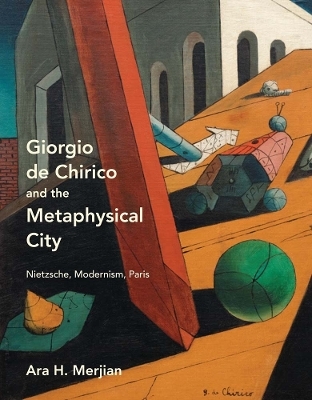
Giorgio de Chirico and the Metaphysical City
Nietzsche, Modernism, Paris
Seiten
2014
Yale University Press (Verlag)
978-0-300-17659-9 (ISBN)
Yale University Press (Verlag)
978-0-300-17659-9 (ISBN)
- Titel ist leider vergriffen;
keine Neuauflage - Artikel merken
For the artist Giorgio de Chirico (1888-1978), a founder of the Metaphysical art movement, the year 1914 marked a momentous and pivotal time in his aesthetic production. This text considers the artist's representation of architectural space in relation to his sustained engagement with the philosophy of Friedrich Nietzsche.
Painted in Paris on the eve of World War One, the Metaphysical cityscapes of Giorgio de Chirico (1888-1978) redirected the course of modernist painting and the modern architectural imagination alike. Giorgio de Chirico and the Metaphysical City examines the two most salient dimensions of the artist’s early imagery: its representations of architectural space and its sustained engagement with the philosophy of Friedrich Nietzsche. Centering upon a single painting from 1914 – deemed by the painter “the fatal year” – each chapter examines why and how de Chirico’s self-declared “Nietzschean method” takes architecture as its pictorial means and metaphor. The first, full-length study in English to focus on the painter’s seminal work from pre-war Paris, the book places de Chirico’s “literary” images back in the context of the city’s avant-garde, particularly the circle of Guillaume Apollinaire. Merjian’s study sheds light on one of the most influential and least understood figures in 20th-century aesthetics, while also contributing to an understanding of Nietzsche’s paradoxical consequences for modernism.
Painted in Paris on the eve of World War One, the Metaphysical cityscapes of Giorgio de Chirico (1888-1978) redirected the course of modernist painting and the modern architectural imagination alike. Giorgio de Chirico and the Metaphysical City examines the two most salient dimensions of the artist’s early imagery: its representations of architectural space and its sustained engagement with the philosophy of Friedrich Nietzsche. Centering upon a single painting from 1914 – deemed by the painter “the fatal year” – each chapter examines why and how de Chirico’s self-declared “Nietzschean method” takes architecture as its pictorial means and metaphor. The first, full-length study in English to focus on the painter’s seminal work from pre-war Paris, the book places de Chirico’s “literary” images back in the context of the city’s avant-garde, particularly the circle of Guillaume Apollinaire. Merjian’s study sheds light on one of the most influential and least understood figures in 20th-century aesthetics, while also contributing to an understanding of Nietzsche’s paradoxical consequences for modernism.
Ara H. Merjian is associate professor of Italian studies at New York University, where he is an affiliate of the Institute of Fine Arts and the Department of Art History.
| Erscheint lt. Verlag | 16.6.2014 |
|---|---|
| Zusatzinfo | 83 color + 160 b-w illus. |
| Sprache | englisch |
| Maße | 210 x 273 mm |
| Gewicht | 1696 g |
| Themenwelt | Kunst / Musik / Theater ► Kunstgeschichte / Kunststile |
| Kunst / Musik / Theater ► Malerei / Plastik | |
| ISBN-10 | 0-300-17659-7 / 0300176597 |
| ISBN-13 | 978-0-300-17659-9 / 9780300176599 |
| Zustand | Neuware |
| Informationen gemäß Produktsicherheitsverordnung (GPSR) | |
| Haben Sie eine Frage zum Produkt? |
Mehr entdecken
aus dem Bereich

aus dem Bereich
kleine Kulturgeschichte einer brillanten Allianz
Buch | Softcover (2025)
Iudicium (Verlag)
CHF 33,90


