


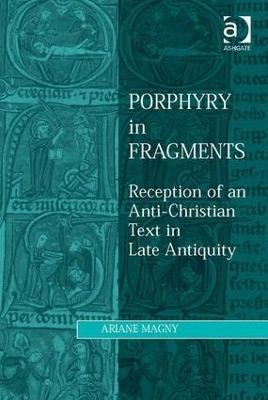
Porphyry in Fragments
Reception of an Anti-Christian Text in Late Antiquity
Seiten
2014
Routledge (Verlag)
9781409441151 (ISBN)
Routledge (Verlag)
9781409441151 (ISBN)
The Greek philosopher Porphyry of Tyre had a reputation as the fiercest critic of Christianity. It was well-deserved: he composed fifteen discourses against the Christians, so offensive that Christian emperors ordered them to be burnt. We thus rely on the testimonies of three prominent Christian writers to know what Porphyry wrote.
The Greek philosopher Porphyry of Tyre had a reputation as the fiercest critic of Christianity. It was well-deserved: he composed (at the end the 3rd century A.D.) fifteen discourses against the Christians, so offensive that Christian emperors ordered them to be burnt. We thus rely on the testimonies of three prominent Christian writers to know what Porphyry wrote. Scholars have long thought that we could rely on those testimonies to know Porphyry's ideas. Exploring early religious debates which still resonate today, Porphyry in Fragments argues instead that Porphyry's actual thoughts became mixed with the thoughts of the Christians who preserved his ideas, as well as those of other Christian opponents.
The Greek philosopher Porphyry of Tyre had a reputation as the fiercest critic of Christianity. It was well-deserved: he composed (at the end the 3rd century A.D.) fifteen discourses against the Christians, so offensive that Christian emperors ordered them to be burnt. We thus rely on the testimonies of three prominent Christian writers to know what Porphyry wrote. Scholars have long thought that we could rely on those testimonies to know Porphyry's ideas. Exploring early religious debates which still resonate today, Porphyry in Fragments argues instead that Porphyry's actual thoughts became mixed with the thoughts of the Christians who preserved his ideas, as well as those of other Christian opponents.
Ariane Magny is Lecturer in Ancient and Medieval History at Thompson Rivers University, Canada.
Contents: Foreword, Gillian Clark; Preface; Introduction; New methods; Eusebius; Jerome; Augustine’s letter 102; Augustine’s On the Harmony of the Gospels; Conclusion; Bibliography; Index.
| Erscheint lt. Verlag | 28.7.2014 |
|---|---|
| Reihe/Serie | Studies in Philosophy and Theology in Late Antiquity |
| Verlagsort | London |
| Sprache | englisch |
| Maße | 156 x 234 mm |
| Gewicht | 544 g |
| Themenwelt | Kunst / Musik / Theater ► Kunstgeschichte / Kunststile |
| Geschichte ► Allgemeine Geschichte ► Altertum / Antike | |
| Geschichte ► Teilgebiete der Geschichte ► Religionsgeschichte | |
| Religion / Theologie ► Christentum ► Kirchengeschichte | |
| ISBN-13 | 9781409441151 / 9781409441151 |
| Zustand | Neuware |
| Informationen gemäß Produktsicherheitsverordnung (GPSR) | |
| Haben Sie eine Frage zum Produkt? |
Mehr entdecken
aus dem Bereich

aus dem Bereich
ohne den ganzen langweiligen Kram
Buch | Hardcover (2025)
C.H.Beck (Verlag)
CHF 36,40
von den Anfängen bis zum Untergang
Buch | Hardcover (2025)
Alfred Kröner Verlag
CHF 48,95
von den Anfängen bis zur Gegenwart
Buch | Softcover (2025)
C.H.Beck (Verlag)
CHF 16,80


