


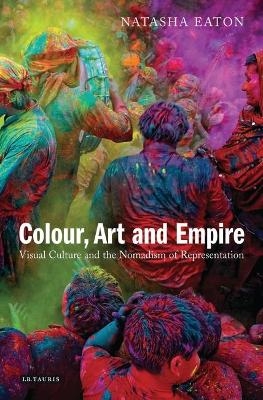
Colour, Art and Empire
I.B. Tauris (Verlag)
978-1-78076-519-8 (ISBN)
Colour, Art and Empire explores the entanglements of visual culture, enchanted technologies, waste, revolution, resistance and otherness. The materiality of colour offers a critical and timely force-field for approaching afresh debates on colonialism. This book analyses the formation of colour and politics as qualitative overspill. Colour can be viewed both as central and supplemental to early photography, the totem, alchemy, tantra and mysticism. From the eighteenth-century Austrian Empress Maria Theresa to Rabindranath Tagore and Gandhi, to 1970s Bollywood, colour makes us adjust our take on the politics of the human sensorium as defamiliarising and disorienting. The four chapters conjecture how European, Indian and Papua New Guinean artists, writers, scientists, activists, anthropologists or their subjects sought to negotiate the highly problematic stasis of colour in the repainting of modernity. Specifically, the thesis of this book traces Europeans' admiration and emulation of what they termed 'Indian colour' to its gradual denigration and the emergence of a 'space of exception'.
This space of exception pitted industrial colours against the colonial desire for a massive workforce whose slave-like exploitation ignited riots against the production of pigments - most notably indigo. Feared or derided, the figure of the vernacular dyer constituted a force capable of dismantling the imperial machinations of colour. Colour thus wreaks havoc with Western expectations of biological determinism, objectivity and eugenics. Beyond the cracks of such discursive practice, colour becomes a sentient and nomadic retort to be pitted against a perceived colonial hegemony. The ideological reinvention of colour as a resource for independence struggles make it fundamental to multivalent genealogies of artistic and political action and their relevance to the present.
Natasha Eaton is Lecturer in History of Art, University College London. She specialises in eighteenth- and nineteenth-century British Art and the Visual Culture of South Asia, and is author of Mimesis Across Empires: Artworks and Networks in India, 1765 - 1860 (2013).
Illustrations
Acknowledgements
Introduction: Chromo Zones and the Nomadism of Colour
1. Alchemy, Painting and Revolution in India, c.1750-1860
2. Supplement, Subaltern Art, Design and Dyeing in Britain and South Asia, c.1851-c.1905
3. Part 1: Still Dreaming of the Blue Flower? Race, Anthropology and the Colour Sense
Part 2: Creole Laboratory: Anthropology and Affect in the Torres Strait
4.Swadeshi Colour Throughout the Philtre/Filter of Indian Nationalism, c.1905- c. 1947
Postscript: Wiath and Rag and a Knife
Notes
Index
| Erscheint lt. Verlag | 28.10.2013 |
|---|---|
| Zusatzinfo | 13 b&w integrated, 16pp colour plates |
| Sprache | englisch |
| Maße | 158 x 236 mm |
| Gewicht | 800 g |
| Themenwelt | Kunst / Musik / Theater ► Allgemeines / Lexika |
| Sozialwissenschaften | |
| ISBN-10 | 1-78076-519-3 / 1780765193 |
| ISBN-13 | 978-1-78076-519-8 / 9781780765198 |
| Zustand | Neuware |
| Informationen gemäß Produktsicherheitsverordnung (GPSR) | |
| Haben Sie eine Frage zum Produkt? |
aus dem Bereich


