


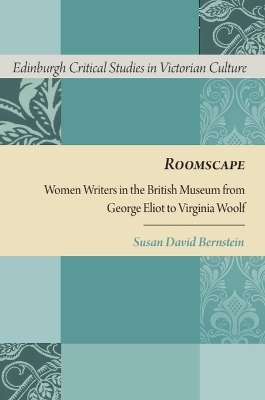
Roomscape
Women Writers in the British Museum from George Eliot to Virginia Woolf
Seiten
2013
Edinburgh University Press (Verlag)
978-0-7486-4065-2 (ISBN)
Edinburgh University Press (Verlag)
978-0-7486-4065-2 (ISBN)
Examines the Reading Room of the British Museum as a space of imaginative and historically generative potential in relation to the emergence of modern women writers in Victorian and early twentieth-century London
Drawing on archival materials around this national library reading room, Roomscape is the first study that integrates documentary, theoretical, historical, and literary sources to examine the significance of this public interior space for women writers and their treatment of reading and writing spaces in literary texts. This book challenges an assessment of the Reading Room of the British Museum as a bastion of class and gender privilege, an image firmly established by Virginia Woolf's 1929 A Room of One's Own and the legions of feminist scholarship that uphold this spatial conceit.
Susan David Bernstein argues not only that the British Museum Reading Room facilitated various practices of women's literary traditions, she also questions the overdetermined value of privacy and autonomy in constructions of female authorship, a principle generated from Woolf's feminist manifesto. Rather than viewing reading and writing as solitary, individual events, Roomscape considers the meaning of exteriority and the public and social and gendered dimensions of literary production.
In addition to new perspectives on George Eliot, Christina Rossetti, and Virginia Woolf, Roomscape offers original research on other novelists, poets, and translators including Amy Levy, Mathilde Blind, Eleanor Marx, Clementina Black, Constance Black Garnett, A. Mary F. Robinson, and Vernon Lee (Violet Paget). Looking at the Reading Room of the British Museum as a networking site for a variety of readers, this study examines political radicals and women activists who found a transnational community in this London public space. An appendix of notable readers lists details of more than 200 women readers who registered for admission to the Reading Room of the British Museum from the middle of the nineteenth century through the early twentieth century.
Drawing on archival materials around this national library reading room, Roomscape is the first study that integrates documentary, theoretical, historical, and literary sources to examine the significance of this public interior space for women writers and their treatment of reading and writing spaces in literary texts. This book challenges an assessment of the Reading Room of the British Museum as a bastion of class and gender privilege, an image firmly established by Virginia Woolf's 1929 A Room of One's Own and the legions of feminist scholarship that uphold this spatial conceit.
Susan David Bernstein argues not only that the British Museum Reading Room facilitated various practices of women's literary traditions, she also questions the overdetermined value of privacy and autonomy in constructions of female authorship, a principle generated from Woolf's feminist manifesto. Rather than viewing reading and writing as solitary, individual events, Roomscape considers the meaning of exteriority and the public and social and gendered dimensions of literary production.
In addition to new perspectives on George Eliot, Christina Rossetti, and Virginia Woolf, Roomscape offers original research on other novelists, poets, and translators including Amy Levy, Mathilde Blind, Eleanor Marx, Clementina Black, Constance Black Garnett, A. Mary F. Robinson, and Vernon Lee (Violet Paget). Looking at the Reading Room of the British Museum as a networking site for a variety of readers, this study examines political radicals and women activists who found a transnational community in this London public space. An appendix of notable readers lists details of more than 200 women readers who registered for admission to the Reading Room of the British Museum from the middle of the nineteenth century through the early twentieth century.
Susan David Bernstein is Professor of English at the University of Wisconsin-Madison
Acknowledgements; List of Figures; Abbreviations; Chapter One: Exteriority: Women Readers at the British Museum; Chapter Two: Translation Work and Women’s Labour from the British Museum; Chapter Three: Poetry in the Round: Mutual Mentorships; Chapter Four: Researching Romola: George Eliot and Dome Consciousness; Chapter Five: Reading Woolf’s Roomscapes; Coda: Closing Years and Afterlives; Notes; Bibliography; Appendix; Index.
| Erscheint lt. Verlag | 14.3.2013 |
|---|---|
| Reihe/Serie | Edinburgh Critical Studies in Victorian Culture |
| Zusatzinfo | 9 black and white illustrations |
| Verlagsort | Edinburgh |
| Sprache | englisch |
| Maße | 156 x 234 mm |
| Gewicht | 522 g |
| Themenwelt | Kunst / Musik / Theater |
| Geisteswissenschaften ► Sprach- / Literaturwissenschaft ► Anglistik / Amerikanistik | |
| Geisteswissenschaften ► Sprach- / Literaturwissenschaft ► Literaturgeschichte | |
| Geisteswissenschaften ► Sprach- / Literaturwissenschaft ► Literaturwissenschaft | |
| Sozialwissenschaften | |
| ISBN-10 | 0-7486-4065-7 / 0748640657 |
| ISBN-13 | 978-0-7486-4065-2 / 9780748640652 |
| Zustand | Neuware |
| Informationen gemäß Produktsicherheitsverordnung (GPSR) | |
| Haben Sie eine Frage zum Produkt? |
Mehr entdecken
aus dem Bereich

aus dem Bereich
Poetik eines sozialen Urteils
Buch | Hardcover (2023)
De Gruyter (Verlag)
CHF 83,90


