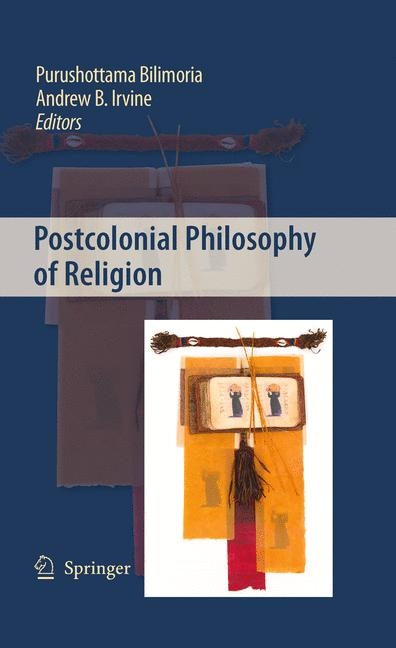
Postcolonial Philosophy of Religion (eBook)
347 Seiten
Springer Netherland (Verlag)
978-90-481-2538-8 (ISBN)
Andrew B. Irvine is Assistant Professor of Philosophy at Maryville College, Maryville, Tennessee. His publications include articles on Latin American liberation theology, theology and neuroscience, and theology and political philosophy.
Purushottama Bilimoria is Professor of Philosophy and Comparative Studies at Deakin University in Australia and Senior Research Fellow, University of Melbourne; Visiting Professor at State University of New York (Stony Brook), and Columbia University. His areas of specialist research and publications cover classical Indian philosophy and comparative ethics; Continental thought; cross-cultural philosophy of religion, diaspora studies; bioethics, and personal law in India.
The present collection of writings on postcolonial philosophy of religion takes its origins from a Philosophy of Religion session during the 1996 Annual Meeting of the American Academy of Religion held in New Orleans. Three presentations, by Purushottama Bilimoria, Andrew B. Irvine, and Bhibuti Yadav, were to be offered at the session, with Thomas Dean presiding and Kenneth Surin responding. (Yadav, unfortunately could not be present because of illness. ) This was the ?rst AAR session ever to examine issues in the study of religion under the rubric of the postcolonial turn in academia. Interest at the session was intense. For instance, Richard King, then at work on the manuscriptof the landmark Orientalism and Religion, was present; so, too, was Paul J. Grif?ths, whose s- sequent work on interreligious engagement has been so noteworthy. In response to numerous audience appeals, revised versions of the presentations eventually were published, as a "e;Dedicated Symposium on 'Subalternity',"e; in volume 39 no. 1 (2000) of Sophia, the international journal for philosophy of religion, metaphysical theology and ethics. Since that time, the importance of the nexus of religion and the postcolonial has become increasingly patent not only to philosophers of religion but to students of religion across the range of disciplines and methodologies. The increased inter- tionalization of the program of the American Academy of Religion, especially in more recent years, is a signi?cant outgrowth of this transformation in conscio- ness among students of religion.
Andrew B. Irvine is Assistant Professor of Philosophy at Maryville College, Maryville, Tennessee. His publications include articles on Latin American liberation theology, theology and neuroscience, and theology and political philosophy. Purushottama Bilimoria is Professor of Philosophy and Comparative Studies at Deakin University in Australia and Senior Research Fellow, University of Melbourne; Visiting Professor at State University of New York (Stony Brook), and Columbia University. His areas of specialist research and publications cover classical Indian philosophy and comparative ethics; Continental thought; cross-cultural philosophy of religion, diaspora studies; bioethics, and personal law in India.
Postcolonial Philosophy of Religion 1
Title Page 2
Copyright Page 3
Preface 5
Contents 6
Contributors 8
Introduction: The State of Philosophy of Religion and Postcoloniality 12
Reference 16
Part I: Surveying the Scene 17
What Is the “Subaltern” of the Philosophy of Religion? 18
The Postcolonial/Subaltern Critique Revisited 26
Dreamy Scenarios 32
Finale 34
Notes 37
References 40
Philosophy of Religion as Border Control: Globalization and the Decolonization of the “Love of Wisdom” (philosophia) 43
The End of European Colonialism and the Crisis ofWestern Philosophy 45
The Paradoxical Parochialism of “Postcolonial Theory” 49
Translating Wisdom Traditions as “Religions” - The Price of Crossing the Border 52
The Subalternization of Non-western Knowledges 55
Subalternization and Resisting Cultural Essentialism 56
Conclusion:W(h)ither the Comparative Philosophy of Religion? 58
References 59
The Third Eye and TwoWays of (Un)knowing: Gnosis, Alternative Modernities, and Postcolonial Futures 62
1 62
2 66
3 69
4 72
References 73
Part II: "India" 75
Mispredicated Identity and Postcolonial Discourse 76
Introduction 76
Sa nkar¯ac¯arya on Adhy ¯ asa 81
The Euro-Christian Colonial Project 88
Neo-ved¯antic Colonialism 96
Conclusion: Postcolonial Complicity and Dalit Protest 104
Notes 105
References 106
On the Death of the Pilgrim: The Postcolonial Hermeneutics of Jarava Lal Mehta 109
Notes 120
References 122
Western Idealism Through Indian Eyes: A Cittamatra Reading of Berkeley, Kant and Schopenhauer 124
Introduction: Metahermeneutic Preliminaries 124
Cittamatra Is Idealism 127
Vasubandhu’s Cittamatra Idealism 130
Berkeley and Parikalpita-Svabh¯ava 132
Kant and Paratantra-Svabhava 132
Schopenhauer and Parinispanna-svabh ¯ ava 135
The Progressive Character ofWestern Idealism 137
Comparative Philosophy as a Road to Conversation 138
Notes 139
References 141
An Approximate Difference: Proximity and Oppression in the West’s Encounter with Sikhism 143
Introduction 143
Incorporating the Foreign: On the Strange Convergence of Pluralism and Stereotyping 145
Violent Religion. Returning Sikhism to Itself 149
Engaging the Other: On the Solicitousness of Sikh Warfare 151
From Battle Play to Playing Soldiers: Colonialism and the Reform of Sikh Militancy 155
Conclusion 157
Notes 158
References 159
Max M¨ uller and Textual Management: A Postcolonial Perspective 161
Colonial Patronage 162
Trope of the Child 163
Classification 165
Concluding Remarks 167
Conclusion 170
Notes 171
References 171
Auto-immunity in the Study of Religion(s): Ontotheology, Historicism and the Theorization of Indic Phenomena 173
Questioning Post-colonial Theory in Light of the “Return of Religion” 173
Indology, Race Theory and the (Re-)Conceptualization of Religion(s) 177
The Unbearable Proximity of the Orient 181
Co-origination, or, the Difference Between Religion and History 182
Linking the Aufhebung to the Ontological Proof for God’s Existence 184
The Reconstitution of Indology 185
The Comparative Imaginary & the Manufacture of Native Informancy
Reading Comparativism in the Study of Religion(s) as a Spectrology of “theWest” 188
Notes 190
References 190
Part III: "America" 192
The Meaning and Function of Religion in an Imperial World 193
The Religion of Empire and the Unmasking of Imperial Man 194
The Overcoming of Spirit and Man 194
God and the Self-recognition of Imperial Man 197
Towards a Post-Imperial Critique of the Critique of Religion 202
Recognition, the Dead God, and the New Project(ion)s of Empire 204
Notes 206
References 210
Cultural Participation and Postcoloniality: A U.S. Case Study 212
Introduction 212
Part I: Fleischacker and Culture as a Moral Posit 213
Part II: Mestizaje. Latino Refractions Through Culture and Religion 220
Conclusion 228
Notes 230
References 232
Imperial Somatics and Genealogies of Religion: How We Never Became Secular* 234
Introduction 234
Imperial Somatologies 237
On Foucault’s Genealogy 240
Religion and Racism 242
Spiritual Conquest and the Inquisition 245
Notes 247
References 248
De-colonial Jewish Thought and the Americas 250
I 250
II 253
III 256
IV 261
V 266
Notes 266
References 268
Enduring Enchantment: Secularism and the Epistemic Privileges of Modernity 272
Notes 289
References 290
Part IV: Uneasy Intersections 292
“Uneasy Intersections”: Postcolonialism, Feminism, and the Study of Religions* 293
On Shutting Up 295
Who Speaks for Whom? 296
Instabilities 297
Notes 299
References 299
Postcolonial Discontent with Postmodern Philosophy of Religion 300
Preamble 300
What Is Postmodernism? 302
Postmodernism Revisited 307
Part I 309
Is There Difference Outside of Postmodernism? 311
Part II 315
Unconcluding Part III 318
Berkeley Modern-Posts 323
References 323
Afterword: Religion and Philosophy between the Modern and Postmodern 325
Notes 332
Index 333
| Erscheint lt. Verlag | 30.9.2009 |
|---|---|
| Zusatzinfo | XIV, 347 p. |
| Verlagsort | Dordrecht |
| Sprache | englisch |
| Themenwelt | Kunst / Musik / Theater |
| Geisteswissenschaften ► Geschichte ► Hilfswissenschaften | |
| Geisteswissenschaften ► Philosophie ► Allgemeines / Lexika | |
| Geisteswissenschaften ► Philosophie ► Geschichte der Philosophie | |
| Geisteswissenschaften ► Philosophie ► Philosophie der Neuzeit | |
| Geisteswissenschaften ► Religion / Theologie | |
| Sozialwissenschaften ► Politik / Verwaltung | |
| Technik | |
| Schlagworte | cross-cultural • Immanuel Kant • Kant • Philosophy • Postcolonial • Religion • Schopenhauer • Theology |
| ISBN-10 | 90-481-2538-3 / 9048125383 |
| ISBN-13 | 978-90-481-2538-8 / 9789048125388 |
| Informationen gemäß Produktsicherheitsverordnung (GPSR) | |
| Haben Sie eine Frage zum Produkt? |
 PDF (Wasserzeichen)
Größe: 4,7 MB
DRM: Digitales Wasserzeichen
Dieses eBook enthält ein digitales Wasserzeichen und ist damit für Sie personalisiert. Bei einer missbräuchlichen Weitergabe des eBooks an Dritte ist eine Rückverfolgung an die Quelle möglich.
Dateiformat: PDF (Portable Document Format)
Mit einem festen Seitenlayout eignet sich die PDF besonders für Fachbücher mit Spalten, Tabellen und Abbildungen. Eine PDF kann auf fast allen Geräten angezeigt werden, ist aber für kleine Displays (Smartphone, eReader) nur eingeschränkt geeignet.
Systemvoraussetzungen:
PC/Mac: Mit einem PC oder Mac können Sie dieses eBook lesen. Sie benötigen dafür einen PDF-Viewer - z.B. den Adobe Reader oder Adobe Digital Editions.
eReader: Dieses eBook kann mit (fast) allen eBook-Readern gelesen werden. Mit dem amazon-Kindle ist es aber nicht kompatibel.
Smartphone/Tablet: Egal ob Apple oder Android, dieses eBook können Sie lesen. Sie benötigen dafür einen PDF-Viewer - z.B. die kostenlose Adobe Digital Editions-App.
Zusätzliches Feature: Online Lesen
Dieses eBook können Sie zusätzlich zum Download auch online im Webbrowser lesen.
Buying eBooks from abroad
For tax law reasons we can sell eBooks just within Germany and Switzerland. Regrettably we cannot fulfill eBook-orders from other countries.
aus dem Bereich