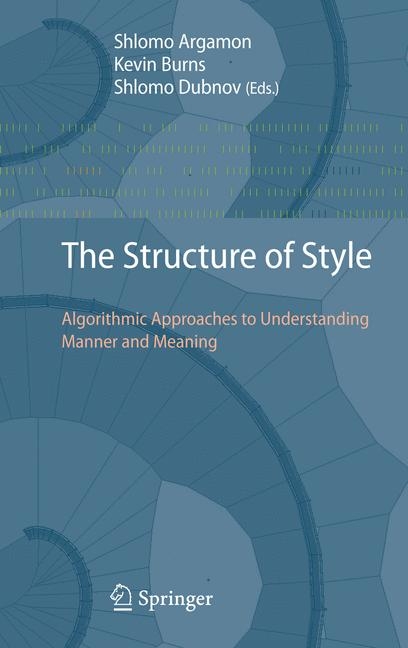
The Structure of Style (eBook)
XVIII, 338 Seiten
Springer Berlin (Verlag)
978-3-642-12337-5 (ISBN)
Style is a fundamental and ubiquitous aspect of the human experience: Everyone instantly and constantly assesses people and things according to their individual styles, academics establish careers by researching musical, artistic, or architectural styles, and entire industries maintain themselves by continuously creating and marketing new styles. Yet what exactly style is and how it works are elusive: We certainly know it when we see it, but there is no shared and clear understanding of the diverse phenomena that we call style.
The Structure of Style explores this issue from a computational viewpoint, in terms of how information is represented, organized, and transformed in the production and perception of different styles. New computational techniques are now making it possible to model the role of style in the creation of and response to human artifacts-and therefore to develop software systems that directly make use of style in useful ways.
Argamon, Burns, and Dubnov organize the research they have collected in this book according to the three roles that computation can play in stylistics. The first section of the book, Production, provides conceptual foundations by describing computer systems that create artifacts-musical pieces, texts, artworks-in different styles. The second section, Perception, explains methods for analyzing different styles and gleaning useful information, viewing style as a form of communication. The final section, Interaction, deals with reciprocal interaction between style producers and perceivers, in areas such as interactive media, improvised musical accompaniment, and game playing.
The Structure of Style is written for researchers and practitioners in areas including information retrieval, computer art and music, digital humanities, computational linguistics, and artificial intelligence, who can all benefit from this comprehensive overview and in-depth description of current research in this active interdisciplinary field.
Shlomo Argamon is Associate Professor of Computer Science at the Illinois Institute of Technology, Chicago, IL, USA, since 2002. Prior to that, he had held academic positions at Bar-Ilan University, where he held a Fulbright Postdoctoral Fellowship (1994-96), and at the Jerusalem College of Technology. Dr. Argamon received his B.S. (1988) in Applied Mathematics from Carnegie-Mellon University, and his M.Phil. (1991) and Ph.D. (1994) in Computer Science from Yale University, where he was a Hertz Foundation Fellow. His current research interests lie mainly in the use of machine learning methods to aid in functional analysis of natural language, with particular focus on questions of style. During his career, Dr. Argamon has worked on a variety of problems in experimental machine learning, including robotic map-learning, theory revision, and natural language processing, and has published numerous research papers in these areas.
Kevin Burns is a Principal Scientist at the MITRE Corporation. His interest is in computational modeling of cognitive processing, including strategic decisions and visual perception, to improve the design of decision support systems. Kevin holds engineering degrees from the Massachusetts Institute of Technology where he also studied cognitive science and media arts.
Shlomo Dubnov is an Associate Professor in music technology at UCSD. Prior to this he served as invited researcher at the Institute for Research and Coordination of Acoustics and Music (IRCAM) in Paris and was a senior lecturer in the department of communication systems engineering at Ben-Gurion-University in Israel. He holds a PhD in Computer Science from Hebrew University in Jerusalem. His research topics include music improvisation systems, machine learning of musical style, computational aesthetics and questions of human perception and experience of fun.
Shlomo Argamon is Associate Professor of Computer Science at the Illinois Institute of Technology, Chicago, IL, USA, since 2002. Prior to that, he had held academic positions at Bar-Ilan University, where he held a Fulbright Postdoctoral Fellowship (1994-96), and at the Jerusalem College of Technology. Dr. Argamon received his B.S. (1988) in Applied Mathematics from Carnegie-Mellon University, and his M.Phil. (1991) and Ph.D. (1994) in Computer Science from Yale University, where he was a Hertz Foundation Fellow. His current research interests lie mainly in the use of machine learning methods to aid in functional analysis of natural language, with particular focus on questions of style. During his career, Dr. Argamon has worked on a variety of problems in experimental machine learning, including robotic map-learning, theory revision, and natural language processing, and has published numerous research papers in these areas. Kevin Burns is a Principal Scientist at the MITRE Corporation. His interest is in computational modeling of cognitive processing, including strategic decisions and visual perception, to improve the design of decision support systems. Kevin holds engineering degrees from the Massachusetts Institute of Technology where he also studied cognitive science and media arts. Shlomo Dubnov is an Associate Professor in music technology at UCSD. Prior to this he served as invited researcher at the Institute for Research and Coordination of Acoustics and Music (IRCAM) in Paris and was a senior lecturer in the department of communication systems engineering at Ben-Gurion-University in Israel. He holds a PhD in Computer Science from Hebrew University in Jerusalem. His research topics include music improvisation systems, machine learning of musical style, computational aesthetics and questions of human perception and experience of fun.
Preface 5
References 11
Contents 12
Contributors 14
Part I Production 16
1 Style as Emergence (from What?) 17
Harold Cohen 17
References 34
2 Whose Style Is It? 35
George Stiny 35
2.1 What Makes a Style? 35
2.2 An Example You Have to See 43
2.3 Changing Styles 47
2.4 Whose Style Is It? 56
2.5 Background 57
3 Style in Music 58
Roger B. Dannenberg 58
3.1 Introduction 58
3.2 What Is Musical Style? 59
3.2.1 An Example: Baroque vs. Classical Style 60
3.2.2 Style in Popular Music 62
3.3 Computational Approaches to Music Style 63
3.3.1 Learning to Recognize Improvisational Styles 63
3.3.2 Genre Classification 65
3.3.3 Markov Models 66
3.3.4 Cope's Experiments in Musical Intelligence 67
3.3.5 Emotion and Expression in Music 68
3.4 Summary and Conclusion 69
References 70
4 Generating Texts in Different Styles 71
Ehud Reiter and Sandra Williams 71
4.1 Introduction 71
4.2 SkillSum 72
4.3 Using Style to Make Microplanning Choices 75
4.4 Style 1: Explicit Stylistic Control 77
4.5 Style 2: Conform to a Genre 79
4.5.1 Genre Modelling with Manual Corpus Analysis 80
4.5.2 Genre Modelling with Machine Learning and Statistics 81
4.6 Style 3: Imitate a Person 83
4.6.1 Imitate an Author 83
4.6.2 Imitate the Style of the Texts That a Reader Prefers 84
4.7 Research Issues 85
References 86
Part II Perception 88
5 The Rest of the Story: Finding Meaning in Stylistic Variation 89
Shlomo Argamon and Moshe Koppel 89
5.1 Introduction 89
5.1.1 Features 90
5.1.2 Overview 92
5.2 Style and the Communicative Act 92
5.3 Computational Stylistics 95
5.3.1 Text Classification 96
5.3.2 Classical Features 98
5.3.3 Functional Lexical Features 98
5.4 Case Study: Author Profiling 103
5.4.1 The Corpus 103
5.4.2 Classification Accuracy 104
5.4.3 Significant Features 104
5.5 Case Study: Authorship Verification 106
5.6 Case Study: Scientific Rhetoric and Methodology 109
5.6.1 Scientific Methodologies 109
5.6.2 Experimental and Historical Science 111
5.6.3 Geology and Paleontology 113
5.7 Discussion 114
5.7.1 Case Studies 115
5.7.2 Future Directions 117
References 117
6 Textual Stylistic Variation: Choices, Genres and Individuals 123
Jussi Karlgren 123
6.1 Stylistic Variation in Text 123
6.2 Detecting Stylistic Variation in Text 124
6.3 Genres as Vehicles for Understanding Stylistic Variation 125
6.4 Factors Which Determine Stylistic Variation in Text 126
6.5 Individual Variation vs Situational Variation 128
6.6 Concrete Example: Newsprint and Its Subgenres 128
6.7 Measurements and Observanda 130
6.8 Aggregation of Measurements 131
6.9 Concrete Example: Configurational Features 131
6.10 Conclusion: Target Measures 134
References 134
7 Information Dynamics and Aspects of Musical Perception 136
Shlomo Dubnov 136
7.1 Introduction: The Pleasure of Listening 136
7.1.1 Structure of Fun? 137
7.1.2 Planning and Style: Is Music Emotional or Rational? 138
7.1.3 Influential Information and Framing 139
7.2 Listening as Analysis of Information Dynamics 141
7.2.1 Our Model 141
7.2.2 Information Rate as Transmission over a ``Time-Channel'' 143
7.2.3 Data-IR Versus Model-IR 145
7.2.4 Model Likelihood and Musical Form 147
7.3 Surface and Form: Two Factors of Musical Experience? 148
7.3.1 Spectral Anticipations 149
7.3.2 Note Anticipations 151
7.3.3 Form, Recurrence and Modeling of Familiarity 151
7.4 IR Analysis of Beethoven's Piano Sonata No. 1 155
7.4.1 Structural Functions in Sonata Form 155
7.4.2 IR Analysis of Sonata Form 157
7.5 Summary and Discussion 159
7.5.1 Afterthoughts: Feeling of Memory and Anticipation 161
References 165
8 Let's Look at Style: Visual and Spatial Representation and Reasoning in Design 167
Julie Jupp and John Gero 167
8.1 Introduction 167
8.1.1 Overview 169
8.2 Perception of Design Style 169
8.2.1 Style and Similarity 170
8.2.2 Style and Reasoning 171
8.3 Computational Stylistics 173
8.3.1 Previous Research in the Design Domain 173
8.3.2 Our Research on Computational Stylistics 175
8.4 Computational Analysis 176
8.4.1 Qualitative Re-representation 176
8.5 Experiments 185
8.5.1 Experiment 1: Q-SOM 185
8.5.2 Experiment 2: Q-SOM:RF 192
8.6 Discussion 198
8.6.1 Experiments 198
8.6.2 Future Work 199
8.6.3 Concluding Remarks 200
References 201
Part III Interaction 204
9 Troiage Aesthetics 205
Sheldon Brown 205
9.1 Introduction 205
9.2 Computing As a Medium? 207
9.3 Troiage 209
9.4 Collage: The Imagistic Antecedent 209
9.5 Assemblage---A Spatial Attitude 211
9.6 Montage 211
9.7 Interactivity As Reception 212
9.8 The Scalable City 217
10 Interaction with Machine Improvisation 225
Gerard Assayag, George Bloch, Arshia Cont, and Shlomo Dubnov 225
10.1 Interaction, Improvisation and Learning 225
10.2 Stylistic Re-injection 227
10.3 Statistical Music Modelling 229
10.4 Factor Oracle 230
10.5 Knowledge-Based Interaction by a Human Operator 232
10.5.1 A Simple OMax Topology 234
10.5.2 A Meta-learning Topology 235
10.6 Knowledge-Based Automatic Interaction 236
10.6.1 Active Learning 237
10.6.2 Model Learning 239
10.6.3 Guidage 242
10.6.4 Anticipatory Learning 244
10.7 Current Uses and Results 246
10.7.1 OMax with Sound: Ofon Extensions 246
10.7.2 Ofon Video 247
10.7.3 Active Learning Generation 247
10.8 Future Perspectives 249
References 250
11 Strategic Style in Pared-Down Poker 252
Kevin Burns 252
11.1 Introducing the Interactions 253
11.1.1 Diagnoses and Decisions 253
11.1.2 Insights and Implications 255
11.2 Underpinnings of Utility 257
11.2.1 Economic Utility 257
11.2.2 Ergonomic Utility 258
11.2.3 Informatic Utility 258
11.2.4 Aesthetic Utility 260
11.3 Inference and Investment 262
11.3.1 Command and Control 262
11.3.2 Pared-down Poker 263
11.3.3 Basics of Bluffing 265
11.3.4 Return to the Real-World 267
11.4 Strategies and Styles 268
11.4.1 Bayesian Belief 268
11.4.2 Style is Simple 272
11.4.3 Style is Skillful 274
11.4.4 Style is Super-Optimal 276
11.5 Applying the Analysis 280
11.5.1 Intelligent Interactions 280
11.5.2 Asymmetric Adversaries 283
11.5.3 Understanding Utilities 286
11.5.4 Rational Risk Assessment 288
References 290
12 Style: A Computational and Conceptual Blending-Based Approach 295
Joseph A. Goguen and D. Fox Harrell 295
12.1 Introduction: Motivations and Goals 295
12.1.1 Style in Interactive and Generative Narrative and Poetry 296
12.1.2 Technical Style Versus Human Style 297
12.1.3 Overview 299
12.2 Linguistic Foundations 299
12.2.1 Metaphor and Blending 299
12.2.2 The Cognitive Optimality Principles 300
12.2.3 Narrative 301
12.3 Algebraic Semiotics 303
12.3.1 Semiotic Spaces 303
12.3.2 Semiotic Morphisms and Structural Blending 305
12.3.3 The House/Boat Example 306
12.4 Blending and the GRIOT System 308
12.4.1 Syntax as Blending 309
12.4.2 Interactive Poetry 310
12.4.3 Unconventional Blends 316
12.4.4 Style as Blending Principle Choice 317
12.5 Conclusions and Future Work 318
References 319
13 The Future of Style 321
Kevin Burns and Mark Maybury 321
13.1 Functions of Style 321
13.2 Levels of Style 323
13.3 Domains of Style 327
13.4 Uses of Style 328
13.4.1 Socialization: Comfort Industries 330
13.4.2 Customization: Money Industries 331
13.4.3 Representation: Knowledge Industries 332
13.4.4 Gratification: Pleasure Industries 333
13.5 The Status of Style 334
References 335
Index 337
| Erscheint lt. Verlag | 13.9.2010 |
|---|---|
| Zusatzinfo | XVIII, 338 p. |
| Verlagsort | Berlin |
| Sprache | englisch |
| Themenwelt | Kunst / Musik / Theater ► Malerei / Plastik |
| Informatik ► Theorie / Studium ► Künstliche Intelligenz / Robotik | |
| Schlagworte | algorithms • Artificial Intelligence • Computational Linguistics • Computer • Computer Art • Computer Music • Information Retrieval • Intelligence • Linguistics • natural language • Natural Language Processing • perception |
| ISBN-10 | 3-642-12337-6 / 3642123376 |
| ISBN-13 | 978-3-642-12337-5 / 9783642123375 |
| Informationen gemäß Produktsicherheitsverordnung (GPSR) | |
| Haben Sie eine Frage zum Produkt? |
 PDF (Wasserzeichen)
DRM: Digitales Wasserzeichen
Dieses eBook enthält ein digitales Wasserzeichen und ist damit für Sie personalisiert. Bei einer missbräuchlichen Weitergabe des eBooks an Dritte ist eine Rückverfolgung an die Quelle möglich.
Dateiformat: PDF (Portable Document Format)
Mit einem festen Seitenlayout eignet sich die PDF besonders für Fachbücher mit Spalten, Tabellen und Abbildungen. Eine PDF kann auf fast allen Geräten angezeigt werden, ist aber für kleine Displays (Smartphone, eReader) nur eingeschränkt geeignet.
Systemvoraussetzungen:
PC/Mac: Mit einem PC oder Mac können Sie dieses eBook lesen. Sie benötigen dafür einen PDF-Viewer - z.B. den Adobe Reader oder Adobe Digital Editions.
eReader: Dieses eBook kann mit (fast) allen eBook-Readern gelesen werden. Mit dem amazon-Kindle ist es aber nicht kompatibel.
Smartphone/Tablet: Egal ob Apple oder Android, dieses eBook können Sie lesen. Sie benötigen dafür einen PDF-Viewer - z.B. die kostenlose Adobe Digital Editions-App.
Buying eBooks from abroad
For tax law reasons we can sell eBooks just within Germany and Switzerland. Regrettably we cannot fulfill eBook-orders from other countries.
aus dem Bereich