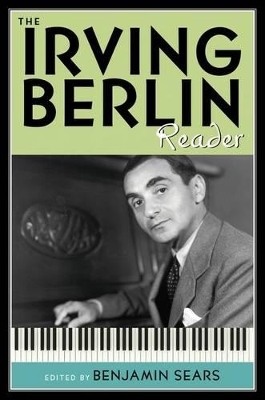
The Irving Berlin Reader
Oxford University Press Inc (Verlag)
978-0-19-538374-4 (ISBN)
Without any formal training in music composition or even the ability to notate melodies on a musical staff, Irving Berlin took a knack for music and turned it into the most successful songwriting career in American history. Berlin was the first Tin Pan Alley songwriter to go "uptown" to Broadway with a complete musical score (Watch Your Step in 1914); he is the only songwriter to build a theater exclusively for his own work (The Music Box); and his name appears above the title of his Broadway shows and Hollywood films (iIrving Berlin's Holiday Inn), still a rare honor for songwriters. Berlin is also notable due the length of his 90+ year career in American Song; he sold his first song at the age of 8 in 1896, and passed away in 1989 at the age of 101 having outlived several of his own copyrights. Throughout his career, Berlin showed that a popular song which appealed to the masses need not be of a lesser quality than songs informed by the principles of "classical" music composition. Forty years after his last published song many of his songs remain popular and several have even entered folk song status ("White Christmas," "Easter Parade," and "God Bless America"), something no other 20th-century American songwriter can claim.
As one of the most seminal figures of twentieth century, both in the world of music and in American culture more generally, and as one of the rare songwriters equally successful with popular songs, Broadway shows, and Hollywood scores, Irving Berlin is the subject of an enormous corpus of writing, scattered throughout countless publications and archives. A noted performer and interpreter of Berlin's works, Benjamin Sears has unprecedented familiarity with these sources and brings together in this Reader a broad range of the most insightful primary and secondary materials. Grouped together according to the chronology of Berlin's life and work, each section and article features a critical introduction to orient the reader and contextualize the materials within the framework of American musical history. Taken as a whole, they provide a new perspective on Berlin that highlights his musical genius in the context of his artistic development through a unique mix of first-hand views of Berlin as an artist, critical assessments of his work, and more general overviews of his life and work.
Benjamin Sears is a singer who, along with pianist Bradford Conner, specializes in the Great American Songbook and the songs of Irving Berlin in particular. With Conner he has recorded four CDs of Berlin's music, featuring over fifty first-time recordings, with two more in process. Together they reconstructed Berlin's first two shows, the classic Dietz & Schwartz revue "The Band Wagon", and created a database of the complete lyrics of Yip Harburg. Sears has written on Berlin, Ann Ronell, the partnership of Fred Astaire and Bing Crosby, and has contributed pieces on women songwriters to The American National Biography and the upcoming second edition of The Grove Dictionary of American Music. Sears & Conner lecture regularly on American songwriters and the great performers of their music.
Acknowledgements ; Introduction ; Part One: Musical Demon - Early Years ; 1.1 A Trip to Chinatown with Irving Berlin, Ward Morehouse ; 1.2 "Alexander" & Irving, Edward Jablonski ; 1.3 Excerpt from Alexander and His Band, Charles Hamm ; 1.4 The Boy Who Revived Ragtime, Rennard Wolf ; 1.5 Review of Watch Your Step by "Madam Critic" ; 1.6 Excerpt from First Nights and First Editions, Harry B. Smith ; 1.7 "Watch Your Step": Irving Berlin's 1914 Musical, Margaret Knapp ; 1.8 Ghost of Verdi Interviewed: Tells How He Suffers Nightly ; 1.9 Fond Memory: Those Old Music Box Revues, Robert Baral ; 1.10 Letter about The Music Box, Robert Benchley ; 1.11 "Yes, We Have No Bananas" in Grand Opera Setting, S.I. deKrafft ; Part Two: Blue Skies - Middle Years ; 2.1 Memoir, George S. Kaufman ; 2.2 Letter from Jerome Kern to Alexander Woollcott from The Story of Irving Berlin ; 2.3 Excerpt from Musical Stages, Richard Rodgers ; 2.4 Excerpt from chapter The March of Time in A Song in the Dark, Richard Barrios ; 2.5 Unity in Word and Tone in Two Ballads by Irving Berlin, Howard Pollack ; 2.6 The Origins of Easter Parade, Benjamin Sears ; 2.7 "Gawd Bless A-M-E-R-I-K-A", Cleve Sallendar ; 2.8 "No Right to a Personal Interest in 'God Bless America'," Berlin is Told, Variety ; 2.9 Excerpt from Stokowski, Here for Concert Tonight, Praises Martial, Folk Songs; Likes to Play for Soldiers, Nashville Tennessean ; 2.10 Irving Berlin Orders Song Word Change, Richmond Afro American ; 2.11 Excerpt from Musical Stages: An Autobiography, Richard Rodgers ; 2.12 Excerpt from Who Could Ask for Anything More, Ethel Merman, as told to Pete Martin ; 2.13 Annie Get Your Gun, Brooks Atkinson ; 2.14 Verse to Halloween, Harold Arlen & Ralph Blane ; 2.15 Excerpt from The Hollywood Musical, John Russell Taylor and Arthur Jackson ; 2.16 Excerpt from Steps in Time, Fred Astaire ; Part Three: The Melody Lingers On - Later Years ; 3.1 A Ninetieth-birthday Salute to the Master of American Song, Joshua Logan ; 3.2 First Encounters: Irving Berlin and George Gershwin, Nancy Caldwell Sorel ; 3.3 Excerpts from Top Hat and Tales, Mark Steyn ; 3.4 Berlin at 100: Life On a High Note, Marilyn Berger ; 3.5 Bit of Blues for Ballads of Berlin, Murray Kempton ; 3.6 Genius Without Tears, Josh Rubins ; 3.7 Irving Berlin (1888-1989), Arthur Maisel ; 3.8 Cartoon: September 22, 1989, Edward Sorel ; Epilogue: Berlin on Songwriting ; 4.1 How to Write Ragtime Songs, Irving Berlin ; 4.2 Song and Sorrow Are Playmates, Irving Berlin ; 4.3 Irving Berlin Gives Nine Rules for Writing Popular Songs, Frank Ward O'Malley ; 4.4 Excerpt from Words and Music From Irving Berlin, Isaac Goldberg ; 4.5 How to Write a Song Hit, Irving Berlin ; Biographical Highlights ; Suggested Reading ; Index
| Reihe/Serie | Readers on American Musicians |
|---|---|
| Zusatzinfo | 12 photographs and 3 musical examples |
| Verlagsort | New York |
| Sprache | englisch |
| Maße | 152 x 236 mm |
| Gewicht | 431 g |
| Themenwelt | Kunst / Musik / Theater ► Musik ► Klassik / Oper / Musical |
| ISBN-10 | 0-19-538374-5 / 0195383745 |
| ISBN-13 | 978-0-19-538374-4 / 9780195383744 |
| Zustand | Neuware |
| Informationen gemäß Produktsicherheitsverordnung (GPSR) | |
| Haben Sie eine Frage zum Produkt? |
aus dem Bereich