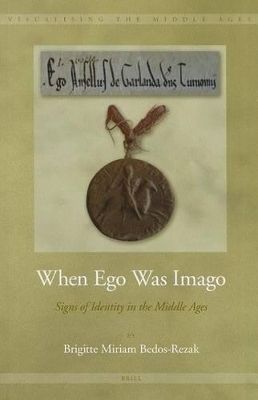
When Ego Was Imago
Brill (Verlag)
978-90-04-19217-1 (ISBN)
Twelfth-century individuals negotiated personal relationships along a continuum connecting rather than polarizing immediacy and mediated representation. Their markers of individuation, signs of identity and media of communication thus evidence practical engagement with contemporary medieval sign theory and perceptions of reality. In this study, the relevance of modern theory for the interpretation of medieval artifacts is shown to depend upon the parallel existence of theoretical activity by the producers and users of such artifacts. In the cultural landscape of the central Middle Ages, the axes of iconicity, semantics and materiality traced by charters, seals, and by both concrete and metaphorical images of the imprint, dynamically shaped the boundaries within which a sense of self was formulated, modulated, experienced, and enacted.
Brigitte Miriam Bedos-Rezak, Professor of History, New York University, has published extensively on medieval seals as conceptual tools, markers of identity, and social agents, including Form as Order in Medieval France (Aldershot, 1993), and “Medieval Identity” (American Historical Review, 2000)
List of Plates ... xi
List of Abbreviations ... xxv
Acknowledgments ... xxvii
Introduction ... 1
PART I: SOURCES AND METHODS
Chapter One Beyond the Text: Medieval Documentary Practices ... 9
Medieval Charters, Then and Now ... 9
Documentary, Production and Conservation ... 13
Diplomatic Discourse and the Performance of Charters ... 17
Acculturation to Documentary Practices ... 22
The Authentication of Charters: Persons, Signs, Seals ... 26
The Scope of Medieval Charter Referentiality ... 31
Chapter Two Toward an Archaeology of the Medieval Charter ... 37
The Archival Profile of Saint-Fursy of Péronne ... 40
The Production and Reproduction of Charters at Notre-Dame of Homblières ... 44
The Dispersed Charters of the Counts of Ponthieu ... 46
Authority, Authenticity, and the Intertextuality of Diplomatic Discourse ... 49
Narrative Form and Material Format: A Mutual Engagement ... 50
Chapter Three Sign Theory, Medieval and Modern ... 55
The Role of Theory in Sigillography ... 55
Evaluating Sign Theories ... 60
A Mutually Challenging Encounter: Semiotic Anthropology and the Middle Ages ... 65
PART II: IMAGO
Chapter Four The King’s Sign ... 75
A Merovingian Icon: The Royal Seal ... 76
Carolingian Rulers: The Power of Royal and Imperial Seals ... 78
Post-Carolingian Kingship: Sealing in Transition ... 84
Capetian Kings: The End of a Prerogative and the Re-Invention of the Royal Seal ... 90
Chapter Five Eucharistic Theology and Episcopal Signature ... 95
Episcopal Modes of Communication ... 96
The Debate over Real Presence and the Appearance of Episcopal Seals ... 102
Chapter Six Medieval Identity: Subject, Object, Agency ... 109
A Network of Schools and Chanceries ... 113
The Augustinian Paradox and its Role in Scholarly Controversy ... 121
Personhood and Individuality ... 129
The Ego of Diplomatic Discourse ... 132
Persona in Sign and Metaphor ... 140
Ego to Imago ... 150
From Identity to Stereotype ... 152
Chapter Seven Images of Identity and the Identity of Images ... 161
Images and the Senses: From Gregory the Great to Guillaume Durand ... 161
The Currency of Imago: Augustine, Byzantine
Anti-Iconoclasm, and Twelfth-Century Scholarship ... 171
Mirror ... 180
Imprint ... 186
Replica ... 202
PART III: EGO
Chapter Eight Difformitas: Invective, Individuality, Identity ... 209
The Invectiva of Arnulf of Lisieux ... 210
Strategies of Character Assassination ... 216
The Rhetoric of Vilification ... 220
‘Difformitas’ as Individuality ... 225
Chapter Nine The Semiotics of Personality in the Middle Ages ... 231
Identity and Individuality ... 233
Individuality and Personhood ... 235
Urban Identity and the Ideal City ... 238
The Saint and the City ... 243
Urban Identity and the Historical City ... 247
The Individuality of Human Collectives ... 249
Conclusion ... 253
Bibliography ... 257
Index ... 287
Plates ... (after 296)
| Erscheint lt. Verlag | 26.11.2010 |
|---|---|
| Reihe/Serie | Visualising the Middle Ages ; 3 |
| Verlagsort | Leiden |
| Sprache | englisch |
| Maße | 155 x 235 mm |
| Gewicht | 1520 g |
| Themenwelt | Kunst / Musik / Theater ► Kunstgeschichte / Kunststile |
| Geschichte ► Allgemeine Geschichte ► Mittelalter | |
| ISBN-10 | 90-04-19217-4 / 9004192174 |
| ISBN-13 | 978-90-04-19217-1 / 9789004192171 |
| Zustand | Neuware |
| Informationen gemäß Produktsicherheitsverordnung (GPSR) | |
| Haben Sie eine Frage zum Produkt? |
aus dem Bereich