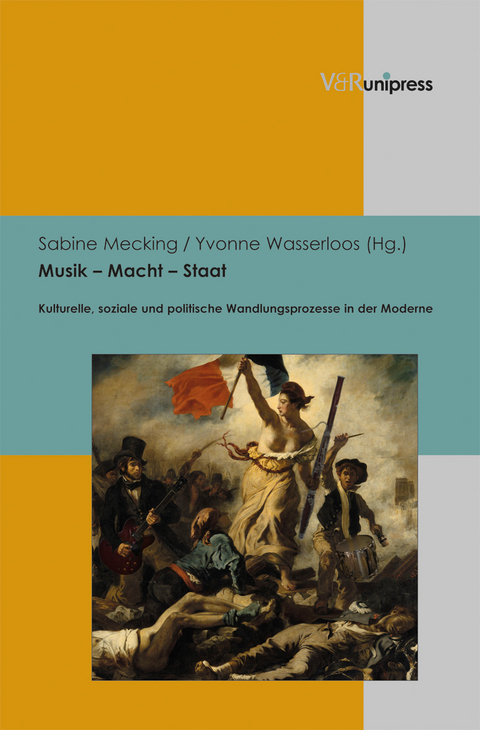
Musik – Macht – Staat
Musik, Macht und Staat stehen in einem symbiotischen Verhältnis zueinander. Musik gilt einerseits als ästhetische Erfahrung oder Anstoß individueller Emotionen, andererseits ist sie ebenso eine Form öffentlicher Inszenierung von staatlicher Macht und damit Teil eines politischen Ritus. Musik hat stets kulturelle, soziale und politische Konsolidierungs- und Wandlungsprozesse begleitet, gespiegelt und klanglich verewigt. Doch was macht Musik so mächtig, dass weder Regierende noch Regierte oder oppositionelle Gruppen auf sie verzichten wollen? Um sich dem komplexen Phänomen Musik aus unterschiedlichen Perspektiven anzunähern, bündelt dieser Band Studien von Geschichts- und Musikwissenschaftlern von der Frühen Neuzeit bis in die Gegenwart. Das Spektrum reicht von Staatsmusik und Kunstmusik über Volkslieder, Schlager und Schnulzen bis hin zu Rock- und Popsongs.
Prof. Dr. Sabine Mecking ist Professorin für Landes- und Zeitgeschichte an der Philipps-Universität Marburg.
Prof. Dr. Yvonne Wasserloos ist Professorin für Musikwissenschaft an der Universität Mozarteum Salzburg. Ihr Forschungsschwerpunkt liegt auf der Untersuchung des Verhältnisses von Musik, Gesellschaft, Staat und Politik. Im Herbst 2023 gründete sie an der Universität Mozarteum Salzburg den Arbeitsschwerpunkt »Musik und Macht - Dimension und Kontext«, den sie seitdem leitet.
Music is regarded as an expression of the individually emotional. Nevertheless, it can be used also to representative purposes or collective protest in the same way. The musical power does not refer in this way only to individually emotional and emphatic moments, but also and or about that onto public places. In this function music can create cultural identity and identities, support power systems and state systems or undermine as well as serve the political positioning and its expression. In this way music supports and accompanies cultural, social and political developments. By means of well-chosen case studies these transformation processes are analyzed in Europe of the early modern times up to the present. Beside nobility courts, armies or political rulers social movements and groups as civic movements and musical youth and subcultures will be focused. The spectrum ranges from state music and art music about (national) songs, the German "Schlager" and hits up to rock songs and pop songs. The authors are experts in the field of history and musicology as well as police science and the military music of the German Federal Armed Forces.
| Erscheint lt. Verlag | 15.8.2012 |
|---|---|
| Reihe/Serie | Schriften zur Politischen Musikgeschichte ; Band 001 |
| Zusatzinfo | mit 26 Abbildungen |
| Verlagsort | Göttingen |
| Sprache | deutsch |
| Maße | 163 x 245 mm |
| Gewicht | 815 g |
| Themenwelt | Kunst / Musik / Theater ► Musik |
| Schlagworte | DDR • Deutschland /Militär • Die Moderne • Emotion • Französische Revolution • Gesellschaft • Hofmusik • Identität • Kultur • Künste • Nationalsozialismus • No Wave • Politik • Pop • Punk • Rock • Sängerbewegung • Schlachtenmusik • Schlager • Sowjetunion /Kultur • Sowjetunion /Kultur, Künste • Weimarer Republik /Geistes- und Kulturleben |
| ISBN-10 | 3-89971-872-0 / 3899718720 |
| ISBN-13 | 978-3-89971-872-0 / 9783899718720 |
| Zustand | Neuware |
| Informationen gemäß Produktsicherheitsverordnung (GPSR) | |
| Haben Sie eine Frage zum Produkt? |
aus dem Bereich