


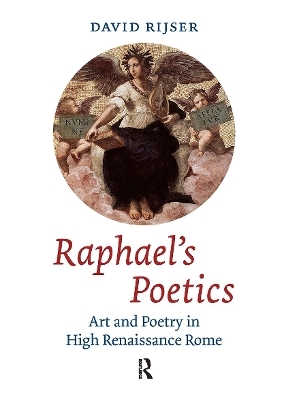
Raphael's Poetics
Art and Poetry in High Renaissance Rome
Seiten
2012
Pallas Publications (Verlag)
978-90-8964-342-1 (ISBN)
Pallas Publications (Verlag)
978-90-8964-342-1 (ISBN)
This book presents strategies of interpretation implicit in antique poetry to the visual art of the Renaissance, concentrating on Raphael’s Roman works and their cultural context.
Raphael’s Poetics applies strategies of interpretation implicit in antique poetry to the visual art of the Renaissance, concentrating on Raphael’s Roman works and their cultural context. Until recently, scholarly discussion was dominated by the application of Renaissance literary theory to visual arts, obscuring the fact that Renaissance humanists who contributed to literary theory were, in the first instance and almost without exception, poets rather than theorists. To counter the tendency towards theory, the hermeneutic rules implicit in their poetry and thus the poetry itself is brought to the fore by this study as a hermeneutical tool. By focusing on the interaction between the work of art and its public, Rijser offers innovative interpretations of canonical works and important insights into the cultural history of the early modern period. Reconstructing a visual grammar and defining the context in which Raphael’s art functioned, this study illuminates contemporary significances that have since been lost.
Raphael’s Poetics applies strategies of interpretation implicit in antique poetry to the visual art of the Renaissance, concentrating on Raphael’s Roman works and their cultural context. Until recently, scholarly discussion was dominated by the application of Renaissance literary theory to visual arts, obscuring the fact that Renaissance humanists who contributed to literary theory were, in the first instance and almost without exception, poets rather than theorists. To counter the tendency towards theory, the hermeneutic rules implicit in their poetry and thus the poetry itself is brought to the fore by this study as a hermeneutical tool. By focusing on the interaction between the work of art and its public, Rijser offers innovative interpretations of canonical works and important insights into the cultural history of the early modern period. Reconstructing a visual grammar and defining the context in which Raphael’s art functioned, this study illuminates contemporary significances that have since been lost.
David Rijser is professor by special appointment at the Rijksuniversiteit Groningen holding a chair of Classical Receptions.
Abbreviations, Preface, Introduction: Aeneas’ Example, Chapter 1. Nature’s Anxiety, Chapter 2. Rule without End, Chapter 3. Let No One without Poem Enter, Chapter 4. Airy Nothing Gets a Local habitation and a Name, Bibliography, List of Figures, List of Plates, Index locorum et imaginum, Index Nominum et rerum
| Sprache | englisch |
|---|---|
| Maße | 156 x 234 mm |
| Gewicht | 960 g |
| Themenwelt | Kunst / Musik / Theater ► Kunstgeschichte / Kunststile |
| Kunst / Musik / Theater ► Malerei / Plastik | |
| Geschichte ► Allgemeine Geschichte ► Altertum / Antike | |
| Geisteswissenschaften ► Sprach- / Literaturwissenschaft ► Anglistik / Amerikanistik | |
| Geisteswissenschaften ► Sprach- / Literaturwissenschaft ► Literaturwissenschaft | |
| ISBN-10 | 90-8964-342-7 / 9089643427 |
| ISBN-13 | 978-90-8964-342-1 / 9789089643421 |
| Zustand | Neuware |
| Informationen gemäß Produktsicherheitsverordnung (GPSR) | |
| Haben Sie eine Frage zum Produkt? |
Mehr entdecken
aus dem Bereich


aus dem Bereich
ohne den ganzen langweiligen Kram
Buch | Hardcover (2025)
C.H.Beck (Verlag)
CHF 36,40
von den Anfängen bis zum Untergang
Buch | Hardcover (2025)
Alfred Kröner Verlag
CHF 48,95


