


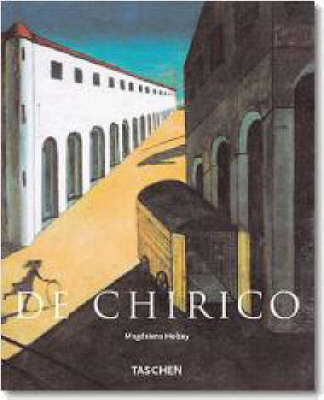
De Chirico Basic Art
Seiten
2005
TASCHEN GmbH (Verlag)
978-3-8228-4152-5 (ISBN)
TASCHEN GmbH (Verlag)
978-3-8228-4152-5 (ISBN)
- Titel ist leider vergriffen;
keine Neuauflage - Artikel merken
Giorgio De Chirico's paintings during the teens caused such a stir that Picasso and Paul Eluard immediately praised them. After 1930, he turned to a more classical style of painting and continued in the same vein for the rest of his career; his later work was widely criticized, especially by the Surrealists who had so admired his early paintings.
Greek-born Italian painter, Giorgio De Chirico (1888-1978) was hugely influential in the early years of the Surrealist movement. His paintings during the teens in Paris, where he moved in 1911, caused such a stir that such important figures as Picasso and Paul Eluard immediately praised them. This phase of his work, which he later termed pittura metafisica (metaphysical painting) was marked by dramatic compositions involving sharp perspective, striking shadows, geometrical planes, voids of space, and a general feeling of anxiety and loneliness; the sense of absurdity evoked by the mannequin-like figures in almost nightmarish landscapes seemed to suggest a Freudian expression of the unconscious. After 1930, De Chirico turned to a more classical style of painting and continued in the same vein for the rest of his career; his later work was widely criticized, especially by the Surrealists who had so admired his early paintings.
Greek-born Italian painter, Giorgio De Chirico (1888-1978) was hugely influential in the early years of the Surrealist movement. His paintings during the teens in Paris, where he moved in 1911, caused such a stir that such important figures as Picasso and Paul Eluard immediately praised them. This phase of his work, which he later termed pittura metafisica (metaphysical painting) was marked by dramatic compositions involving sharp perspective, striking shadows, geometrical planes, voids of space, and a general feeling of anxiety and loneliness; the sense of absurdity evoked by the mannequin-like figures in almost nightmarish landscapes seemed to suggest a Freudian expression of the unconscious. After 1930, De Chirico turned to a more classical style of painting and continued in the same vein for the rest of his career; his later work was widely criticized, especially by the Surrealists who had so admired his early paintings.
The author: Magdalena Holzhey studied art history, Italian, and musicology in Berlin and Pisa. She has held academic and curatorial positions in galleries and museums, including the K20 Kunstsammlung Nordrhein-Westfalen in Dusseldorf. She has published on classical modernism and contemporary art and is currently preparing a dissertation on Joseph Beuys.
| Erscheint lt. Verlag | 25.11.2005 |
|---|---|
| Zusatzinfo | col. Illustrations, ports. |
| Verlagsort | Cologne |
| Sprache | englisch |
| Maße | 185 x 230 mm |
| Themenwelt | Kunst / Musik / Theater ► Kunstgeschichte / Kunststile |
| Kunst / Musik / Theater ► Malerei / Plastik | |
| ISBN-10 | 3-8228-4152-8 / 3822841528 |
| ISBN-13 | 978-3-8228-4152-5 / 9783822841525 |
| Zustand | Neuware |
| Informationen gemäß Produktsicherheitsverordnung (GPSR) | |
| Haben Sie eine Frage zum Produkt? |
Mehr entdecken
aus dem Bereich


aus dem Bereich
kleine Kulturgeschichte einer brillanten Allianz
Buch | Softcover (2025)
Iudicium (Verlag)
CHF 33,90


