


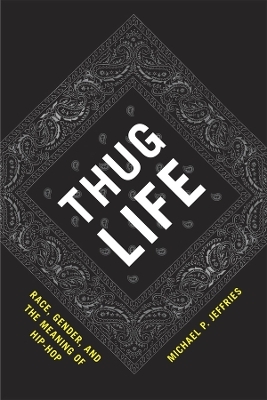
Thug Life
Race, Gender, and the Meaning of Hip-Hop
Seiten
2011
University of Chicago Press (Verlag)
978-0-226-39585-2 (ISBN)
University of Chicago Press (Verlag)
978-0-226-39585-2 (ISBN)
Hip-hop has come a long way from its origins in the Bronx in the 1970s, when rapping and Djing were just part of a lively, decidedly local scene that also venerated break-dancing and graffiti. Focusing on the music's fans - young men, both black and white, this book offers an unbiased examination of how hip-hop works in people's daily lives.
Hip-hop has come a long way from its origins in the Bronx in the 1970s, when rapping and Djing were just part of a lively, decidedly local scene that also venerated break-dancing and graffiti. Now hip-hop is a global phenomenon and, in the United States, a massively successful corporate enterprise predominantly controlled and consumed by whites while the most prominent performers are black. How does this shift in racial dynamics affect our understanding of contemporary hip-hop, especially when the music perpetuates stereotypes of black men? Do black listeners interpret hip-hop differently from white fans? These questions have dogged hip-hop for decades, but unlike most pundits, Michael Jeffries finds answers by interviewing everyday people. Instead of turning to performers or media critics, Thug Life focuses on the music's fans - young men, both black and white - and the resulting account avoids romanticism, offering an unbiased examination of how hip-hop works in people's daily lives.
As Jeffries weaves the fans' voices together with his own sophisticated analysis, we are able to understand hip-hop as a tool listeners use to make sense of themselves and society as well as a rich, self-contained world containing politics and pleasure, virtue and vice.
Hip-hop has come a long way from its origins in the Bronx in the 1970s, when rapping and Djing were just part of a lively, decidedly local scene that also venerated break-dancing and graffiti. Now hip-hop is a global phenomenon and, in the United States, a massively successful corporate enterprise predominantly controlled and consumed by whites while the most prominent performers are black. How does this shift in racial dynamics affect our understanding of contemporary hip-hop, especially when the music perpetuates stereotypes of black men? Do black listeners interpret hip-hop differently from white fans? These questions have dogged hip-hop for decades, but unlike most pundits, Michael Jeffries finds answers by interviewing everyday people. Instead of turning to performers or media critics, Thug Life focuses on the music's fans - young men, both black and white - and the resulting account avoids romanticism, offering an unbiased examination of how hip-hop works in people's daily lives.
As Jeffries weaves the fans' voices together with his own sophisticated analysis, we are able to understand hip-hop as a tool listeners use to make sense of themselves and society as well as a rich, self-contained world containing politics and pleasure, virtue and vice.
Michael Jeffries is assistant professor of American studies at Wellesley College.
| Erscheint lt. Verlag | 15.2.2011 |
|---|---|
| Sprache | englisch |
| Maße | 15 x 23 mm |
| Gewicht | 425 g |
| Themenwelt | Kunst / Musik / Theater ► Musik ► Pop / Rock |
| Sozialwissenschaften ► Ethnologie | |
| Sozialwissenschaften ► Soziologie | |
| ISBN-10 | 0-226-39585-5 / 0226395855 |
| ISBN-13 | 978-0-226-39585-2 / 9780226395852 |
| Zustand | Neuware |
| Informationen gemäß Produktsicherheitsverordnung (GPSR) | |
| Haben Sie eine Frage zum Produkt? |
Mehr entdecken
aus dem Bereich



aus dem Bereich
Buch | Softcover (2024)
Schwarzkopf & Schwarzkopf (Verlag)
CHF 26,90
60 Jahre legendärer Rock : von Hannover in die Welt
Buch | Hardcover (2025)
riva (Verlag)
CHF 18,90


