


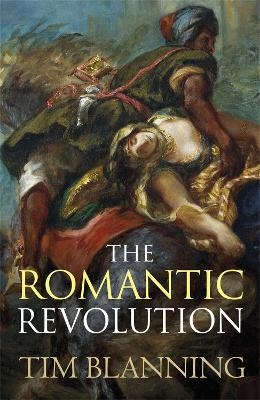
The Romantic Revolution
Seiten
2011
Weidenfeld & Nicolson (Verlag)
978-0-7538-2865-6 (ISBN)
Weidenfeld & Nicolson (Verlag)
978-0-7538-2865-6 (ISBN)
A compelling and persuasive account of how the Romantic Movement permanently changed the way we see things and express ourselves.
Three great revolutions rocked the world around 1800. The first two - the French Revolution and the Industrial Revolution - have inspired the greatest volume of literature. But the third - the romantic revolution - was perhaps the most fundamental and far-reaching. From Byron, Wordsworth, Coleridge and Burns, to Beethoven, Wagner, Berlioz, Rossini and Liszt, to Goya, Turner, Delacroix and Blake, the romantics brought about nothing less than a revolution when they tore up the artistic rule book of the old regime.
This was the period in which art acquired its modern meaning; for the first time the creator, rather than the created, took centre-stage. Artists became the high priests of a new religion, and as the concert hall and gallery came to take the place of the church, the public found a new subject worthy of veneration in paintings, poetry and music. Tim Blanning's sparkling, wide-ranging survey traces the roots and evolution of a cultural revolution whose reverberations continue to be felt today.
Three great revolutions rocked the world around 1800. The first two - the French Revolution and the Industrial Revolution - have inspired the greatest volume of literature. But the third - the romantic revolution - was perhaps the most fundamental and far-reaching. From Byron, Wordsworth, Coleridge and Burns, to Beethoven, Wagner, Berlioz, Rossini and Liszt, to Goya, Turner, Delacroix and Blake, the romantics brought about nothing less than a revolution when they tore up the artistic rule book of the old regime.
This was the period in which art acquired its modern meaning; for the first time the creator, rather than the created, took centre-stage. Artists became the high priests of a new religion, and as the concert hall and gallery came to take the place of the church, the public found a new subject worthy of veneration in paintings, poetry and music. Tim Blanning's sparkling, wide-ranging survey traces the roots and evolution of a cultural revolution whose reverberations continue to be felt today.
Tim Blanning is Professor of Modern European History at the University of Cambridge and a Fellow of Sidney Sussex College, Cambridge. He is also a Fellow of the British Academy. He has been described by THE SUNDAY TIMES as 'a long-time Cambridge academic who can make even the most arcane subject thrum with interest'. He lives in Cambridge.
| Erscheint lt. Verlag | 27.10.2011 |
|---|---|
| Verlagsort | London |
| Sprache | englisch |
| Maße | 128 x 196 mm |
| Gewicht | 240 g |
| Themenwelt | Kunst / Musik / Theater ► Kunstgeschichte / Kunststile |
| Geschichte ► Allgemeine Geschichte ► Neuzeit (bis 1918) | |
| Geschichte ► Teilgebiete der Geschichte ► Kulturgeschichte | |
| ISBN-10 | 0-7538-2865-0 / 0753828650 |
| ISBN-13 | 978-0-7538-2865-6 / 9780753828656 |
| Zustand | Neuware |
| Informationen gemäß Produktsicherheitsverordnung (GPSR) | |
| Haben Sie eine Frage zum Produkt? |
Mehr entdecken
aus dem Bereich
aus dem Bereich
Geschichte einer wilden Handlung
Buch | Hardcover (2024)
C.H.Beck (Verlag)
CHF 47,60


