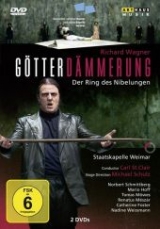
A bleak wind chord of E flat minor opens Richard Wagner’s Götterdämmerung. It establishes the dominant atmosphere of the piece from its first bar: twilight, a deceptive half-light, prevails. Shadowy figures stumble towards the abyss. The last evening of the Ring is one of plotting and betrayal, of ominous oaths, a chilling lust for power, abuse and humiliation – and, also, of a superbly staged apocalypse, when the beings and things destined for destruction shine brightly for one last time. The leitmotivs and thematic ideas from throughout the whole tetralogy recur in Götterdämmerung, intensified and woven into a musical web from which there can be no escape. Everything appears to fit together fatally with everything else. There is nothing more to be done. The net of catastrophe is knotted too fatefully for that, both musically and dramatically. When Wagner sat down to write a prose outline of what turned out as the last part of the Ring, he called it Siegfried’s Death. That was in the year of revolutions, 1848. The new title, usually translated as Twilight of the Gods, came later (Bernard Shaw called it Night Falls on the Gods but that never caught on). All the threads of the drama run now towards the hero’s fall. The death of Siegfried precipitates the final dissolution of the gods’ world, set in train by Wotan when he impiously tore a branch from the World Ash-Tree, and to which the god was already resigned long ago, before he knew of Siegfried’s conception. The natural order has been diverted from its proper course, and the last hope of righting it rests with Siegfried – the human being of the future. He knows no constraints, no fear of violence moderates his thirst for action, he is naïve and spontaneous. To Wagner he represented Utopia, Thomas Mann described him as “harlequin, god of light and anarchistic social revolutionary”, Shaw as “a totally unmoral person, a born anarchist, the ideal of Bakunin, an anticipation of the ‘overman’ of Nietzsche”. Yet he is unfree, nevertheless: he must run on the rails laid by Wotan and thus he is the instrument (one might say, war machine) of the failing power of the old gods as they wait for annihilation. The truly new, however, as Wagner saw it, can only rise from the ashes of the old. So Siegfried too must die, and Brünnhilde, magnanimous in forgiveness, assumes the roles of tragic heroine and redeemer by her self-sacrifice.
Wilhelm Richard Wagner wurde 1813 in Leipzig als neuntes Kind des Polizeiaktuarius Carl Friedrich Wagner und der Bäckerstochter Johanna Rosine Wagner geboren und starb 1883 in Venedig, im Palazzo Vendramin-Calergi. Er war war Komponist, Dramatiker, Philosoph, Dichter, Schriftsteller, Theaterregisseur und Dirigent. Mit seinen Musikdramen gilt er als einer der bedeutendsten Erneuerer der europäischen Musik im 19. Jahrhundert. Er veränderte die Ausdrucksfähigkeit romantischer Musik und die theoretischen und praktischen Grundlagen der Oper, indem er dramatische Handlungen als Gesamtkunstwerk gestaltete und dazu Text, Musik und Regieanweisungen schrieb. Als erster Komponist gründete er Festspiele in dem von ihm geplanten Bayreuther Festspielhaus. Seine Neuerungen in der Harmonik beeinflussten die Entwicklung der Musik bis in die Moderne. Mit seiner Schrift "Das Judenthum" in der Musik gehört er geistesgeschichtlich zu den Verfechtern des Antisemitismus.
Prof. Dr. rer. Medic. Michael Schulz leitet den Bachelor-Studiengang Psychiatrische Pflege an der Fachhochschule der Diakonie Bethel. Er ist Mitherausgeber der Zeitschrift "Psychiatrische Pflege heute".
| Reihe/Serie |
Arthaus Musik, Opera
|
| Mitarbeit |
Dirigent: Carl St. Clair
|
| Sprache |
deutsch |
| Gewicht |
150 g |
| Themenwelt
|
Kunst / Musik / Theater ► Musik |
| Sachbuch/Ratgeber ► Freizeit / Hobby ► Singen / Musizieren |
| Schlagworte |
Klassik-DVD • Oper • Opern, Operetten und Musicals (DVD) • Opern, Operetten und Musicals-DVD • Richard Wagner • Staatskapelle Weimar • Wagner, Richard • Wagner, Richard; DVD |
| Zustand |
Neuware |