


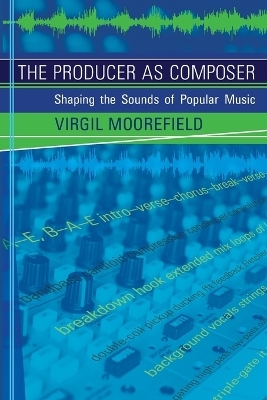
The Producer as Composer
Shaping the Sounds of Popular Music
Seiten
2010
MIT Press (Verlag)
978-0-262-51405-7 (ISBN)
MIT Press (Verlag)
978-0-262-51405-7 (ISBN)
- Lieferbar
- Versandkostenfrei
- Auch auf Rechnung
- Artikel merken
The evolution of the record producer from organizer to auteur, from Phil Spector and George Martin to the rise of hip-hop and remixing.
In the 1960s, rock and pop music recording questioned the convention that recordings should recreate the illusion of a concert hall setting. The Wall of Sound that Phil Spector built behind various artists and the intricate eclecticism of George Martin's recordings of the Beatles did not resemble live performances-in the Albert Hall or elsewhere-but instead created a new sonic world. The role of the record producer, writes Virgil Moorefield in The Producer as Composer, was evolving from that of organizer to auteur; band members became actors in what Frank Zappa called a "movie for your ears." In rock and pop, in the absence of a notated score, the recorded version of a song-created by the producer in collaboration with the musicians-became the definitive version. Moorefield, a musician and producer himself, traces this evolution with detailed discussions of works by producers and producer-musicians including Spector and Martin, Brian Eno, Bill Laswell, Trent Reznor, Quincy Jones, and the Chemical Brothers. Underlying the transformation, Moorefield writes, is technological development: new techniques-tape editing, overdubbing, compression-and, in the last ten years, inexpensive digital recording equipment that allows artists to become their own producers. What began when rock and pop producers reinvented themselves in the 1960s has continued; Moorefield describes the importance of disco, hip-hop, remixing, and other forms of electronic music production in shaping the sound of contemporary pop. He discusses the making of Pet Sounds and the production of tracks by Public Enemy with equal discernment, drawing on his own years of studio experience. Much has been written about rock and pop in the last 35 years, but hardly any of it deals with what is actually heard in a given pop song. The Producer as Composer tries to unravel the mystery of good pop: why does it sound the way it does?
In the 1960s, rock and pop music recording questioned the convention that recordings should recreate the illusion of a concert hall setting. The Wall of Sound that Phil Spector built behind various artists and the intricate eclecticism of George Martin's recordings of the Beatles did not resemble live performances-in the Albert Hall or elsewhere-but instead created a new sonic world. The role of the record producer, writes Virgil Moorefield in The Producer as Composer, was evolving from that of organizer to auteur; band members became actors in what Frank Zappa called a "movie for your ears." In rock and pop, in the absence of a notated score, the recorded version of a song-created by the producer in collaboration with the musicians-became the definitive version. Moorefield, a musician and producer himself, traces this evolution with detailed discussions of works by producers and producer-musicians including Spector and Martin, Brian Eno, Bill Laswell, Trent Reznor, Quincy Jones, and the Chemical Brothers. Underlying the transformation, Moorefield writes, is technological development: new techniques-tape editing, overdubbing, compression-and, in the last ten years, inexpensive digital recording equipment that allows artists to become their own producers. What began when rock and pop producers reinvented themselves in the 1960s has continued; Moorefield describes the importance of disco, hip-hop, remixing, and other forms of electronic music production in shaping the sound of contemporary pop. He discusses the making of Pet Sounds and the production of tracks by Public Enemy with equal discernment, drawing on his own years of studio experience. Much has been written about rock and pop in the last 35 years, but hardly any of it deals with what is actually heard in a given pop song. The Producer as Composer tries to unravel the mystery of good pop: why does it sound the way it does?
Virgil Moorefield is a composer, producer, and sound artist. He is Associate Professor of Music at University of Michigan, Ann Arbor, where he teaches composition and new media.
| Reihe/Serie | The MIT Press |
|---|---|
| Sprache | englisch |
| Maße | 152 x 229 mm |
| Gewicht | 272 g |
| Themenwelt | Kunst / Musik / Theater ► Musik ► Pop / Rock |
| ISBN-10 | 0-262-51405-2 / 0262514052 |
| ISBN-13 | 978-0-262-51405-7 / 9780262514057 |
| Zustand | Neuware |
| Informationen gemäß Produktsicherheitsverordnung (GPSR) | |
| Haben Sie eine Frage zum Produkt? |
Mehr entdecken
aus dem Bereich

aus dem Bereich
Buch | Softcover (2024)
Schwarzkopf & Schwarzkopf (Verlag)
CHF 26,90
60 Jahre legendärer Rock : von Hannover in die Welt
Buch | Hardcover (2025)
riva (Verlag)
CHF 18,90
Westdeutschlands Reise von Jazz und Schlager zu Krautrock und darüber …
Buch | Softcover (2024)
Halvmall (Verlag)
CHF 38,90


