


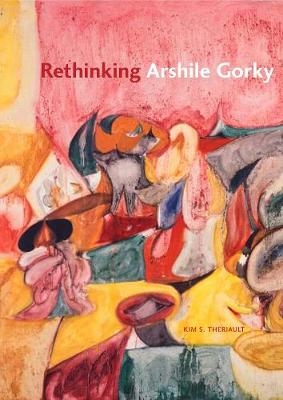
Rethinking Arshile Gorky
Seiten
2009
Pennsylvania State University Press (Verlag)
978-0-271-03646-5 (ISBN)
Pennsylvania State University Press (Verlag)
978-0-271-03646-5 (ISBN)
A reexamination of the art of Arshile Gorky (1904-1948), and an exploration of his role in the development of modern abstraction in America.
Often referred to as the last Surrealist and first Abstract Expressionist, Arshile Gorky (c. 1900–1948) appears as an interstice within art history’s linear progression. Gorky embraced dream imagery in the tradition of the Surrealists, used all-over patterning before Jackson Pollock, promoted disembodied color before Mark Rothko, exploited the physicality of paint before Willem de Kooning, and anticipated stain painting. His life—he escaped the Armenian Genocide of 1915 and struggled as an immigrant artist in New York in the 1930s and 1940s—and his tumultuous personal relationships have cast the artist as a tragic figure and often overshadowed the genius of his art.
Rethinking Arshile Gorky is an examination of the artist and his work based on themes of displacement, self-fashioning, trauma, and memory. By applying a multitude of techniques, including psychoanalytic, semiotic, and constructivist analyses, to explain and demythologize the artist, Kim Theriault offers a contemporary critique of both the way we construct the idea of the “artist” in modern society and the manner in which Arshile Gorky and his art have historically been addressed.
Often referred to as the last Surrealist and first Abstract Expressionist, Arshile Gorky (c. 1900–1948) appears as an interstice within art history’s linear progression. Gorky embraced dream imagery in the tradition of the Surrealists, used all-over patterning before Jackson Pollock, promoted disembodied color before Mark Rothko, exploited the physicality of paint before Willem de Kooning, and anticipated stain painting. His life—he escaped the Armenian Genocide of 1915 and struggled as an immigrant artist in New York in the 1930s and 1940s—and his tumultuous personal relationships have cast the artist as a tragic figure and often overshadowed the genius of his art.
Rethinking Arshile Gorky is an examination of the artist and his work based on themes of displacement, self-fashioning, trauma, and memory. By applying a multitude of techniques, including psychoanalytic, semiotic, and constructivist analyses, to explain and demythologize the artist, Kim Theriault offers a contemporary critique of both the way we construct the idea of the “artist” in modern society and the manner in which Arshile Gorky and his art have historically been addressed.
Kim S. Theriault is Assistant Professor of Art History, Theory, and Criticism at Dominican University.
Contents
List of Illustrations
Acknowledgments
Introduction
1.Genocide, Displacement, and Identity
2.Constructions of Gender, Self, and Other
3.Language, Translation, and Diaspora
4.Exile, Abstraction, and Nonobjectivity
5.Difference, Likeness, and Synthesis
6.Conflation, Re-membering, and Indeterminacy
7.Primitivism, the Feminine, and Orientalization
8.Enigma, Erasure, and Arshile Gorky’s Afterlife
Conclusion
Notes
Selected Bibliography
Index
| Zusatzinfo | 24 Halftones, color; 80 Halftones, black and white |
|---|---|
| Verlagsort | Pennsylvania |
| Sprache | englisch |
| Maße | 178 x 254 mm |
| Gewicht | 794 g |
| Themenwelt | Kunst / Musik / Theater ► Kunstgeschichte / Kunststile |
| Kunst / Musik / Theater ► Malerei / Plastik | |
| ISBN-10 | 0-271-03646-X / 027103646X |
| ISBN-13 | 978-0-271-03646-5 / 9780271036465 |
| Zustand | Neuware |
| Informationen gemäß Produktsicherheitsverordnung (GPSR) | |
| Haben Sie eine Frage zum Produkt? |
Mehr entdecken
aus dem Bereich

aus dem Bereich
kleine Kulturgeschichte einer brillanten Allianz
Buch | Softcover (2025)
Iudicium (Verlag)
CHF 33,90


