


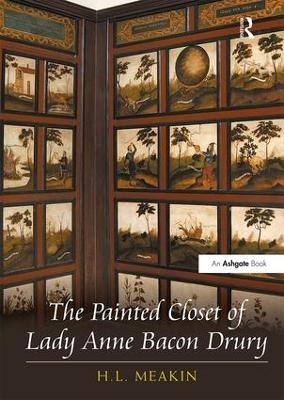
The Painted Closet of Lady Anne Bacon Drury
Seiten
2013
Routledge (Verlag)
978-0-7546-6397-3 (ISBN)
Routledge (Verlag)
978-0-7546-6397-3 (ISBN)
- Titel z.Zt. nicht lieferbar
- Versandkostenfrei
- Auch auf Rechnung
- Artikel merken
Lady Anne Bacon Drury (1572-1624) devised dozens of panels comprised of pictures and Latin mottoes for the walls of her closet or study. The panels function as a 'book' of meditations to enable her - well-connected, wealthy, and well-educated as she was - to cope with the disappointments of her life. For the first time in 400 years.
Lady Anne Bacon Drury (1572-1624) was the granddaughter and niece of two of England's Lord Keepers of the Great Seal, Sir Nicholas Bacon and Sir Francis Bacon. Lady Anne was also the friend and patroness of John Donne and Joseph Hall; however, she deserves to be remembered in her own right. Within her massive country house, Lady Anne created a tiny painted room that she seems to have used as a kind of three-dimensional book. The walls consisted of panels of pictures and mottoes, grouped under Latin sentences. These panels can still be viewed in a Suffolk museum: Christchurch Mansion in Ipswich. Some panels point to classical and Biblical sources, and to popular emblem books. The sources of other panels are more recondite, while still others are original compositions by Lady Anne. The panels exhibit a contemptus mundi theme and reflect a struggle with ambition, pride, and even despair. Some panels also appear to register carefully veiled but pointed critiques of political and religious events and figures. Lady Anne's painted closet or 'architext' is thus relevant to a wide range of early modern scholarship in various disciplines but is as yet largely unappreciated. For the first time in four hundred years, this book fully describes the closet and places it in its personal, social, intellectual, and aesthetic contexts. It argues for the painted closet's importance for understanding early modern conceptualizations of private and public spaces, and for illuminating fundamental early modern habits of seeing and reading (especially combinations of text and image). Finally, this book explores the closet as an example of the ingenious ways in which female subjectivity found ways to express itself even within the constraints of early modern patriarchal society in England.
Lady Anne Bacon Drury (1572-1624) was the granddaughter and niece of two of England's Lord Keepers of the Great Seal, Sir Nicholas Bacon and Sir Francis Bacon. Lady Anne was also the friend and patroness of John Donne and Joseph Hall; however, she deserves to be remembered in her own right. Within her massive country house, Lady Anne created a tiny painted room that she seems to have used as a kind of three-dimensional book. The walls consisted of panels of pictures and mottoes, grouped under Latin sentences. These panels can still be viewed in a Suffolk museum: Christchurch Mansion in Ipswich. Some panels point to classical and Biblical sources, and to popular emblem books. The sources of other panels are more recondite, while still others are original compositions by Lady Anne. The panels exhibit a contemptus mundi theme and reflect a struggle with ambition, pride, and even despair. Some panels also appear to register carefully veiled but pointed critiques of political and religious events and figures. Lady Anne's painted closet or 'architext' is thus relevant to a wide range of early modern scholarship in various disciplines but is as yet largely unappreciated. For the first time in four hundred years, this book fully describes the closet and places it in its personal, social, intellectual, and aesthetic contexts. It argues for the painted closet's importance for understanding early modern conceptualizations of private and public spaces, and for illuminating fundamental early modern habits of seeing and reading (especially combinations of text and image). Finally, this book explores the closet as an example of the ingenious ways in which female subjectivity found ways to express itself even within the constraints of early modern patriarchal society in England.
H.L. Meakin received her doctorate from the University of Oxford and is the author of John Donne’s Articulations of the Feminine. She now teaches English literature at the University of South Florida.
Contents: Introduction; Lady Drury’s life and relations; ’She leaves this space’: the Drury monument and epitaph; ’Never less alone than when alone’: the rhetorical space of the closet; Situating the closet panels; The order of the closet panels; ’Small but fit for me; and yet I find no rest here’: the closet panels; Appendices; Works consulted; Index.
| Erscheint lt. Verlag | 11.10.2013 |
|---|---|
| Verlagsort | London |
| Sprache | englisch |
| Maße | 174 x 246 mm |
| Gewicht | 1190 g |
| Themenwelt | Literatur ► Biografien / Erfahrungsberichte |
| Kunst / Musik / Theater | |
| Geisteswissenschaften ► Geschichte | |
| Geisteswissenschaften ► Sprach- / Literaturwissenschaft ► Anglistik / Amerikanistik | |
| Geisteswissenschaften ► Sprach- / Literaturwissenschaft ► Literaturwissenschaft | |
| Sozialwissenschaften ► Soziologie ► Spezielle Soziologien | |
| ISBN-10 | 0-7546-6397-3 / 0754663973 |
| ISBN-13 | 978-0-7546-6397-3 / 9780754663973 |
| Zustand | Neuware |
| Informationen gemäß Produktsicherheitsverordnung (GPSR) | |
| Haben Sie eine Frage zum Produkt? |
Mehr entdecken
aus dem Bereich



aus dem Bereich
Poetik eines sozialen Urteils
Buch | Hardcover (2023)
De Gruyter (Verlag)
CHF 83,90


