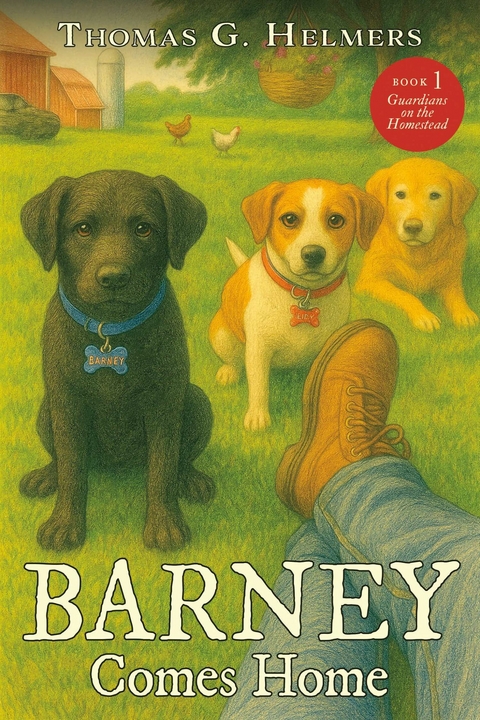
Barney Comes Home (eBook)
260 Seiten
Bookbaby (Verlag)
979-8-3178-2100-5 (ISBN)
Thomas G. Helmers is an engineer by trade, a farmer by accident, and a writer thanks to a large black dog who wouldn't take no for an answer. He lives on a small family homestead in the Midwest with his wife, a handful of animals (most of them opinionated), and a half-full box of round to-its that life on the farm has generously produced. The breezeway has slowly transformed into an unofficial infirmary for injured chickens, and the line between it and the coop gets blurrier every year. Along the way, he's earned an unofficial degree in poultry counseling. His debut novel, Barney Comes Home, was inspired by true events-especially the day Diane brought home a quiet, unassuming dog who had been overlooked by many. That pup's gentle spirit, patient heart, and quiet determination to belong became the heartbeat of the story. With encouragement from his wife and mother, a nudge from his son, and just enough quiet mornings with coffee and a blank page, Tom began writing the stories that unfolded during his daily chores. One chapter turned into two. The story wouldn't leave him alone. Eventually, Barney Comes Home became the first book in the Guardians on the Homestead series. Book Two in the series is currently in the works, shifting the spotlight to Edward the rooster and the next chapter of life on the farm. Edward has poor vision, a strong personality, and an uncanny ability to stick to a routine. He free-ranges near the house, checks his reflection in the mirror each night, and sleeps in a tote beside a crippled hen. He also comes when called, naps on Tom's lap, and has a few things to say about punctuality. His story is one of loyalty, resilience, and the quiet ways animals become part of the family-whether you meant to adopt them or not.
Barney isn't the loudest pup in the litter. He isn't the fastest or the flashiest, either. Born small, with a limp that set him apart, Barney quickly learns that life doesn't always reward the gentle ones. While his brothers and sisters bounce, tumble, and demand attention, Barney waits-watching from the edges, hoping to be noticed. When Bobby, a young man weighed down by hard choices, brings the litter to a shelter, Barney's quiet nature and crooked gait make him easy to overlook. Days turn into weeks, and one by one his siblings are adopted. Barney is left behind. Then Miss Diane arrives. She doesn't flinch at his limp. She doesn't pass him over. She sees him and brings him home to her farm, where the unexpected becomes the everyday. At the homestead, Barney finds a world alive with chickens, curious pups, and people who understand hardship. There's healing here, and laughter, and chores that always need doing. But there is also danger. Slowly, patiently, Barney begins to discover that belonging isn't about being the loudest or the strongest. It's about being yourself and trusting that someone will recognize your quiet strength. Barney Comes Home is a tender middle grade novel about second chances, resilience, and the unlikely bonds between animals and people. Inspired by real-life events on a Midwest family farm, this story explores what it means to find family in unexpected places and how love can grow in the most ordinary moments. With heartfelt prose and memorable characters, debut author Thomas G. Helmers introduces readers to the Guardians on the Homestead series a world where animals aren't just background figures, but central to the story of healing, hope, and home. Perfect for ages 8 12 and for anyone who has ever loved a dog, rescued an animal, or discovered that strength doesn't always bark the loudest this book will resonate with families, teachers, librarians, and animal lovers alike. Fans of Because of Winn-Dixie, Shiloh, and A Dog Called Homeless will feel right at home in Barney's story and eager for the next chapter in the Guardians on the Homestead series.
Chapter 1
A Tough Start
Section 1: Bobby and Marlene’s Life Before the Puppies
The German shepherd mix had been watching him for almost a minute before Bobby realized he had stopped moving. He had just turned seventeen, and he was in love.
It was a blistering summer afternoon, and the pet adoption event in the grocery store’s parking lot shimmered in the heat. All the other dogs barked and lunged at the edges of their crates, tails spinning like helicopter blades. But not her.
She sat perfectly still in her pen, lean and wiry, with a dust-colored coat and ears that seemed almost too big for her head. Her eyes were calm and steady, almost human, watching him like she was making quiet judgments.
When Bobby stepped closer, she did not flinch. She simply met his gaze as if she had been waiting for him.
“Bobby?” his mom called from the car, her voice muffled by the air thick with asphalt heat.
He did not move.
She walked over, gave the dog a long look, then turned her gaze on Bobby. “You’re really stuck, aren’t you?”
Bobby stayed silent.
His mom sighed. “Your father had that same look every time he saw a motorcycle. You both have a soft spot for trouble.”
She signed the paperwork.
They brought Marlene home that day, in the back seat wrapped in an old beach towel like a newborn. The towel smelled faintly of saltwater and sunscreen from some long-forgotten summer. From that moment on, she and Bobby were inseparable.
Seven years later, Bobby Maddux was twenty-four and doing his best to stay afloat.
He lived alone in the same house his father had left him unexpectedly, a one-story place with creaky floors, a leaky faucet, and windows that groaned every time the wind changed direction. The house sat on the edge of a quiet subdivision near the city, where cracked sidewalks buckled under the roots of old trees and sagging mailboxes leaned like tired old men. Overgrown lawns competed with ivy, and black patches of creeping fungus dotted the sides of several homes. No one seemed to care much. Most folks had more pressing worries, like putting food on the table and keeping jobs that barely covered rent. Yard work was a luxury.
The house had not been touched in years. The wallpaper peeled in the corners. The furnace wheezed like it had asthma. But it was paid for, and that counted for something.
Back in high school, Bobby had worked afternoons and weekends at that same grocery store where he first saw Marlene. It was dull work—bagging groceries, collecting carts, and mopping up the occasional broken jar of pickles—but it gave him a sense of motion, however small. Then, he was living with his mom in a third-floor walk-up above a coin laundry. Things were not easy, but they made it work.
Marlene was smart. Not just clever, but aware. She picked up on things Bobby had not even said. She never begged for food, never chewed the legs off furniture, and never barked without a reason. She understood the flow of life in a way that felt too precise to be taught.
But she had her quirks.
She loved carrots, truly loved them. The sound of the fridge drawer sliding open brought her running every time, toenails tapping on the linoleum like hail on a tin roof. She would sit, tail swishing, eyes locked on the orange prize in Bobby’s hand as if it were the finest cut of steak. She crunched them loudly, one paw bracing the carrot like a hand, lips smacking afterward with satisfaction.
At night, she dreamed, paws twitching like she was running in her sleep. Sometimes she let out muffled woofs and rolled over like she had caught the squirrel this time.
Thunderstorms, however, were her one weakness. At the first low rumble, she slinked beneath Bobby’s bed or wedged herself behind the couch, tail tucked and breathing shallow. And if a stranger walked up to the house after dark, she let out a low growl that started in her chest and rolled through the floorboards like a warning shot.
She only growled when it mattered. Like a safety clicking off.
Bobby loved her more than he had loved anything. Maybe more than he would ever admit.
She met him at the door every day without fail. Tail wagging, eyes bright. On the days he came home tired or tight-chested from worry, she did not jump or bark. She simply walked over, rested her head on his knee, and sat with him in silence.
When Bobby’s father died unexpectedly, suddenly, and with nothing but a two-sentence will, Marlene sat beside him on the porch while he tried to make sense of it. The man had been a shadow for most of Bobby’s life, a voice on a phone or a birthday card late in the mail. But now there was a house, a key, and a door Bobby had not opened since he was eight years old.
After graduation, his mom helped him move in. She told him not to waste his time chasing what-ifs. “Life’s short,” she said. “Do the thing you were made to do.”
He believed her.
Bobby wanted to paint cars, real custom work. Flames. Metallic sheens. Street art turned to horsepower. He enrolled in a few art classes at a small private college and took out a student loan to cover the rest. He worked part-time at the grocery store and did odd jobs where he could.
For a while, it looked like it might work.
But his mom got sick not long after he started. She could not work. The savings they had scraped together evaporated like steam on a hot hood. Tuition bills kept coming. So did the late notices.
Bobby dropped out of school and started working nights at a twenty-four-hour gas station on the edge of town. The shift was rough. The customers were rougher. But it paid a little more, and it let him be home during the day to take care of his mom.
He installed a doggie door in the kitchen for Marlene, so she could come and go while he was gone. Not because he stopped caring, but because he was surviving, not living.
Life fell into an upside-down rhythm.
When most folks were pouring cereal or walking their kids to school, Bobby was just dragging himself home, shoulders sagging and eyes gritty with fatigue. Marlene would be waiting at the back door, tail wagging like she had not just spent the night curled up in his warm spot on the couch.
He would toss his keys on the counter, kick off his boots, and divide up whatever scraps he had brought home from the mini-mart—half a sandwich, a bruised banana, crushed crackers.
Marlene never complained.
Then they would sit for dinner, him on the floor, her curled beside his knee, chin resting patiently on his leg in case he accidentally dropped a bite. He always saved her a carrot or two. She always waited without asking.
Afterward, he would let her out into the fenced backyard while he grabbed a shower and slipped into an old T-shirt and pajama pants. When he stepped back out to check her water bowl, Marlene would already be lying in the grass by the doghouse, eyes blinking slowly, as if she had never moved.
Sometimes he wondered how she always seemed so settled, so still, no matter how early he came out. She had that look of a dog who had already had a full morning before the day had even started, though he never thought much of it.
“Night, girl,” he would murmur, giving her a soft pat on the side.
Sometimes she would give one slow wag. Other times, she would just close her eyes.
On the rare nights he did not have to work, the itch would come back, the need to make something, to leave a mark.
He would sling his paint bag over his shoulder and disappear into the dark.
Marlene went with him. No leash. No commands. Just an understanding.
They had a favorite wall behind the train depot, faded and graffiti-covered from years of tags. Bobby added to it, layer over layer, piece by piece. Flames. Faces. Birds with broken wings. Color bleeding into color, pain hiding in design.
The city called it vandalism. Bobby called it therapy. Some of it looked so good, no one dared paint over it.
He worked in fast, long, clean arcs with practiced hands. The hiss of the can was soothing, like rain on a metal roof. Sometimes he would sit in the grass afterward, legs stretched out, sweat clinging to his back, hands stained with paint, and just look at what he had done.
“This is all I got,” he would whisper.
Marlene would sit beside him. She never barked.
Sometimes she would give him a single, soft wag. And that was enough.
Section 2: Marlene’s Secret Routine
What Bobby did not know was that Marlene had her own rhythm too, a quiet life tucked neatly between the lines of his.
Once Bobby shut his bedroom door and the house slipped into its daytime silence, Marlene waited a few minutes, stretched with a jaw-cracking yawn, then trotted toward the back fence. The sun filtered through the kitchen windows, laying long stripes of gold across the linoleum floor. Outside, the grass still held the cool dampness of morning.
She glanced over her shoulder once, then leapt over the back fence as if it were a curb. Her nails clicked softly when she landed on the sidewalk. Tail high. Ears swiveling. She went to work.
No leash. No collar. No rules.
She cut through the side yard, slipping past Mr. Jensen’s tall hedge, her usual shortcut. His little terrier, a wiry-haired ankle-biter named Skippy, barked at everything with legs. But when Marlene passed through, he fell silent, tail tucked, eyes fixed on her like a rookie soldier watching the captain walk...
| Erscheint lt. Verlag | 13.11.2025 |
|---|---|
| Sprache | englisch |
| Themenwelt | Kinder- / Jugendbuch |
| ISBN-13 | 979-8-3178-2100-5 / 9798317821005 |
| Informationen gemäß Produktsicherheitsverordnung (GPSR) | |
| Haben Sie eine Frage zum Produkt? |
 EPUB (Ohne DRM)
Größe: 1,5 MB
Digital Rights Management: ohne DRM
Dieses eBook enthält kein DRM oder Kopierschutz. Eine Weitergabe an Dritte ist jedoch rechtlich nicht zulässig, weil Sie beim Kauf nur die Rechte an der persönlichen Nutzung erwerben.
Dateiformat: EPUB (Electronic Publication)
EPUB ist ein offener Standard für eBooks und eignet sich besonders zur Darstellung von Belletristik und Sachbüchern. Der Fließtext wird dynamisch an die Display- und Schriftgröße angepasst. Auch für mobile Lesegeräte ist EPUB daher gut geeignet.
Systemvoraussetzungen:
PC/Mac: Mit einem PC oder Mac können Sie dieses eBook lesen. Sie benötigen dafür die kostenlose Software Adobe Digital Editions.
eReader: Dieses eBook kann mit (fast) allen eBook-Readern gelesen werden. Mit dem amazon-Kindle ist es aber nicht kompatibel.
Smartphone/Tablet: Egal ob Apple oder Android, dieses eBook können Sie lesen. Sie benötigen dafür eine kostenlose App.
Geräteliste und zusätzliche Hinweise
Buying eBooks from abroad
For tax law reasons we can sell eBooks just within Germany and Switzerland. Regrettably we cannot fulfill eBook-orders from other countries.
aus dem Bereich