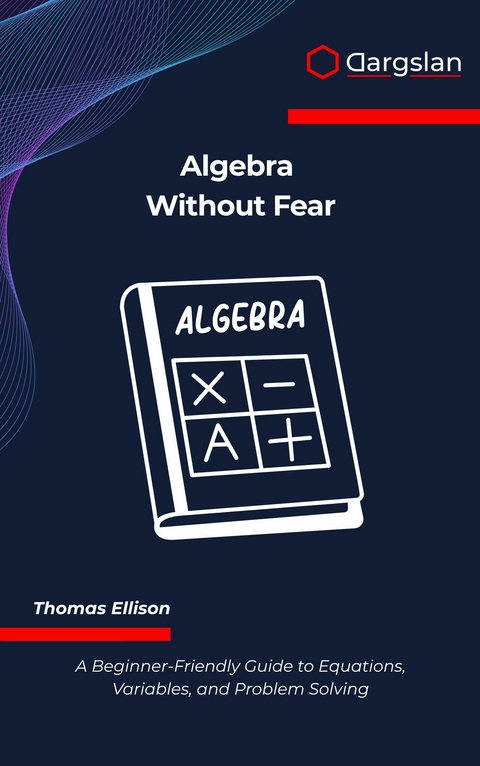
Algebra Without Fear (eBook)
298 Seiten
Dargslan s.r.o. (Verlag)
978-0-00-106806-3 (ISBN)
Transform Your Math Anxiety Into Algebraic Confidence with This Complete Beginner's Guide
Are you intimidated by equations with letters instead of numbers? Do you break into a cold sweat when someone mentions 'solving for x'? You're not alone-and more importantly, you're about to discover that algebra doesn't have to be your mathematical nemesis.
Algebra Without Fear is the comprehensive, beginner-friendly guide that finally makes algebra accessible to everyone. Whether you're a student facing algebra for the first time, an adult returning to mathematics, or someone determined to conquer lingering math anxieties, this book provides the clear, step-by-step foundation you need to succeed.
What Makes This Algebra Book Different:
Real-world connections - Discover how algebra appears in daily life, from calculating tips to understanding loan payments
Fear-free approach - Build confidence gradually with logical progression from basic concepts to advanced topics
Complete coverage - Master everything from variables and expressions to quadratic equations
Extensive practice - Reinforce learning with worked examples and 50 practice problems with detailed solutions
Inside You'll Find:
Demystified variables and expressions that actually make sense
Foolproof equation-solving strategies for one-step through multi-step problems
Clear explanations of functions, graphing, and systems of equations
Introduction to polynomials, factoring, and quadratic equations
Comprehensive appendices including formula cheat sheets and study strategies
Perfect For:
High school students beginning their algebra journey
College students needing algebra review
Adult learners returning to mathematics
Anyone wanting to build mathematical confidence
Parents helping children with algebra homework
Test prep for standardized exams requiring algebra skills
What Readers Are Saying: Students consistently praise this book's ability to transform their relationship with mathematics. The clear explanations, abundant examples, and practical applications help readers see algebra as an accessible problem-solving tool rather than an insurmountable obstacle.
Your Algebraic Success Starts Here Stop letting algebra intimidate you. This book proves that with the right approach, anyone can master algebraic thinking. You'll gain more than just problem-solving skills-you'll develop the mathematical confidence to tackle any algebraic challenge.
From understanding why variables work to graphing linear equations and solving systems, every concept builds logically on the previous one. No confusing jargon, no skipped steps, no assumptions about prior knowledge-just clear, patient instruction that meets you exactly where you are.
Ready to discover that algebra can be both understandable and enjoyable?
Join thousands of students who have already transformed their mathematical anxiety into algebraic confidence. Your fear-free algebra journey begins with turning the first page.
Scroll up and click 'Buy Now' to start mastering algebra today!
Chapter 1: Why Algebra Isn't Scary
Introduction: Breaking Down Mental Barriers
Picture this: You're sitting in a classroom, and the teacher writes something like "2x + 5 = 13" on the whiteboard. Suddenly, your palms start sweating, your heart rate increases, and a voice in your head whispers, "I can't do this." If this scenario sounds familiar, you're not alone. Millions of students and adults around the world experience what mathematicians call "math anxiety" when they encounter algebra for the first time.
But here's the truth that might surprise you: algebra isn't a mysterious, incomprehensible language designed to torture students. It's actually one of the most practical and logical systems humans have ever developed. In fact, you've been using algebraic thinking your entire life without even realizing it.
When you figure out how much change you should receive at the store, when you calculate how long it will take to drive somewhere at a certain speed, or when you determine how many ingredients you need to double a recipe, you're thinking algebraically. The only difference is that formal algebra gives us symbols and systematic methods to solve these problems more efficiently and handle more complex situations.
The Real Nature of Algebra
What Algebra Actually Is
Algebra is fundamentally about relationships and patterns. It's a way of expressing mathematical relationships using symbols instead of just numbers. Think of it as a sophisticated language that allows us to describe and solve problems involving unknown quantities.
Consider a simple real-world scenario: You're planning a party and need to buy pizza. Each pizza costs $12, and you have $60 to spend. How many pizzas can you buy? Most people would instinctively think: "Well, $60 divided by $12 equals 5 pizzas." What you've just done is solve the algebraic equation 12x = 60, where x represents the number of pizzas.
The beauty of algebra lies in its ability to handle situations where the unknown isn't immediately obvious. What if the pizza place offers a deal where you get a $3 discount for every pizza after the first one? Now the problem becomes more complex, but algebra provides us with the tools to solve it systematically.
The Historical Perspective
Understanding where algebra comes from can help demystify it significantly. The word "algebra" comes from the Arabic word "al-jabr," which means "reunion of broken parts." This etymology is quite fitting because algebra is essentially about finding missing pieces and putting mathematical puzzles back together.
Ancient civilizations developed algebraic thinking out of necessity. Babylonian merchants needed to calculate interest rates, Egyptian engineers needed to determine the dimensions of pyramids, and Islamic scholars needed to divide inheritances according to complex religious laws. These weren't abstract academic exercises—they were practical solutions to real-world problems.
The Persian mathematician Al-Khwarizmi, often called the "father of algebra," wrote his famous treatise on algebra around 820 CE not as an intellectual exercise, but as a practical manual for solving everyday problems involving trade, inheritance, and land measurement. His work was titled "The Compendious Book on Calculation by Completion and Balancing," which perfectly captures what algebra is all about: completing what's missing and balancing equations.
Common Misconceptions and Fears
"I'm Not a Math Person"
One of the most damaging myths in education is the idea that people are either "math people" or they're not. This fixed mindset creates unnecessary barriers and prevents many capable individuals from developing mathematical skills. Research in cognitive science has consistently shown that mathematical ability is not a fixed trait—it's a skill that can be developed through practice and proper instruction.
Dr. Jo Boaler, a mathematics education researcher at Stanford University, has demonstrated through extensive studies that the brain's capacity for mathematical thinking is far more plastic than previously believed. When students approach math with a growth mindset—believing that their abilities can improve through effort and learning—they perform significantly better than those who believe mathematical ability is fixed.
The truth is that algebra requires the same kinds of thinking skills you use every day: logical reasoning, pattern recognition, and problem-solving. If you can follow a recipe, plan a budget, or figure out the best route to work, you have the cognitive tools necessary for algebraic thinking.
"Algebra Is Too Abstract"
Another common fear is that algebra is too abstract to be useful or understandable. While it's true that algebra uses abstract symbols, this abstraction is actually its greatest strength. By using variables like x and y instead of specific numbers, algebra allows us to solve entire classes of problems at once.
Consider the formula for the area of a rectangle: A = length × width, or A = lw. This simple algebraic expression can calculate the area of any rectangle, whether it's a postage stamp or a football field. Without algebra, we'd need a separate calculation method for every possible rectangle size.
The abstraction in algebra is similar to the abstraction in language. When we use the word "chair," we're not referring to one specific chair but to an entire category of objects with certain characteristics. Similarly, when we use the variable x in algebra, we're referring to a number with certain characteristics that we're trying to discover.
"I Need to Be Perfect at Arithmetic First"
Many students believe they can't learn algebra until they've mastered every aspect of arithmetic. While basic arithmetic skills are certainly helpful, this belief often becomes an unnecessary roadblock. Algebra actually provides a different way of thinking about mathematical relationships that can sometimes make arithmetic concepts clearer.
For example, students who struggle with fraction arithmetic often find that algebraic approaches to fraction problems make more sense. The systematic methods of algebra can provide structure and logic that makes arithmetic operations more understandable rather than less so.
The Practical Applications of Algebra
Personal Finance
One of the most immediate and practical applications of algebra is in personal financial planning. Every time you create a budget, calculate loan payments, or figure out investment returns, you're using algebraic thinking.
Let's examine a common scenario: You want to buy a car that costs $20,000. You can make a down payment of $5,000 and finance the rest at 4% annual interest for 5 years. How much will your monthly payment be? This problem involves the algebraic formula for loan payments:
M = P[r(1+r)^n]/[(1+r)^n-1]
Where:
While this formula might look intimidating at first glance, it's simply a systematic way of calculating something you need to know for a major life decision. Understanding the algebraic relationship between these variables helps you make informed choices about loan terms, down payments, and affordability.
Career Applications
Algebra appears in virtually every career field, often in ways that aren't immediately obvious. Here are some examples:
Healthcare: Nurses use algebra to calculate medication dosages based on patient weight and desired concentration. A nurse might need to solve: "If the medication concentration is 250mg per 5ml, how many milliliters should I administer to give a patient 150mg?"
Business: Entrepreneurs use algebra to determine break-even points, optimize pricing strategies, and forecast sales. A business owner might ask: "If my fixed costs are $10,000 per month and I make $25 profit per unit, how many units do I need to sell to break even?"
Construction: Contractors use algebra to calculate materials needed, determine load capacities, and ensure proper proportions in concrete mixtures. They might need to solve: "If a concrete mixture requires a 1:2:3 ratio of cement to sand to gravel, and I need 12 cubic yards of concrete, how much of each material do I need?"
Technology: Software developers use algebraic thinking to create algorithms, optimize database queries, and solve computational problems. Even seemingly simple applications like GPS navigation rely heavily on algebraic calculations to determine optimal routes.
Everyday Problem Solving
Beyond formal career applications, algebra enhances your ability to solve everyday problems more efficiently and accurately. Consider these common situations:
Travel Planning: You're planning a road trip and want to determine the optimal departure time. You know the distance (300 miles), your average driving speed (60 mph), and the time you want to arrive (3:00 PM). The algebraic relationship distance = speed × time allows you to work backward and determine you need to leave at 8:00 AM.
Home Improvement: You're installing tile flooring and need to determine how many tiles to buy. The room is 12 feet by 15 feet, and each tile covers 1 square foot. You also want to buy 10% extra for waste and future repairs. This involves the algebraic calculation: (12 × 15) × 1.10 = 198 tiles.
Cooking and Baking: You want to make a recipe that serves 6 people, but you need to feed 10 people. Algebra helps you scale the recipe proportionally: if the original recipe calls for 2 cups of flour, you need...
| Erscheint lt. Verlag | 30.9.2025 |
|---|---|
| Sprache | englisch |
| Themenwelt | Kinder- / Jugendbuch |
| ISBN-10 | 0-00-106806-7 / 0001068067 |
| ISBN-13 | 978-0-00-106806-3 / 9780001068063 |
| Informationen gemäß Produktsicherheitsverordnung (GPSR) | |
| Haben Sie eine Frage zum Produkt? |
 EPUB (Adobe DRM)
Größe: 1,3 MB
Kopierschutz: Adobe-DRM
Adobe-DRM ist ein Kopierschutz, der das eBook vor Mißbrauch schützen soll. Dabei wird das eBook bereits beim Download auf Ihre persönliche Adobe-ID autorisiert. Lesen können Sie das eBook dann nur auf den Geräten, welche ebenfalls auf Ihre Adobe-ID registriert sind.
Details zum Adobe-DRM
Dateiformat: EPUB (Electronic Publication)
EPUB ist ein offener Standard für eBooks und eignet sich besonders zur Darstellung von Belletristik und Sachbüchern. Der Fließtext wird dynamisch an die Display- und Schriftgröße angepasst. Auch für mobile Lesegeräte ist EPUB daher gut geeignet.
Systemvoraussetzungen:
PC/Mac: Mit einem PC oder Mac können Sie dieses eBook lesen. Sie benötigen eine
eReader: Dieses eBook kann mit (fast) allen eBook-Readern gelesen werden. Mit dem amazon-Kindle ist es aber nicht kompatibel.
Smartphone/Tablet: Egal ob Apple oder Android, dieses eBook können Sie lesen. Sie benötigen eine
Geräteliste und zusätzliche Hinweise
Buying eBooks from abroad
For tax law reasons we can sell eBooks just within Germany and Switzerland. Regrettably we cannot fulfill eBook-orders from other countries.
aus dem Bereich