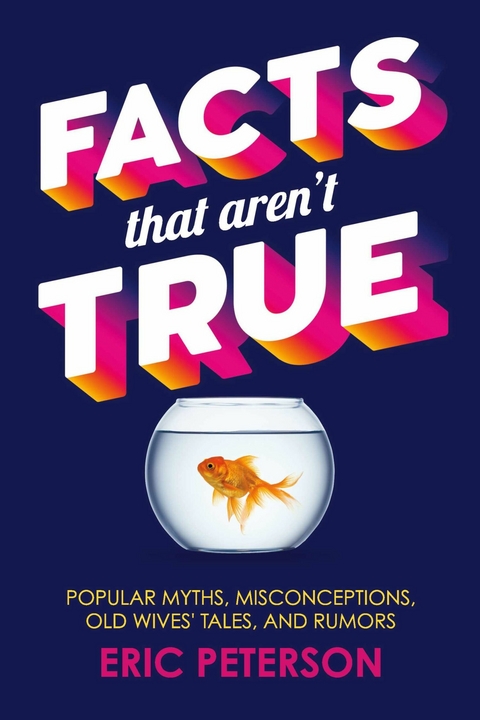
Facts That Aren't True (eBook)
276 Seiten
Bookbaby (Verlag)
979-8-3509-8901-4 (ISBN)
Eric Peterson is a high school science teacher from California. He is also a popular online science communicator and debater. Eric's passion for education and commitment to spreading the truth has inspired him to tackle misinformation. His first book, Rational Answers to Stupid Questions, is a collection of rebuttals to the most common arguments against mainstream science. In his most recent book, Facts That Aren't True, Eric takes aim at false claims that permeate all aspects of life.
Welcome to "e;Facts That Aren't True,"e; a mind-expanding journey into the world of misinformation, urban legends, and half-truths that have been passed down from generation to generation. From ancient superstitions to modern media myths, this book pulls back the curtain on the lies we've all accepted as fact. But this isn't just a collection of busted myths - it's a masterclass in critical thinking, logic, and the power of evidence-based knowledge. Every section tackles a different set of "e;facts"e; lurking in your life's background. Some of these ideas are so ingrained in popular culture that it feels wrong to challenge them. Do toads really give you warts? Nope. Does sugar make kids hyper? Sorry, parents that one's false too. Are there really "e;taste zones"e; on your tongue? Not at all. Each claim is investigated, debunked, and explained with clarity, humor, and a dash of healthy skepticism. With each story, the author dives deep into the origins of the myth, tracing its history and cultural impact. This book reveals the surprising journeys these "e;facts"e; have taken from hearsay to household wisdom. The internet has only made it easier for false information to spread. But with this book as your guide, you'll learn how to spot bad logic, recognize cognitive biases, and think critically about the world around you. Each part isn't just an entertaining takedown of common myths it's also a lesson in how to question everything you see and hear. What makes a claim believable? Why do people cling to misinformation even when it's been debunked? How can you protect yourself from being misled in the future?The author, a seasoned educator and science communicator, breaks down each misconception with humor and simplicity. Drawing on years of teaching and creating educational content, they make every story fun, accessible, and downright unforgettable. The author doesn't just debunk the myths he makes the process fun. With quick wit and vivid storytelling, the book takes you on a wild ride of discovery. You'll be entertained, educated, and more than a little surprised. Whether you're a trivia lover, a science enthusiast, or just someone who enjoys knowing more than the people around you, this book is your next favorite read.
The Human Body
We only use ten percent of our brain.
Sometimes, a claim has a convoluted history. Perhaps a book that references a quote, that itself references a study from a different book, written in a different language and then mistranslated, leads us to the original claim that, like in the game of telephone, becomes distorted or changes completely. However, the myth about using only ten percent of the brain doesn’t appear to have a singular origin. No book or paper made the claim until it had already become a viral factoid. So why did people start saying it to begin with?
There seems to be a loose association with William James (1842-1910), an American psychologist who wrote, “We are making use of only a small part of our possible mental and physical resources.” It’s common for people to hear something vague and spread their version of what it means. This is no different than how a high school rumor begins.
Arguably, those who perpetuate the myth about only using ten percent of the brain the most are psychic gurus and charla- tans trying to make money. Many of them pitch their sale by telling you we only consciously use ten percent of our brain, but they know how to unlock the rest of that untapped potential.
Therein lies one of the major problems with this claim–its vagueness. Does it mean ninety percent of our brain is useless? Does it mean you can only access ten percent of the brain at a time? Does it mean only ten percent of the brain is active at any time? Despite the lack of clarity, these more specific claims are disprovable.
Do we only use ten percent of the tissue in our brain? Obviously not. Using fMRI techniques, scientists have seen that no part of the brain is ever inactive. An fMRI is tuned to detect minute changes in blood flow in the brain. Imaging shows that rather than a constant stream of blood, oxygen, and nutrients, different parts of the brain increase their consumption when regions associated with certain activities are stimulated. Simple tasks such as breathing don’t stimulate the entire brain, but most of our conscious deliberate actions do.
Although the brain makes up around three percent of our body’s mass, it consumes a whopping twenty percent of our daily calories. This is true even when we are asleep. Studies on patients with brain damage further reveal that damage to various parts of the brain results in wildly different effects. If we only use ten percent of the brain, damage to the other ninety percent should have little or no effect, but there are always significant effects.
Remarkably, you can get by with not much brain. I remember watching Ripley’s Believe It or Not as a child and learning about Mike, the chicken who lived without a head. The story goes that the Olson family, who were farmers, took the chicken out to behead him for dinner. It’s common for a chicken to flail around for a bit after being decapitated, but Mike did more than that. Mike lived for 18 months and traveled the country with the Olsons as a side-show attraction. Mike survived because his brain stem was saved from being detached from the rest of his body. The brain stem contains our life-support network and regulates breathing, digestion, heart rate, and more. Because Mike had no head, he had to be manually fed, hydrated, and maintained. Mike could breathe but not swallow. Mike eventually died due to mucus buildup in his airway that could not be removed in time, essentially drowning.
There have been human cases that almost defy explanation. A woman in China had her head scanned only to reveal that she did not have a cerebellum. The cerebellum’s primary role is in motor control. You would think a person without a cerebellum would have no motor control, but this woman displayed no symptoms. In 2007, a French man appeared to be missing 90% of his brain. Scans revealed a skull filled almost entirely with fluid and a minuscule shell of a brain around the edges. The man did have a below-average IQ but was otherwise a high-functioning adult and father. More recent studies suggest that what happened is that fluid in his skull slowly accumulated, squashing his brain against the inner skull. The brain is remarkably soft with a consistency like Jello after you’ve swished it between your teeth (we’ve all done it). This man probably has the same number of neurons as a typical adult, so he’s not really missing anything.
In some extreme cases of epilepsy, an entire hemisphere of the brain is purposely removed. Despite having half a brain, people who have undergone a hemispherectomy also live normal lives. This is due to what people who study the brain refer to as its plasticity–the ability to change and adapt. Different brain regions can compensate for damaged or missing regions. While this may seem to support the idea that we only use ten percent of the brain, I think it shows a high degree of interconnectedness in the brain. If some functions in the brain were entirely localized to certain regions, you could never regain their function if those regions were lost or damaged.
The most famous brain-damaged person who ever lived is probably Phineas Gage (1823–1860). Despite how well-known his story is, so much of what you hear about him is false. Gage was a construction foreman working for a railroad. While trying to stuff a hole in the ground with gunpowder using a metal rod, Gage inadvertently created a spark that ignited the gunpowder. This launched the meter-long rod through his skull. The story goes that, having much of his frontal lobe destroyed, Gage permanently lost all inhibitions and acted more animal than man. While there are some documented cases of Gage’s behavior changing following his accident, none of the more damning claims have been corroborated. They almost all appear to be hearsay.
Gage left his native New England and moved to Chile in 1852 following a gold rush. Gage could never have managed such a life change if what we’re told about him was true. Gage lived for nearly twelve years after his accident. He died in 1860 after suffering several violent seizures in one night, almost certainly connected to his accident.
What about the claim that we can only access ten percent of our brain’s abilities at any time? I don’t know where the ten percent comes from because I cannot fathom how anybody would quantify it. What does it even mean? Am I consciously aware of only ten percent of what my brain does? Can we only retrieve ten percent of our brain’s stored information? Some people have a condition called hyperthymesia. They can recall (with extraordinary detail) almost everything that’s ever happened in their lives. Presumably, we all have this same information in our brains, but we cannot access it to the degree they can. But if this is what people mean when they say we only use ten percent of the brain, then it’s obvious that the typical person doesn’t use anywhere close to one percent let alone ten.
In the end, while not all of the brain may be active to the same degree at any moment, it’s clear that we use the entire brain throughout the day. Activities in the brain don’t solely take place in a small region, while ninety percent of it goes unused. Instead, neuroscience supports the idea that almost all mental tasks involve more than ten percent of the brain.
Sources
- We only use 10% of our brains. Centre for Educational Neuroscience. University College London.
- William James. The Energies of Men. Classics in the History of Psychology. York University, Toronto.
- David Mikkelson. Do We Only Use 10% of Our Brains? Snopes.
- Kendra Cherry. How Much of Our Brain Do We Use? Very Well Mind.
- Danielle Pacheco & Anis Rehman. How Your Body Uses Calories While You Sleep. Sleep Foundation.
- Mike the Headless Chicken. www.miketheheadlesschicken.org
- Josh Hrala. This Woman Lived 24 Years Without Knowing She Was Missing Her Entire Cerebellum. Science Alert.
- Fiona Macdonald. Meet the Man Who Lives Normally With Damage to 90% of His Brain. Science Alert.
- Annelisa Leinbach. You can live just fine with half a brain. Big Think.
- Sam Kean. Everything You Know About Phineas Gage is Wrong. Science History Institute.
- Louise Morales-Brown. Hyperthymesia: What is it? Medical News Today.
The right brain is creative, and the left
brain is analytical.
Pop psychology and self-help literature have perpetuated a compelling but oversimplified narrative of the brain being divided into two distinct halves, with the right hemisphere being the seat of creativity, emotion, and intuition, while the left hemisphere is responsible for logic, analysis, and language. This untrue fact has entered educational systems (I audibly roll my eyes when it’s brought up at staff meetings), corporate training, and everyday conversations. Modern neuroscience tells a different story that reveals a more intricate and interconnected brain. Much of the oversimplification of the right/left brain myth overlaps with the myth that we only use ten percent of our brains.
The roots of the right brain vs. left brain myth can be traced back to the mid-20th century, particularly to the groundbreaking work of Roger W. Sperry. Sperry was a neuropsychologist and Nobel laureate who conducted experiments on patients who had undergone a corpus callosotomy—a surgical procedure severing the...
| Erscheint lt. Verlag | 25.3.2025 |
|---|---|
| Sprache | englisch |
| Themenwelt | Kinder- / Jugendbuch |
| ISBN-13 | 979-8-3509-8901-4 / 9798350989014 |
| Informationen gemäß Produktsicherheitsverordnung (GPSR) | |
| Haben Sie eine Frage zum Produkt? |
 EPUB (Ohne DRM)
Größe: 2,9 MB
Digital Rights Management: ohne DRM
Dieses eBook enthält kein DRM oder Kopierschutz. Eine Weitergabe an Dritte ist jedoch rechtlich nicht zulässig, weil Sie beim Kauf nur die Rechte an der persönlichen Nutzung erwerben.
Dateiformat: EPUB (Electronic Publication)
EPUB ist ein offener Standard für eBooks und eignet sich besonders zur Darstellung von Belletristik und Sachbüchern. Der Fließtext wird dynamisch an die Display- und Schriftgröße angepasst. Auch für mobile Lesegeräte ist EPUB daher gut geeignet.
Systemvoraussetzungen:
PC/Mac: Mit einem PC oder Mac können Sie dieses eBook lesen. Sie benötigen dafür die kostenlose Software Adobe Digital Editions.
eReader: Dieses eBook kann mit (fast) allen eBook-Readern gelesen werden. Mit dem amazon-Kindle ist es aber nicht kompatibel.
Smartphone/Tablet: Egal ob Apple oder Android, dieses eBook können Sie lesen. Sie benötigen dafür eine kostenlose App.
Geräteliste und zusätzliche Hinweise
Buying eBooks from abroad
For tax law reasons we can sell eBooks just within Germany and Switzerland. Regrettably we cannot fulfill eBook-orders from other countries.
aus dem Bereich