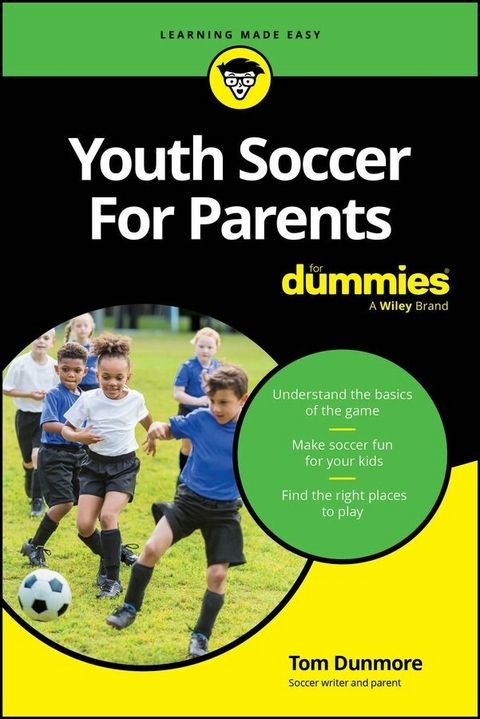
Youth Soccer For Parents For Dummies (eBook)
338 Seiten
For Dummies (Verlag)
978-1-394-29384-1 (ISBN)
Understand the sport of soccer and encourage your kids to have fun
Youth Soccer For Parents For Dummies explains how you can prepare your children to play and enjoy the sport of soccer, whether they play recreationally or at the elite youth level. Get up to speed on the basic rules, and learn to keep kids interested and motivated in a sport that's great for their physical and mental health. This ultimate parents' guide covers the rules, player positions, and strategies, including what gear your kids need to start playing. You'll learn coaching and refereeing basics, too, so you'll be ready to get involved. Plus, this book has tips on deciding which program and level makes sense for your child, evaluating travel soccer programs and specialized training camps, dealing with coaches (good and bad), and supporting your kid from the sidelines.
- Discover the basics of soccer and learn how to get kids started at any age
- Learn basic soccer drills to help your kids practice on their own
- Keep your kids motivated, even when they're injured or disappointed
- Help kids prevent injuries and participate in coaching and team management
- Navigate the competitive landscape of soccer at the teen level
Parents with children of all ages will find tips, advice, support, and encouragement in Youth Soccer For Parents For Dummies. Part soccer book, part parenting book, this guide can help you get your kids started and support them all the way through college.
Tom Dunmore is the author of Historical Dictionary of Soccer and Soccer For Dummies. He grew up playing soccer in England and is now a parent dealing daily with the commitments of kids playing youth soccer. Tom has a coaching license and has worked extensively in American soccer.
Chapter 1
Getting into the World’s Most Popular Sport
IN THIS CHAPTER
Seeing how soccer benefits your child
Taking a closer look at “the world’s game”
Getting the fundamentals of soccer down pat
Looking at the key rules
Soccer, the world’s game. It’s called that for a reason: No sport attracts more participants and followers across the globe. The soccer World Cup is watched by billions of people every four years, and superstars like Lionel Messi or Cristiano Ronaldo rival any celebrity in the world for their number of fans. (Ronaldo is the most followed human being in the world on Instagram, with 640 million followers!)
Why is soccer so popular? Well, for a start, it is very easy to play. It’s also been called the simplest game because if you have a ball — or really, any spherical object — you basically have all the equipment you need to get out there and play. Throw down a couple of objects to craft a makeshift goal to score in, find a few friends, and you (and your child) can be playing on a field, street, or beach anywhere in the world right away.
This utter simplicity is what will make it easy for your kid to pick up the game of soccer as well. While America woke up later to the “world’s game” than most countries, every town or city in America these days has a soccer team or league that your child can take part in (and in many cities, a bewildering number of options this book will help you parse through). You can also get your kids started yourself in the back yard or at a local park by just kicking around a ball for fun.
Adding Up the Benefits of Youth Soccer
So, why should your kid join the millions of soccer participants in the United States? Because it can provide a lifetime of fun and fitness, and a fantastic opportunity to follow and play a game so popular around the world.
Having fun and making friends
There is one cardinal rule to remember when your kid starts playing soccer: They are doing it primarily to have fun and burn off some of that excess energy almost every kid has. Don’t worry about your kid being the next Cristiano Ronaldo. Very, very few of the millions of youth soccer participants will go on to become professional soccer players.
The score doesn’t really matter in youth soccer games. Some parents put far too much pressure on their kids to excel and win games — instead of allowing them to develop a pure love of the game. Far too often, this leads to teenagers who grew up enjoying the sport burning out under the pressure and spoiling that passion.
Soccer is ultimately all about the joy of the game. Making a good pass, saving a goal, scoring a “screamer” (a brilliant goal) — these are the moments that make kids light up with smiles. Because the ball is always moving in soccer, boredom rarely creeps in — and unlike with individual sports, that joy is shared immediately with others on their team.
In fact, soccer is a sport particularly dependent on teamwork to be successful, so it’s a great way for children to learn the value of working together toward a common goal (pun intended!).
Perhaps even more importantly, playing on a team provides an instant opportunity to make a whole bunch of new friends. Your kid will be playing with a dozen plus other children at practices and at games, as well as likely soon spending time with them outside of soccer. Lifelong friendships are made on the soccer field.
Developing fitness and physical skills
Soccer is a great way for your kid to keep fit — and is definitely more fun than calisthenics. Running is integral to soccer in training and at games, developing stamina and burning off some of that childhood energy.
Coordination, endurance, and agility are three further key physical components of the game that your child can develop while playing the sport. The fun of soccer — chasing the ball in all sorts of directions — helps develop strong physical motor skills such as balance and acceleration without your kid even realizing it. Exercise that your kid finds fun and wants to do is certainly the best kind!
Over the long run, playing soccer frequently develops important physical skills including
- Coordination: As with playing any ball game, soccer helps develop coordination between the eyes and body movements, responding to the moving object — the ball. Even though soccer players (except the goalkeeper) do not use their hands, the coordination required to “see ball, kick ball” helps develop skills that can transfer to other athletic activities or even playing an instrument.
- Balance: Soccer is a sport particularly reliant on body control, because almost every movement in the sport requires getting into a balanced position. Players are constantly turning, changing direction, and reacting to rapid movements of the ball — being able to pivot quickly and position the body to kick the ball effectively requires plenty of agility. Soccer players’ balance has been compared to that of gymnasts.
- Speed and acceleration: Soccer is one of the least stationary sports — compare it to baseball or (American) football — so your kid will be running a lot. And not just running a lot: Sprinting quickly after the ball and accelerating as fast as possible over short distances are critical parts of the sport. Playing soccer frequently will develop sprinting muscles and quickness.
- Strength: Soccer isn’t a sport in which lifting weights is necessarily a plus. But playing it will develop muscle and bone strength, lower body fat, and provide a great workout. This is particularly true for lower body muscles, such as hamstrings and quadriceps, and this can translate into improved athletic strength for other sports and everyday life.
- Stamina: Few ball sports require as much running as soccer, with repeated short and long runs taking place in practices and games. Players are on their feet moving for prolonged periods of time. This helps develop endurance and is fantastic aerobic exercise!
Fortunately, while playing plenty of soccer helps develop all these physical attributes, this isn’t a sport that only those supremely physically fit or those blessed with unusual size or strength can enjoy.
A variety of body types and sizes can participate at recreational levels and excel at the elite level. Unlike for basketball, for example, height is not necessarily an advantage in soccer. Some of the best players in the sport’s history, like Lionel Messi (5'7") and Diego Maradona (5'5"), are below the height of an average male. Guile, skill, and a low center of gravity can beat pure size and strength.
Different positions on the field suit different body sizes and shapes. Defenders playing in the center, where leaping and heading the ball may be called for, are often taller players, while a shorter but speedier player may be better suited for sprinting up and down the sideline.
What this means for your child is that their genetic inheritance for height won’t limit how they enjoy and progress in soccer. It’s a sport for everyone to participate in at all levels of the game.
Discovering the world’s game
Playing soccer will naturally develop an interest in the wider world of the professional game for any child playing. Kids often want to know who the big stars are, watch and emulate the skills they showcase, and perhaps start following a team as a fan.
This opens a global-sized chance to develop fandom. Soccer has a rich history and an incredible tapestry of teams playing all over the world to discover. It can be a great way for your child to find out a little about global geography — from Madrid to Manchester and beyond. Soccer players come from all countries and continents, representing areas that are less commonly seen in other American sports.
Following star players is also a great way for your kid to be inspired and look to copy some of the moves and styles of play practiced by the world’s top players.
Fortunately, it’s now easy in the United States for kids to watch the stars and the action from the world of soccer. Some of the biggest competitions to follow include the FIFA World Cup and FIFA Women’s World Cup, both held every four years, along with the top European competitions such as the UEFA Champions League, UEFA Women’s Champions League, the English Premier League, and Spain’s La Liga, along with the American domestic leagues.
A lifetime of fun fandom can follow for your kid as they explore the world of soccer, which will further encourage them to play and find out more about tactics and styles of play, informing their own efforts on the field.
Understanding How the Game Is Played
Soccer games are played by two teams on a rectangular field with a goal at each end. The objective for each team is to score goals (points) by getting the ball into the opponent’s goal.
Each game is played for an allotted length of time, and the team with the most goals at the end of that time period is the winner. If the teams score the same number of goals in a game, it’s considered a tie — or in soccer parlance, a draw.
Players in soccer primarily use their feet to strike the ball, with only the goalkeeper permitted to use their...
| Erscheint lt. Verlag | 31.1.2025 |
|---|---|
| Sprache | englisch |
| Themenwelt | Kinder- / Jugendbuch ► Bilderbücher |
| Kinder- / Jugendbuch ► Sachbücher | |
| Schlagworte | kids soccer • referee for dummies • Soccer • Soccer Coach • soccer coaching book • soccer dad • Soccer Drills • soccer mom • soccer parent • soccer parenting • soccer player training • soccer practice • soccer referee • Sports Parenting • team sport • youth soccer |
| ISBN-10 | 1-394-29384-4 / 1394293844 |
| ISBN-13 | 978-1-394-29384-1 / 9781394293841 |
| Informationen gemäß Produktsicherheitsverordnung (GPSR) | |
| Haben Sie eine Frage zum Produkt? |
 EPUB (Adobe DRM)
Kopierschutz: Adobe-DRM
Adobe-DRM ist ein Kopierschutz, der das eBook vor Mißbrauch schützen soll. Dabei wird das eBook bereits beim Download auf Ihre persönliche Adobe-ID autorisiert. Lesen können Sie das eBook dann nur auf den Geräten, welche ebenfalls auf Ihre Adobe-ID registriert sind.
Details zum Adobe-DRM
Dateiformat: EPUB (Electronic Publication)
EPUB ist ein offener Standard für eBooks und eignet sich besonders zur Darstellung von Belletristik und Sachbüchern. Der Fließtext wird dynamisch an die Display- und Schriftgröße angepasst. Auch für mobile Lesegeräte ist EPUB daher gut geeignet.
Systemvoraussetzungen:
PC/Mac: Mit einem PC oder Mac können Sie dieses eBook lesen. Sie benötigen eine
eReader: Dieses eBook kann mit (fast) allen eBook-Readern gelesen werden. Mit dem amazon-Kindle ist es aber nicht kompatibel.
Smartphone/Tablet: Egal ob Apple oder Android, dieses eBook können Sie lesen. Sie benötigen eine
Geräteliste und zusätzliche Hinweise
Buying eBooks from abroad
For tax law reasons we can sell eBooks just within Germany and Switzerland. Regrettably we cannot fulfill eBook-orders from other countries.
aus dem Bereich