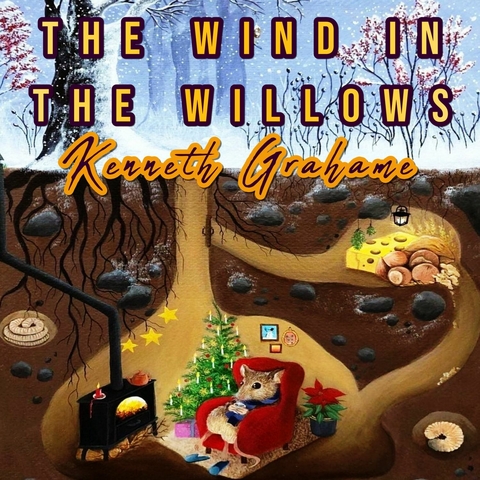
The Wind In the Willows (eBook)
200 Seiten
Seven Books (Verlag)
978-3-68995-697-4 (ISBN)
Kenneth Grahame (/1859 1932) was a British writer. He is best remembered for the classic of children's literature The Wind in the Willows (1908). Scottish by birth, he spent most of his childhood with his grandmother in England, following the death of his mother and his father's inability to look after the children. After attending St Edward's School in Oxford, his ambition to attend university was thwarted and he joined the Bank of England, where he had a successful career. Before writing The Wind in the Willows, he published three other books: Pagan Papers (1893), The Golden Age (1895), and Dream Days (1898).
Kenneth Grahame (/1859 1932) was a British writer. He is best remembered for the classic of children's literature The Wind in the Willows (1908). Scottish by birth, he spent most of his childhood with his grandmother in England, following the death of his mother and his father's inability to look after the children. After attending St Edward's School in Oxford, his ambition to attend university was thwarted and he joined the Bank of England, where he had a successful career. Before writing The Wind in the Willows, he published three other books: Pagan Papers (1893), The Golden Age (1895), and Dream Days (1898).
II. The Open Road
'Ratty,' said the Mole suddenly, one bright summer morning, 'if you please, I want to ask you a favour.'
The Rat was sitting on the river bank, singing a little song. He had just composed it himself, so he was very taken up with it, and would not pay proper attention to Mole or anything else. Since early morning he had been swimming in the river, in company with his friends the ducks. And when the ducks stood on their heads suddenly, as ducks will, he would dive down and tickle their necks, just under where their chins would be if ducks had chins, till they were forced to come to the surface again in a hurry, spluttering and angry and shaking their feathers at him, for it is impossible to say quite ALL you feel when your head is under water. At last they implored him to go away and attend to his own affairs and leave them to mind theirs. So the Rat went away, and sat on the river bank in the sun, and made up a song about them, which he called
'DUCKS' DITTY.'
All along the backwater,
Through the rushes tall,
Ducks are a-dabbling,
Up tails all!
Ducks' tails, drakes' tails,
Yellow feet a-quiver,
Yellow bills all out of sight
Busy in the river!
Slushy green undergrowth
Where the roach swim—
Here we keep our larder,
Cool and full and dim.
Everyone for what he likes!
We like to be
Heads down, tails up,
Dabbling free!
High in the blue above
Swifts whirl and call—
We are down a-dabbling
Uptails all!
'I don't know that I think so VERY much of that little song, Rat,' observed the Mole cautiously. He was no poet himself and didn't care who knew it; and he had a candid nature.
'Nor don't the ducks neither,' replied the Rat cheerfully. 'They say, "WHY can't fellows be allowed to do what they like WHEN they like and AS they like, instead of other fellows sitting on banks and watching them all the time and making remarks and poetry and things about them? What NONSENSE it all is!" That's what the ducks say.'
'So it is, so it is,' said the Mole, with great heartiness.
'No, it isn't!' cried the Rat indignantly.
'Well then, it isn't, it isn't,' replied the Mole soothingly. 'But what I wanted to ask you was, won't you take me to call on Mr. Toad? I've heard so much about him, and I do so want to make his acquaintance.'
'Why, certainly,' said the good-natured Rat, jumping to his feet and dismissing poetry from his mind for the day. 'Get the boat out, and we'll paddle up there at once. It's never the wrong time to call on Toad. Early or late he's always the same fellow. Always good-tempered, always glad to see you, always sorry when you go!'
'He must be a very nice animal,' observed the Mole, as he got into the boat and took the sculls, while the Rat settled himself comfortably in the stern.
'He is indeed the best of animals,' replied Rat. 'So simple, so good-natured, and so affectionate. Perhaps he's not very clever—we can't all be geniuses; and it may be that he is both boastful and conceited. But he has got some great qualities, has Toady.'
Rounding a bend in the river, they came in sight of a handsome, dignified old house of mellowed red brick, with well-kept lawns reaching down to the water's edge.
'There's Toad Hall,' said the Rat; 'and that creek on the left, where the notice-board says, "Private. No landing allowed," leads to his boat-house, where we'll leave the boat. The stables are over there to the right. That's the banqueting-hall you're looking at now—very old, that is. Toad is rather rich, you know, and this is really one of the nicest houses in these parts, though we never admit as much to Toad.'
They glided up the creek, and the Mole shipped his sculls as they passed into the shadow of a large boat-house. Here they saw many handsome boats, slung from the cross beams or hauled up on a slip, but none in the water; and the place had an unused and a deserted air.
The Rat looked around him. 'I understand,' said he. 'Boating is played out. He's tired of it, and done with it. I wonder what new fad he has taken up now? Come along and let's look him up. We shall hear all about it quite soon enough.'
They disembarked, and strolled across the gay flower-decked lawns in search of Toad, whom they presently happened upon resting in a wicker garden-chair, with a pre-occupied expression of face, and a large map spread out on his knees.
'Hooray!' he cried, jumping up on seeing them, 'this is splendid!' He shook the paws of both of them warmly, never waiting for an introduction to the Mole. 'How KIND of you!' he went on, dancing round them. 'I was just going to send a boat down the river for you, Ratty, with strict orders that you were to be fetched up here at once, whatever you were doing. I want you badly—both of you. Now what will you take? Come inside and have something! You don't know how lucky it is, your turning up just now!'
'Let's sit quiet a bit, Toady!' said the Rat, throwing himself into an easy chair, while the Mole took another by the side of him and made some civil remark about Toad's 'delightful residence.'
'Finest house on the whole river,' cried Toad boisterously. 'Or anywhere else, for that matter,' he could not help adding.
Here the Rat nudged the Mole. Unfortunately the Toad saw him do it, and turned very red. There was a moment's painful silence. Then Toad burst out laughing. 'All right, Ratty,' he said. 'It's only my way, you know. And it's not such a very bad house, is it? You know you rather like it yourself. Now, look here. Let's be sensible. You are the very animals I wanted. You've got to help me. It's most important!'
'It's about your rowing, I suppose,' said the Rat, with an innocent air. 'You're getting on fairly well, though you splash a good bit still. With a great deal of patience, and any quantity of coaching, you may——'
'O, pooh! boating!' interrupted the Toad, in great disgust. Silly boyish amusement. I've given that up LONG ago. Sheer waste of time, that's what it is. It makes me downright sorry to see you fellows, who ought to know better, spending all your energies in that aimless manner. No, I've discovered the real thing, the only genuine occupation for a life time. I propose to devote the remainder of mine to it, and can only regret the wasted years that lie behind me, squandered in trivialities. Come with me, dear Ratty, and your amiable friend also, if he will be so very good, just as far as the stable-yard, and you shall see what you shall see!'
He led the way to the stable-yard accordingly, the Rat following with a most mistrustful expression; and there, drawn out of the coach house into the open, they saw a gipsy caravan, shining with newness, painted a canary-yellow picked out with green, and red wheels.
'There you are!' cried the Toad, straddling and expanding himself. 'There's real life for you, embodied in that little cart. The open road, the dusty highway, the heath, the common, the hedgerows, the rolling downs! Camps, villages, towns, cities! Here to-day, up and off to somewhere else to-morrow! Travel, change, interest, excitement! The whole world before you, and a horizon that's always changing! And mind! this is the very finest cart of its sort that was ever built, without any exception. Come inside and look at the arrangements. Planned 'em all myself, I did!'
The Mole was tremendously interested and excited, and followed him eagerly up the steps and into the interior of the caravan. The Rat only snorted and thrust his hands deep into his pockets, remaining where he was.
It was indeed very compact and comfortable. Little sleeping bunks—a little table that folded up against the wall—a cooking-stove, lockers, bookshelves, a bird-cage with a bird in it; and pots, pans, jugs and kettles of every size and variety.
'All complete!' said the Toad triumphantly, pulling open a locker. 'You see—biscuits, potted lobster, sardines—everything you can possibly want. Soda-water here—baccy there—letter-paper, bacon, jam, cards and dominoes—you'll find,' he continued, as they descended the steps again, 'you'll find that nothing what ever has been forgotten, when we make our start this afternoon.'
'I beg your pardon,' said the Rat slowly, as he chewed a straw, 'but did I overhear you say something about "WE," and "START," and "THIS AFTERNOON?"'
'Now, you dear good old Ratty,' said Toad, imploringly, 'don't begin talking in that stiff and sniffy sort of way, because you know you've GOT to come. I can't possibly manage without you, so please...
| Erscheint lt. Verlag | 30.1.2025 |
|---|---|
| Verlagsort | Vachendorf |
| Sprache | englisch |
| Themenwelt | Kinder- / Jugendbuch ► Kinderbücher bis 11 Jahre |
| Schlagworte | children classics • Fiction • In the Willows • Kenneth Grahame • the wind • The Wind in the Willows |
| ISBN-10 | 3-68995-697-8 / 3689956978 |
| ISBN-13 | 978-3-68995-697-4 / 9783689956974 |
| Informationen gemäß Produktsicherheitsverordnung (GPSR) | |
| Haben Sie eine Frage zum Produkt? |
 EPUB (Wasserzeichen)
DRM: Digitales Wasserzeichen
Dieses eBook enthält ein digitales Wasserzeichen und ist damit für Sie personalisiert. Bei einer missbräuchlichen Weitergabe des eBooks an Dritte ist eine Rückverfolgung an die Quelle möglich.
Dateiformat: EPUB (Electronic Publication)
EPUB ist ein offener Standard für eBooks und eignet sich besonders zur Darstellung von Belletristik und Sachbüchern. Der Fließtext wird dynamisch an die Display- und Schriftgröße angepasst. Auch für mobile Lesegeräte ist EPUB daher gut geeignet.
Systemvoraussetzungen:
PC/Mac: Mit einem PC oder Mac können Sie dieses eBook lesen. Sie benötigen dafür die kostenlose Software Adobe Digital Editions.
eReader: Dieses eBook kann mit (fast) allen eBook-Readern gelesen werden. Mit dem amazon-Kindle ist es aber nicht kompatibel.
Smartphone/Tablet: Egal ob Apple oder Android, dieses eBook können Sie lesen. Sie benötigen dafür eine kostenlose App.
Geräteliste und zusätzliche Hinweise
Buying eBooks from abroad
For tax law reasons we can sell eBooks just within Germany and Switzerland. Regrettably we cannot fulfill eBook-orders from other countries.
aus dem Bereich