Teens' Guide To Making Friends (eBook)
172 Seiten
Distributed via Smashwords (Verlag)
978-1-7384145-1-2 (ISBN)
Does it ever feel impossible to strike up a conversation with other people?
Perhaps you get frustrated watching classmates converse with each other, striking up new friendships in the blink of an eye.
Maybe you have tried to make friends in the past, but whenever the conversation goes flat or becomes awkward, you find it too stressful and difficult to rectify the situation, and you leave conversations feeling deflated and unmotivated.
Don't worry. Your days of social anxiety are over!
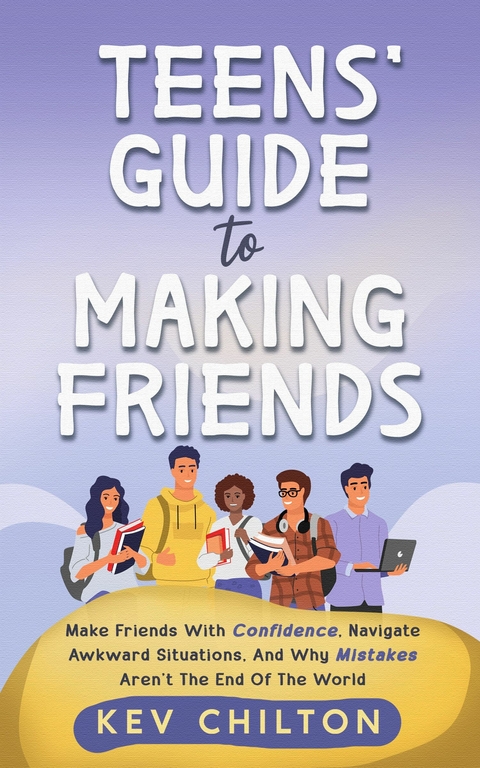
Teen's Guide to Making Friends will teach you ways to talk to others with confidence, work your way through complex social situations, and understand that mistakes aren't the end of the world.
From reading this book, you will feel much more socially confident, and will have all the tools you need to create engaging conversations and develop new friendships.
Social situations can be incredibly stressful for anyone, but that doesn't mean you can't change that!
With the right tools and information at your disposal, you will become much more confident at any social gathering, and with people that you want to become closer friends with.
Inside Teen's Guide to Making Friends, discover:
● how to overcome your insecurities and utilize self-care
● why parents and adults find it difficult to understand your issues-and how to address this
● why we all struggle to make friends sometimes
● how to become the best version of yourself
● ways to step out of your comfort zone and make it feel like second nature
Get your hands on Teen's Guide to Making Friends today!
Does it ever feel impossible to strike up a conversation with other people?Perhaps you get frustrated watching classmates converse with each other, striking up new friendships in the blink of an eye.Maybe you have tried to make friends in the past, but whenever the conversation goes flat or becomes awkward, you find it too stressful and difficult to rectify the situation, and you leave conversations feeling deflated and unmotivated.Don't worry. Your days of social anxiety are over!Teen's Guide to Making Friends will teach you ways to talk to others with confidence, work your way through complex social situations, and understand that mistakes aren't the end of the world.From reading this book, you will feel much more socially confident, and will have all the tools you need to create engaging conversations and develop new friendships.Social situations can be incredibly stressful for anyone, but that doesn't mean you can't change that!With the right tools and information at your disposal, you will become much more confident at any social gathering, and with people that you want to become closer friends with.Inside Teen's Guide to Making Friends, discover:? how to overcome your insecurities and utilize self-care? why parents and adults find it difficult to understand your issues and how to address this? why we all struggle to make friends sometimes? how to become the best version of yourself? ways to step out of your comfort zone and make it feel like second natureGet your hands on Teen's Guide to Making Friends today!
It’s Official: Adolescence Sucks!
Adolescence is just one big walking pimple. –Carol Burnett
Being a teenager is supposed to encompass some of the best years of your life, at least according to the adults who know what’s on the other side. Okay, so you’re still at school, and now you’ve got the added pressure of exams to navigate, but you’re also handed extra independence and the freedom to take more control over your own life and your own decisions. Your responsible adults might get involved more than you want, but there’s a definite shift in expectations from both parties.
As a kid, this is probably something you were looking forward to. Growing up sounds exciting and there are loads of things to look forward to. So why is the reality such a disappointment? Luckily, we can sum up the problem in one word: puberty. While you’re busy looking forward to spending more time hanging out with your mates, dipping a tentative toe into the dating pool, and having a curfew with double figures, your hormones seem to be directly plotting against you.
Biology Is a Bitch
You might think you know exactly what happens to your body when you go through adolescence; after all, most school curriculums cover it repeatedly. What they don’t always tell you, though, is what’s going on behind the scenes.
Let the Change Begin!
Everyone starts puberty at a different age. Most people start to feel changes between the ages of 8 and 14. Once your body hits its own personal point-of-no-return, your brain releases an entirely new hormone into your bloodstream. This hormone is called GnRH—scientific name gonadotropin-releasing hormone—and it’s basically chaos personified. (Dowshen, 2015). Once it makes its way to your sexual organs, it causes them to start behaving differently. If you have ovaries, they’ll begin to manufacture estrogen, and if you have testes, they’ll manufacture more testosterone. Both these hormones are responsible for the physical changes you’ll see in your bodies, but they also have a substantial effect on the way that you feel and how you process your emotions.
Growth Spurt or Sprouting Growths?
During puberty your entire body speeds up its growth rate. Some people can grow as much as 4 in taller in a year, but it’s not just your height that is changing. You’ll gain weight as your body starts to develop muscle mass and fat stores. (Dowshen, 2015). This is perfectly normal, but it can make you feel uncomfortable and self-conscious because it’s an obvious change that other people can see. As if growing out of your clothes almost overnight wasn’t enough cause for embarrassment, getting used to your new body dimensions can take a while. Some teenagers find they become clumsier during puberty, because their limbs are slightly different lengths, or they didn’t realize they now have to duck through doorways.
Another change that everyone can see is that you’ll start to grow more body hair. Everyone has a thin covering of hair on their arms and legs, but once those puberty hormones kick in, this hair can become darker and thicker, and it starts to grow from new places, like under your arms and around your groin.
The changing hormone levels also affect your skin. Some people find their skin gets drier; others find it is more oily. Most teenagers suffer from acne at some point during puberty. Acne most often appears on your face, but it can also break out on your back, shoulders, and chest.
Your Brain Is a Saboteur
The effect that increased estrogen and testosterone have on your bodies is nothing compared to how they can mess up your brain. During puberty, your brain is completely rewired as you level up from a child’s brain to an adult’s. Until now, your thoughts have been fairly simple; I’m hungry, I want to play football, that child looks friendly. But once puberty strikes, you start to become more aware of other people and their opinions. You also become more aware of your own looks, actions, and behavior, especially in the context of how other people view you.
Here’s an example:
You wear your comfiest t-shirt and jeans to the cinema to meet some friends. Some other teens from your class are there too, but they are significantly more dressed up. You don’t really know them but give a small wave and a smile to be polite. The group laughs, turns around, and walks off.
So, how do you feel?
In all probability, they didn’t see you and were laughing at something one of them said. But give your brain a big dose of crazy puberty hormones and it goes into overdrive.
Are they laughing at me? Is it my clothes, my hair, my skin, or just because they hate me? I shouldn’t have waved; waving is lame and now they think I’m lame. They’re going to tell everyone at school what a loser I am and the whole school will laugh at me. I can’t go in tomorrow. Maybe I’d better just transfer.
During adolescence, your brain learns to analyze situations, which is basically it playing a giant game of “What if?” Instead of shrugging and moving on, you start imagining an endless stream of scenarios, which can quickly lead to extreme “solutions.” Teenagers have a reputation for overreacting and being dramatic, but you can’t actually help it! It’s all part of growing up and developing a proper adult brain. Eventually your brain works out what is an appropriate amount of analyzing in situations like these and you’ll stop feeling like a crazy person, but until then, you’ll have to put up with watching your friends overthink every situation just as badly as you do.
Even the Good Bits Suck
We’ve already established that adolescence is the time when your body goes haywire and your brain betrays you, so it would make sense to lie low for five or six years until it all blows over, right? Unfortunately, life doesn’t work that way, and many of the changes you’re going through rely on social interactions to fine-tune them.
Imagine you’ve invented a new kind of ice cream. You need people to taste it to see if they like it. The first person says it’s too sweet, so you change the recipe. The next person says it’s too fruity, so you change it again. You repeat the process until eventually everyone says they love it, even if that takes a year. Now, imagine you spend that year developing your ice cream in secret with only you tasting it and then launch it in the world. Will it be as well received?
In case you didn’t work it out, you’re the ice cream. Not that you should spend your teenage years asking people to lick you; you’re a metaphorical ice cream. Every social interaction, every boundary you push, and every new friend you make contributes to the well-rounded adult you will become. Even though everything feels awkward at the time, it’s necessary to make the best version of you.
During your teenage years, you will have many wonderful experiences, and you will remember those far better than the horrible ones, even if it doesn’t seem like it right now. This is the time of your life when you start to forge deeper and more meaningful friendships with people you choose because you’re on the same path, rather than because your parents are friends or you live nearby.
For the first time, you’re capable of forming informed opinions and preferences. These can range from which books you like to which people are worth hanging out with. You also start to make long-term plans, which are more grounded in reality, and you consider where you belong in society. You’ll also have more independence over making your own decisions, and for the first time have to deal with serious consequences of making the wrong ones. Your adolescence is the time to start trying out new activities, new personal styles, and really working out exactly who you are. All while dealing with the clumsiest, spottiest, least confident version of yourself. What could possibly go wrong?
What Can You Do About it?
It’s all very well knowing what is happening to you, but that doesn’t mean you can do much to control it. Those hormones are going to have their way with you, whether you like it or not, but what you do have agency over is how you manage those changes and the unpredictability they bring. Here are a few suggestions for making the road through puberty as smooth as you can.
Self-Care Begins at Home
Dealing with growth spurts and rapid brain development requires your body to consume an enormous amount of energy. If you’ve been feeling sleepy, sluggish, and lacking the get-up-and-go that children seem to have in abundance, this is why.
Many teenagers use the weight gained through puberty as a reason to start dieting, but this is actually giving your body less energy to do what it needs to do. A balanced diet with regular meals and plenty of vegetables—because they’re full of the vitamins you need to support bone and muscle growth—will make sure your energy stores are replenished regularly. You might be craving junk food, but that’s only because extracting calories from sugar is the fastest way for your body to get energy, and once it’s burned through it, you’ll end up feeling flat again.
Another way to combat that sluggish feeling is to make sure you get some regular exercise. Exercise makes you feel better because it releases endorphins in your brain and these lift your mood and slow down the production of stress hormones, including adrenaline and cortisol. Go for a walk, dance to your top playlist, learn a yoga routine, or join a team sport.
Exercise also helps to clear your mind, so if you’ve had an argument or found a situation particularly stressful, this is a...
| Erscheint lt. Verlag | 18.10.2023 |
|---|---|
| Sprache | englisch |
| Themenwelt | Kinder- / Jugendbuch ► Sachbücher ► Körper / Sexualität |
| Geisteswissenschaften ► Psychologie | |
| ISBN-10 | 1-7384145-1-5 / 1738414515 |
| ISBN-13 | 978-1-7384145-1-2 / 9781738414512 |
| Informationen gemäß Produktsicherheitsverordnung (GPSR) | |
| Haben Sie eine Frage zum Produkt? |
 EPUB (Adobe DRM)
Größe: 1,2 MB
Kopierschutz: Adobe-DRM
Adobe-DRM ist ein Kopierschutz, der das eBook vor Mißbrauch schützen soll. Dabei wird das eBook bereits beim Download auf Ihre persönliche Adobe-ID autorisiert. Lesen können Sie das eBook dann nur auf den Geräten, welche ebenfalls auf Ihre Adobe-ID registriert sind.
Details zum Adobe-DRM
Dateiformat: EPUB (Electronic Publication)
EPUB ist ein offener Standard für eBooks und eignet sich besonders zur Darstellung von Belletristik und Sachbüchern. Der Fließtext wird dynamisch an die Display- und Schriftgröße angepasst. Auch für mobile Lesegeräte ist EPUB daher gut geeignet.
Systemvoraussetzungen:
PC/Mac: Mit einem PC oder Mac können Sie dieses eBook lesen. Sie benötigen eine
eReader: Dieses eBook kann mit (fast) allen eBook-Readern gelesen werden. Mit dem amazon-Kindle ist es aber nicht kompatibel.
Smartphone/Tablet: Egal ob Apple oder Android, dieses eBook können Sie lesen. Sie benötigen eine
Geräteliste und zusätzliche Hinweise
Buying eBooks from abroad
For tax law reasons we can sell eBooks just within Germany and Switzerland. Regrettably we cannot fulfill eBook-orders from other countries.
aus dem Bereich