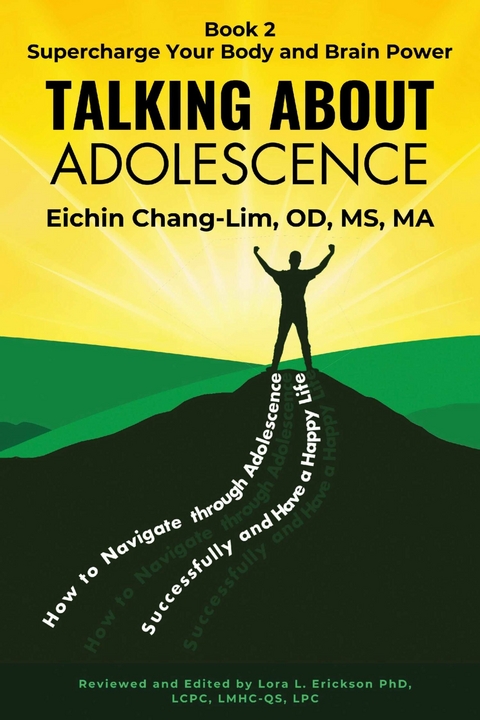
Talking About Adolescence (eBook)
392 Seiten
Bookbaby (Verlag)
9798350959932 (ISBN)
Dr. Lora Erickson is an international psychologist, licensed mental health clinician, and core faculty in the Master of Arts in Psychology program with The Chicago School of Professional Psychology.
Feeling confused? One minute, you're a carefree kid; the next, you're worried about fitting in, and your body's changing faster than ever. Welcome to adolescence! This exciting, often challenging time is all about transformation. "e;Supercharge Your Body and Brain Power"e; is your ultimate guide to navigating this amazing journey. You'll discover: The science behind your changing body: Learn how your body and brain work together to make you smarter, stronger, and more capable. How to manage mood swings: This book will equip you with practical tips to deal with stress, anxiety, and make healthy choices. The secrets to brainpower: Unlock the full potential of your brain and learn how to boost memory, focus, and decision-making skills. How to build resilience: Develop healthy habits and strategies to overcome challenges and setbacks. This engaging, easy-to-read book uses a conversational style and fun "e;PowerPoint"e; format to keep you hooked. Each chapter starts with thought-provoking questions and ends with reflections to solidify your learning. "e;Supercharge Your Body and Brain Power"e; is more than just a book; it's a toolkit for building a solid foundation for your future. You'll graduate from adolescence feeling confident, empowered, and ready to take charge of your health and well-being. This book is also a valuable resource for parents, educators, and anyone who cares about a teen's development. Embark on this exciting journey of self-discovery and unlock your full potential.
Chapter 1
How Does the Journey Begin?
Puberty was rough. But I learned that it’s important to embrace your flaws and imperfections, because they make you who you are.
~ Demi Lovato
Introduction
During adolescence, your understanding of the world is thrown into chaos, thanks to rapid physical, sexual, and emotional changes. Adjusting to all these changes can be exciting, confusing, disheartening, and stressful. On top of all these, you’re expected to keep up with academic demands and adults’ expectations.
No wonder some people regard adolescence as one of the most thrilling, yet challenging, times of life.
The Initiation of Adolescence
Entering puberty is marked as the beginning of adolescence. The American Psychological Association defines puberty as “the stage of development when the genital organs reach maturity, and secondary sex characteristics begin to appear, signaling the start of adolescence.”
You may say, “Hey, wait a minute. I didn’t sign up for this initiation.” I know that! You are right! None of us asked to be born. Getting on the train for this journey is not like joining a club. Your body automatically proceeds to the changes. In fact, your body has undergone the transformation even before you notice it. There are a few things to be noted:
• Physical and sexual maturation occurring during puberty is due to the increase in gonadal hormone. Everyone goes through puberty and begins the journey of adolescence at their own pace and timing.
• You might be tempted to compare your puberty changes with those of your friends. Please be aware that no two people have the exact same experiences during puberty. Please ask your parents, a trusted adult, or school nurse if you have any questions or concerns about your body changes.
• The onset of puberty and the initiation of adolescence depends on several factors, such as genes, gender, nutrition, and environment. After researching and reading, I have found the age of pubertal onset ranges from 8 to 14 years for females and 10 to 16 for males. You may find some variations in different reports.
• Researchers also reported that pubertal onset starts earlier now than in the 1970s. There is no definite explanation for that. However, social scientists are studying the implications that might result from individuals experiencing puberty at an earlier age.1, 2, 3
Stages of Adolescence
As mentioned earlier, adolescence is a journey. You are a unique individual. However, your growth along this journey may be influenced by outside factors, like your family, neighborhood environment, culture, faith, and the media. Based on the collective characteristics of physical, biological, intellectual, behavioral, emotional, and social developments, researchers suggest three phases along this journey: early, middle, and late adolescence/young adulthood.
Early Adolescence (10 to 14 Years)
In this phase, you are somewhere between fifth grade and junior high school.
During this time, you may be asking yourself, “Am I normal?”
• Your body is changing rapidly as puberty begins. You may feel overwhelmed, awkward, self-conscious, and insecure about your appearance.4
• You may become anxious and wonder whether your peers are judging you.
• You want privacy. You don’t want anyone else in your bedroom. If you share a bedroom with your siblings, you don’t want anyone to get near your desk. You guard your phone so that no one can listen to your phone conversations or see your text messages.
• You want a sense of independence and can be annoyed by the adults treating you like a child and constantly asking your whereabouts or nagging about little things when you think it’s absolutely unnecessary.
• You want to hang out with your peers, those you call your close friends, to share your secrets and stories. It’s much more fun with your buddies than with your family!
• You feel it is super important that you fit in with your peer group.
• You may start arguing with your parents more frequently and doubt your parents’ opinions. You might Google whatever your parents say, intending to find faults.
• You may be plain rude to your parents without concern for their feelings, especially when they seem to disagree with you about everything: your music, the TV shows you watch, the amount of time you spend on social media, or how you dress.
• You get moody and act out your emotions more than you intend to. You might feel overly sensitive or become easily agitated.
Middle Adolescence (14 to 17 Years)
Most of you are attending high school at this stage. You may be asking yourself, “Who am I?” and try to discover your strengths and interests during this time.
• The puberty-related changes continue. Some of you may become interested in romantic relationships, exploring sex and sexuality.
• Intellectual thinking becomes important to you.
• You may have difficulty controlling your impulses and handling peer pressure. Because of that, you may make inappropriate or unwise decisions that you might regret later. (We will talk about the reasons and remedies for this in later chapters. Don’t feel awful if you’ve made poor decisions. Think about how to avoid making the same mistake next time, though).
• The tension between you and your parents or immediate adults may intensify because you strive to be independent.
• At this stage, you may be even more self-conscious about your appearance. Concerns about sexual attractiveness and popularity can be an important matter. Some of you may become a loner and sink into constant self-doubt and depression. (We will talk more about this later, so hang in there for now).
• You may alternate between being overly self-confident, with high expectations, and feeling self-doubt with intense insecurity.
• You may have feelings of passion and love for someone special during this time. You might even be fearful of showing them your true feelings. This can consume you and affect your concentration at school and at home. You probably share your secret with your close friends.
• You grow greater awareness in moral reasoning, and intellectual gain becomes important.
• You may advance your ideals, select your role models, and search for spirituality.
• You may begin thinking about your future.
Those who intend to go to college are often stressed with grades. To boost your college application, you may be registering for advanced placement (AP) classes, taking the ACT and SAT, joining extracurricular activities, etc. All of these can generate tremendous pressure on you. Deciding on a major or field of study can be challenging. Working with your high school counselor is essential.
Some of you may join the military and set long-term goals. Additionally, for those who plan to enter the workforce after high school, you may take ROP (Regional Occupational Program) classes and contemplate your future career. You may do part-time jobs and consult with your school counselor for guidance or check out the free online career tests at https://www.truity.com.
Yes, finding what you like to do and your occupational direction can be overwhelming. At this time, you may even feel the burden and worries of becoming financially independent.
• Some may drop out of school due to unforeseen circumstances or engage in risky behaviors.
• Some youth in foster care may face an age-out dilemma and need support. For support and resources on transitioning to independence, learning about opportunities for educational advancement, and participating in job training programs, please check out local Foster Care Transition Programs, the Annie E. Casey Foundation, and the National Foster Youth Institute (NFYI).
https://www.aecf.org/resources/fostering-youth-transitions-2023
Late Adolescence/Young Adulthood
(18 to 25 years or beyond)
You may continue with your academic pursuits or enter the job market at this stage. The lingering questions can remain: “Where am I going?” Or, “Am I heading in the right direction?” Therefore, you focus more on the future based on your hopes and ideals.
• Most of you have fully grown, physically and biologically.
• You may become more comfortable with your body and sexual feelings.
• You gain a stronger sense of your own individuality/identity and establish your values.
• You have better impulse control and judge risks vs. rewards more accurately. You are more stable emotionally and gain the ability to delay gratification.
• Some may have a stable romantic relationship. You gain confidence in tender and sensual love. However, some may put the steady, intimate relationship on the back burner until the completion of graduate/professional school or until their income reaches a certain level.
• You probably move away from your parents but reestablish an adult relationship with them. You might consider your parents’ advice and respect their perspective more.
• You may take more...
| Erscheint lt. Verlag | 29.10.2024 |
|---|---|
| Sprache | englisch |
| Themenwelt | Kinder- / Jugendbuch |
| ISBN-13 | 9798350959932 / 9798350959932 |
| Informationen gemäß Produktsicherheitsverordnung (GPSR) | |
| Haben Sie eine Frage zum Produkt? |
 EPUB (Ohne DRM)
Größe: 6,4 MB
Digital Rights Management: ohne DRM
Dieses eBook enthält kein DRM oder Kopierschutz. Eine Weitergabe an Dritte ist jedoch rechtlich nicht zulässig, weil Sie beim Kauf nur die Rechte an der persönlichen Nutzung erwerben.
Dateiformat: EPUB (Electronic Publication)
EPUB ist ein offener Standard für eBooks und eignet sich besonders zur Darstellung von Belletristik und Sachbüchern. Der Fließtext wird dynamisch an die Display- und Schriftgröße angepasst. Auch für mobile Lesegeräte ist EPUB daher gut geeignet.
Systemvoraussetzungen:
PC/Mac: Mit einem PC oder Mac können Sie dieses eBook lesen. Sie benötigen dafür die kostenlose Software Adobe Digital Editions.
eReader: Dieses eBook kann mit (fast) allen eBook-Readern gelesen werden. Mit dem amazon-Kindle ist es aber nicht kompatibel.
Smartphone/Tablet: Egal ob Apple oder Android, dieses eBook können Sie lesen. Sie benötigen dafür eine kostenlose App.
Geräteliste und zusätzliche Hinweise
Buying eBooks from abroad
For tax law reasons we can sell eBooks just within Germany and Switzerland. Regrettably we cannot fulfill eBook-orders from other countries.
aus dem Bereich