


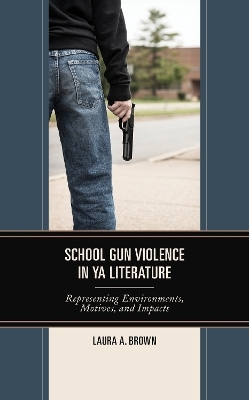
School Gun Violence in YA Literature
Representing Environments, Motives, and Impacts
Seiten
2022
Lexington Books (Verlag)
978-1-7936-2207-5 (ISBN)
Lexington Books (Verlag)
978-1-7936-2207-5 (ISBN)
Using Bronfenbrenner’s Ecological Systems Theory and Peter Langman’s categorical descriptions of school shooters, this book analyzes several Young Adult (YA) texts about school shootings and uncovers how the authors represent such violence and the perpetrators while developing stories that effectively speak to their adolescent readers
Since Columbine, the topic of school shootings has become ever more prevalent in the media, in research, and in fiction. This book provides analyses of several Young Adult (YA) texts about school shootings and uncovers how the authors represent such violence (and those who perpetrate it) while developing stories that effectively speak to their adolescent readers. Employing Bronfenbrenner’s Ecological Systems Theory, Laura A. Brown examines how the texts frame particular settings and events as important to the development of young people as a way of accounting for the shootings. Likewise, psychologist Peter Langman’s classification of the three populations of school shooters is utilized as a framework to analyze the characterization of fictional shooters in the texts. The author argues that these texts, while not easy to read, are important, as they problematize the ways we think about, approach, and react to school shootings and the students who commit such acts.
Since Columbine, the topic of school shootings has become ever more prevalent in the media, in research, and in fiction. This book provides analyses of several Young Adult (YA) texts about school shootings and uncovers how the authors represent such violence (and those who perpetrate it) while developing stories that effectively speak to their adolescent readers. Employing Bronfenbrenner’s Ecological Systems Theory, Laura A. Brown examines how the texts frame particular settings and events as important to the development of young people as a way of accounting for the shootings. Likewise, psychologist Peter Langman’s classification of the three populations of school shooters is utilized as a framework to analyze the characterization of fictional shooters in the texts. The author argues that these texts, while not easy to read, are important, as they problematize the ways we think about, approach, and react to school shootings and the students who commit such acts.
Laura A. Brown is associate professor at the State University of New York, and department chair of secondary education.
Introduction
Chapter 1: Schools
Chapter 2: Peers
Chapter 3: Parents
Chapter 4: Media and Technology
Chapter 5: Sociocutural Norms & Gun Access
Chapter 6: Traumatized School Shooters
Chapter 7: Psychopathic School Shooters
Chapter 8: Psychotic School Shooters
Chapter 9: Outliers
Chapter 10: Community Fallout
Chapter 11: School Reactions & Policies
Conclusion
| Erscheinungsdatum | 11.05.2022 |
|---|---|
| Reihe/Serie | Children and Youth in Popular Culture |
| Sprache | englisch |
| Maße | 160 x 227 mm |
| Gewicht | 386 g |
| Themenwelt | Kinder- / Jugendbuch ► Sachbücher |
| Geisteswissenschaften ► Psychologie | |
| Geisteswissenschaften ► Sprach- / Literaturwissenschaft ► Anglistik / Amerikanistik | |
| Geisteswissenschaften ► Sprach- / Literaturwissenschaft ► Literaturwissenschaft | |
| ISBN-10 | 1-7936-2207-8 / 1793622078 |
| ISBN-13 | 978-1-7936-2207-5 / 9781793622075 |
| Zustand | Neuware |
| Informationen gemäß Produktsicherheitsverordnung (GPSR) | |
| Haben Sie eine Frage zum Produkt? |
Mehr entdecken
aus dem Bereich

aus dem Bereich
Poetik eines sozialen Urteils
Buch | Hardcover (2023)
De Gruyter (Verlag)
CHF 83,90


