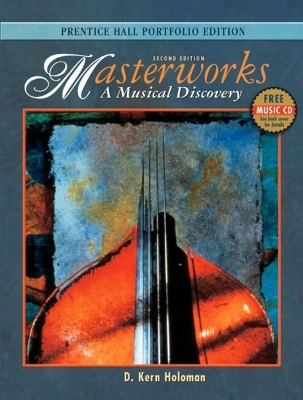
Masterworks, Portfolio Edition w/CD
Pearson
978-0-13-184425-4 (ISBN)
- Titel ist leider vergriffen;
keine Neuauflage - Artikel merken
Masterworks, Portfolio Edition is a price-friendly alternative to traditional music appreciation texts. Consisting of a textbook and a free music compact disk included with every text, Masterworks, Portfolio Edition is designed to introduce students to the most important music of the Western tradition, classical and popular and provide the student with the greatest textbook value at the lowest price available.
D. Kern Holoman presents an elegantly crafted narrative that draws on his long experience as lecturer in the popular Introduction to Music course at the University of California, Davis. Conductor of the University of California, Davis, Symphony Orchestra, Holoman is author of articles and books on Berlioz and orchestral life in 19th-century France.
Introduction: Hearing the Music.
Composers and Performers. Interactive Learning.
I. FUNDAMENTALS OF MUSIC STUDY.
1. What's Happening?
Gershwin: “Summertime,” from Porgy and Bess (1935). Pitch and Its Notation. Rhythm, Melody, Harmony, Texture, Nuance. Voices and Instruments. Tonality.
2. On Periods, Genres, Titles, Forms, & Schools.
Periods of Music History. Titles. Form. Schools.
II. HISTORY OF MUSICAL STYLE.
3. The Middle Ages and Renaissance.
The Middle Ages. Plainchant: Kyrie eleison (Kyrie Cunctipotens genitor). Hildegard of Bingen: Kyrie eleison (1150). Plainchant Hymn: Pange lingua (c. 1264). Anonymous: Sumer is icumen in (c. 1240). The Renaissance. Josquin Desprez: Déploration sur la mort de Johannes Ockeghem (c. 1497). Byrd: Agnus Dei, from Mass in 4 Parts (1592-93). Andréz Martinez: Agnus Dei, from “Zapotec” Mass (1636). Monteverdi: Io mi son giovinetta (1603). Dowland: Flow My Tears (1600).
4. The Baroque.
Venice: Monteverdi and the Opera. Basso Continuo; The Ritornello Principle. Purcell: “When I Am Laid in Earth” (Dido's Lament), from Dido and Aeneas (1689). Vivaldi, Bach, Handel. The Baroque Concerto. Bach: from Double Concerto in D minor, BWV 1043 (c. 1720). Bach: Fugue in C Minor from The Well-Tempered Clavier (book I, 1722). The Suite of Dances. Bach: “Badinerie” from Orchestral Suite No. 2 in B Minor, BWV 1067 (c. 1735). Chorale, Cantata, Oratorio. Bach: From Cantata 80: Ein' feste Burg (c. 1734). Handel: Excerpt from Messiah, (part I, 1741).
5. The Classical Style.
Vienna. The Viennese Sonata. Mozart: Eine kleine Nachtmusik, K. 525 (1787), movts. I, III. Mozart and Haydn. Classical Genres. Haydn: From String Quartet in C Major, op. 76, no. 3 (1797, “Emperor”), movt. II: Poco adagio; cantabile. Haydn: From Piano Sonata no. 59 in E flat Major (1790), movt. I: Allegro. Mozart: From Piano Concerto no. 25 in C Major, K. 503 (1786), movt. I: Allegro maestoso. Mozart Operas. Mozart: from Symphony No. 40 in G Minor, K. 550 (1788), movt. I: Allegro non troppo.
6. Romanticism.
The French Revolution; Napoleon. Beethoven. Beethoven: Symphony No. 5 in C Minor, op. 67 (1808). Schubert. Schubert: Gretchen am Spinnrade (1814). Romanticism. Schumann: From Carnaval (1835): Arlequin—Valse noble; Chiarina—Chopin. Europe After Napoleon. Paris: Berlioz, Liszt, Chopin. Berlioz: From Symphonie fantastique (1830), movt. V: Dream of a Witches Sabbath. Chopin: Mazurka in A Minor, op. 17, No. 4 (1834). Leipzig: Schumann and Mendelssohn. Romanticism, Again. Romantic Opera. Bellini: “Casta Diva,” from Norma (1831).
7. Götterdämmerung.
Verdi and Wagner. Verdi: From Otello (1887): Love Duet (Otello, Desdemona: Act I): “Quando narravi”. Wagner: Brunnhilde's Immolation (Final Scene), from Götterdämmerung (1876). Brahms, Mahler, and Strauss. Brahms: From Variations on a Theme by Haydn, op. 56a (1873): Theme, Variations I-III, Finale. The Nationalists. Smetana: “Furiant,” from The Bartered Bride (1866). Russian Nationalism: The Mighty Handful. Tchaikovsky, Puccini. Tchaikovsky: Romeo and Juliet Overture Fantasy (1869). Paris, Again: Debussy, Ravel, the Ballet Russes, Stravinsky. Debussy: La Soirée dans Grenade (1903). Stravinsky: From The Rite of Spring (1913): Introduction: Les Augures printinières: Danses des Adolescentes. Boulanger: Psalm 24 (1916).
III. MUSIC HERE AND NOW.
8. Music in the Land of Plenty.
Congregational Singing. Billings: David's Lamentation (1778) and David's Lamentation (performed 1959). Music of the Slaves. Parlor Songs and Quicksteps. Sousa: Semper Fidelis (1888). Joplin: Maple Leaf Rag (1899). Jazz. Handy: St. Louis Blues (1914). Ellington: New East St. Louis Toodle-O (1937). Parker: Lady Be Good (1946). American Classical Music. Beach: from Violin Sonata in A Minor, op. 34 (1896), movt. III: Scherzo. Ives: “Putnam's Camp”, from Three Places in New England (1912). Gershwin: “Summertime,” from Porgy and Bess (1935). Broadway. Rodgers & Hammerstein: “Some Enchanted Evening”, from South Pacific (1949). Bernstein: “Somewhere”, from West Side Story (1957).
9. Getting Hip and Staying That Way.
Schoenberg, Berg, Webern. Schoenberg: From Pierrot lunaire, op. 21 (1912): Mondestrunken—Valse de Chopin. Webern: From Symphony, op. 21 (1928), movt. II: Theme and Variations. The Emigration. The Electronic Age. Babbitt: From Philomel (1964). Shulamit Ran. Fusing the Elements. Shulamit Ran, Private Game (1979). Tan: “Opera in Temple Street”, from Symphony 1997 (1997).
Epilogue: What Next?
| Erscheint lt. Verlag | 26.3.2004 |
|---|---|
| Sprache | englisch |
| Maße | 178 x 235 mm |
| Gewicht | 617 g |
| Themenwelt | Kinder- / Jugendbuch ► Sachbücher ► Kunst / Musik |
| ISBN-10 | 0-13-184425-3 / 0131844253 |
| ISBN-13 | 978-0-13-184425-4 / 9780131844254 |
| Zustand | Neuware |
| Informationen gemäß Produktsicherheitsverordnung (GPSR) | |
| Haben Sie eine Frage zum Produkt? |
aus dem Bereich