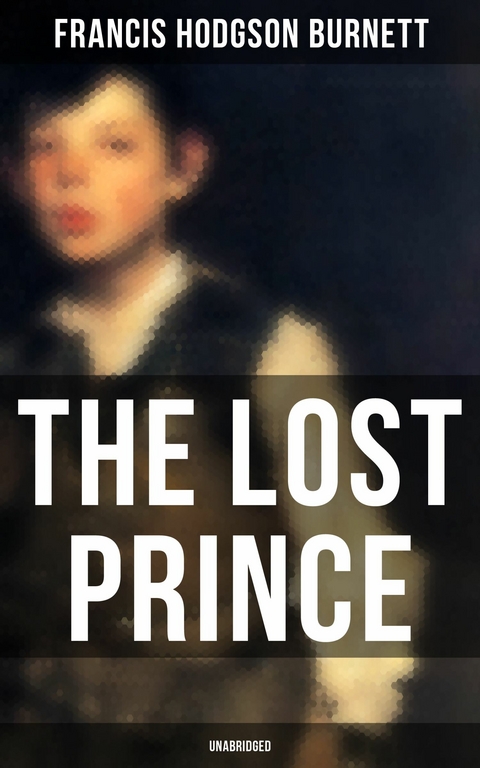
The Lost Prince (Unabridged) (eBook)
243 Seiten
Musaicum Books (Verlag)
978-80-272-4077-7 (ISBN)
II
A Young Citizen of the World
He had been in London more than once before, but not to the lodgings in Philibert Place. When he was brought a second or third time to a town or city, he always knew that the house he was taken to would be in a quarter new to him, and he should not see again the people he had seen before. Such slight links of acquaintance as sometimes formed themselves between him and other children as shabby and poor as himself were easily broken. His father, however, had never forbidden him to make chance acquaintances. He had, in fact, told him that he had reasons for not wishing him to hold himself aloof from other boys. The only barrier which must exist between them must be the barrier of silence concerning his wanderings from country to country. Other boys as poor as he was did not make constant journeys, therefore they would miss nothing from his boyish talk when he omitted all mention of his. When he was in Russia, he must speak only of Russian places and Russian people and customs. When he was in France, Germany, Austria, or England, he must do the same thing. When he had learned English, French, German, Italian, and Russian he did not know. He had seemed to grow up in the midst of changing tongues which all seemed familiar to him, as languages are familiar to children who have lived with them until one scarcely seems less familiar than another. He did remember, however, that his father had always been unswerving in his attention to his pronunciation and method of speaking the language of any country they chanced to be living in.
"You must not seem a foreigner in any country," he had said to him. "It is necessary that you should not. But when you are in England, you must not know French, or German, or anything but English."
Once, when he was seven or eight years old, a boy had asked him what his father's work was.
"His own father is a carpenter, and he asked me if my father was one," Marco brought the story to Loristan. "I said you were not. Then he asked if you were a shoemaker, and another one said you might be a bricklayer or a tailor—and I didn't know what to tell them." He had been out playing in a London street, and he put a grubby little hand on his father's arm, and clutched and almost fiercely shook it. "I wanted to say that you were not like their fathers, not at all. I knew you were not, though you were quite as poor. You are not a bricklayer or a shoemaker, but a patriot—you could not be only a bricklayer—you!" He said it grandly and with a queer indignation, his black head held up and his eyes angry.
Loristan laid his hand against his mouth.
"Hush! hush!" he said. "Is it an insult to a man to think he may be a carpenter or make a good suit of clothes? If I could make our clothes, we should go better dressed. If I were a shoemaker, your toes would not be making their way into the world as they are now." He was smiling, but Marco saw his head held itself high, too, and his eyes were glowing as he touched his shoulder. "I know you did not tell them I was a patriot," he ended. "What was it you said to them?"
"I remembered that you were nearly always writing and drawing maps, and I said you were a writer, but I did not know what you wrote—and that you said it was a poor trade. I heard you say that once to Lazarus. Was that a right thing to tell them?"
"Yes. You may always say it if you are asked. There are poor fellows enough who write a thousand different things which bring them little money. There is nothing strange in my being a writer."
So Loristan answered him, and from that time if, by any chance, his father's means of livelihood were inquired into, it was simple enough and true enough to say that he wrote to earn his bread.
In the first days of strangeness to a new place, Marco often walked a great deal. He was strong and untiring, and it amused him to wander through unknown streets, and look at shops, and houses, and people. He did not confine himself to the great thoroughfares, but liked to branch off into the side streets and odd, deserted-looking squares, and even courts and alleyways. He often stopped to watch workmen and talk to them if they were friendly. In this way he made stray acquaintances in his strollings, and learned a good many things. He had a fondness for wandering musicians, and, from an old Italian who had in his youth been a singer in opera, he had learned to sing a number of songs in his strong, musical boy-voice. He knew well many of the songs of the people in several countries.
It was very dull this first morning, and he wished that he had something to do or some one to speak to. To do nothing whatever is a depressing thing at all times, but perhaps it is more especially so when one is a big, healthy boy twelve years old. London as he saw it in the Marylebone Road seemed to him a hideous place. It was murky and shabby-looking, and full of dreary-faced people. It was not the first time he had seen the same things, and they always made him feel that he wished he had something to do.
Suddenly he turned away from the gate and went into the house to speak to Lazarus. He found him in his dingy closet of a room on the fourth floor at the back of the house.
"I am going for a walk," he announced to him. "Please tell my father if he asks for me. He is busy, and I must not disturb him."
Lazarus was patching an old coat as he often patched things—even shoes sometimes. When Marco spoke, he stood up at once to answer him. He was very obstinate and particular about certain forms of manner. Nothing would have obliged him to remain seated when Loristan or Marco was near him. Marco thought it was because he had been so strictly trained as a soldier. He knew that his father had had great trouble to make him lay aside his habit of saluting when they spoke to him.
"Perhaps," Marco had heard Loristan say to him almost severely, once when he had forgotten himself and had stood at salute while his master passed through a broken-down iron gate before an equally broken-down-looking lodging-house—"perhaps you can force yourself to remember when I tell you that it is not safe—IT IS NOT SAFE! You put us in danger!"
It was evident that this helped the good fellow to control himself. Marco remembered that at the time he had actually turned pale, and had struck his forehead and poured forth a torrent of Samavian dialect in penitence and terror. But, though he no longer saluted them in public, he omitted no other form of reverence and ceremony, and the boy had become accustomed to being treated as if he were anything but the shabby lad whose very coat was patched by the old soldier who stood "at attention" before him.
"Yes, sir," Lazarus answered. "Where was it your wish to go?"
Marco knitted his black brows a little in trying to recall distinct memories of the last time he had been in London.
"I have been to so many places, and have seen so many things since I was here before, that I must begin to learn again about the streets and buildings I do not quite remember."
"Yes, sir," said Lazarus. "There HAVE been so many. I also forget. You were but eight years old when you were last here."
"I think I will go and find the royal palace, and then I will walk about and learn the names of the streets," Marco said.
"Yes, sir," answered Lazarus, and this time he made his military salute.
Marco lifted his right hand in recognition, as if he had been a young officer. Most boys might have looked awkward or theatrical in making the gesture, but he made it with naturalness and ease, because he had been familiar with the form since his babyhood. He had seen officers returning the salutes of their men when they encountered each other by chance in the streets, he had seen princes passing sentries on their way to their carriages, more august personages raising the quiet, recognizing hand to their helmets as they rode through applauding crowds. He had seen many royal persons and many royal pageants, but always only as an ill-clad boy standing on the edge of the crowd of common people. An energetic lad, however poor, cannot spend his days in going from one country to another without, by mere every-day chance, becoming familiar with the outer life of royalties and courts. Marco had stood in continental thoroughfares when visiting emperors rode by with glittering soldiery before and behind them, and a populace shouting courteous welcomes. He knew where in various great capitals the sentries stood before kingly or princely palaces. He had seen certain royal faces often enough to know them well, and to be ready to make his salute when particular quiet and unattended carriages passed him by.
"It is well to know them. It is well to observe everything and to train one's self to remember faces and circumstances," his father had said. "If you were a young prince or a young man training for a diplomatic career, you would be taught to notice and remember people and things as you would be taught to speak your own language with elegance. Such observation would be your most practical accomplishment and greatest power. It is as practical for one man as another—for a poor lad in a patched coat as for one whose place is to be in courts. As you cannot be educated in the ordinary way, you must learn from travel and the world. You must lose nothing—forget nothing."
It was his father who had taught him everything, and he had learned a great deal. Loristan had the power of making all things interesting to fascination. To Marco it seemed that he knew everything in the world. They were not rich enough to buy many books, but Loristan knew the treasures of all great cities, the resources of the...
| Erscheint lt. Verlag | 21.3.2018 |
|---|---|
| Verlagsort | Prague |
| Sprache | englisch |
| Themenwelt | Literatur ► Historische Romane |
| Kinder- / Jugendbuch ► Spielen / Lernen ► Abenteuer / Spielgeschichten | |
| Schlagworte | Crippled street urchin • diary of a wimpy kid • Dictatorship • Drilling boys • European journey • Friendship • Harry Potter • Huck Finn • literary adventure • London club • Lord of the Flies • Oliver Twist • Peter Pan • Revolutionary plot • Samavian patriot • secret mission • The Chronicles of Narnia • The Jungle Book • The Little Prince • The Maze Runner |
| ISBN-10 | 80-272-4077-8 / 8027240778 |
| ISBN-13 | 978-80-272-4077-7 / 9788027240777 |
| Informationen gemäß Produktsicherheitsverordnung (GPSR) | |
| Haben Sie eine Frage zum Produkt? |
 EPUB (Wasserzeichen)
DRM: Digitales Wasserzeichen
Dieses eBook enthält ein digitales Wasserzeichen und ist damit für Sie personalisiert. Bei einer missbräuchlichen Weitergabe des eBooks an Dritte ist eine Rückverfolgung an die Quelle möglich.
Dateiformat: EPUB (Electronic Publication)
EPUB ist ein offener Standard für eBooks und eignet sich besonders zur Darstellung von Belletristik und Sachbüchern. Der Fließtext wird dynamisch an die Display- und Schriftgröße angepasst. Auch für mobile Lesegeräte ist EPUB daher gut geeignet.
Systemvoraussetzungen:
PC/Mac: Mit einem PC oder Mac können Sie dieses eBook lesen. Sie benötigen dafür die kostenlose Software Adobe Digital Editions.
eReader: Dieses eBook kann mit (fast) allen eBook-Readern gelesen werden. Mit dem amazon-Kindle ist es aber nicht kompatibel.
Smartphone/Tablet: Egal ob Apple oder Android, dieses eBook können Sie lesen. Sie benötigen dafür eine kostenlose App.
Geräteliste und zusätzliche Hinweise
Buying eBooks from abroad
For tax law reasons we can sell eBooks just within Germany and Switzerland. Regrettably we cannot fulfill eBook-orders from other countries.
aus dem Bereich