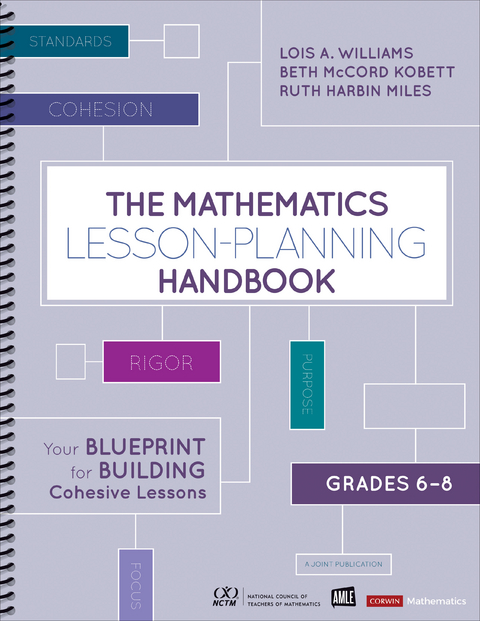
Mathematics Lesson-Planning Handbook, Grades 6-8 (eBook)
264 Seiten
Corwin (Verlag)
978-1-5063-8792-5 (ISBN)

Book at a Glance
Praise Page
Acknowledgements
Publisher′s Acknowledgements
Letter to 6-8 Teachers
Letter to Middle School Principals
Letter to Mathematics Coaches
Letter to Preservice College and University Instructors
How to Use This Book
Part I: You are the Architect of Your Classroom
Chapter 1: Surveying Your Site: Knowing Your Students
Why Is It So Important to Know Your Students?
What Do Access and Equity Really Mean?
What Is Prior Knowledge in Mathematics
What Do Culturally and Linguistically Diverse Students Need?
What Do Students Living in Poverty Need?
What Are Learning Needs?
What Are the Common Themes?
Chapter 2: Your 6-8 Blueprint: Planning Mathematics Lessons for Coherence, Rigor, and Purpose
What Is Coherence?
What Is Rigor?
What Is the Purpose of a Lesson?
How Can You Ensure That You Plan Lessons for Coherence, Rigor, and Purpose?
Lesson-Planning Template
Part II: Drafting Your 6-8 Blueprint
Chapter 3: Laying Your Foundation: It Starts with Big Ideas, Essential Questions, and Standards
What Are State Standards for Mathematics?
What Are Essential Questions?
What Are Process Standards?
Building Unit Coherence
Sixth Grade Snapshot: Big Ideas, Essential Questions, and Standards
Eighth Grade Snapshot: Big Ideas, Essential Questions, and Standards
Under Construction
Chapter 4: Reinforcing Your Plan: Learning Intentions and Success Criteria
What Are Learning Intentions?
What Are Mathematics Learning Intentions?
What Are Language and Social Learning Intentions?
How Do You Communicate Learning Intentions with Students?
What Are Success Criteria?
How Do Learning Intentions Connect to the Success Criteria?
When Should Learning Intentions and Success Criteria Be Shared With Students?
Building Unit Coherence
Sixth Grade Snapshot: Learning Intentions and Success Criteria
Seventh Grade Snapshot: Learning Intentions and Success Criteria Decision-Making Snapshot
Eighth Grade Snapshot: Learning Intentions and Success Criteria
Under Construction
Chapter 5: Deciding on Purpose: Why Are You Building This Lesson?
What Is the Role of a Conceptual Understanding Lesson?
What Is Procedural Fluency, and How Does It Build from a Conceptual Understanding Lesson?
How Do You Know if You Need a Conceptual Understanding or Procedural Fluency Lesson?
How Do You Create a Transfer Lesson?
Building Unit Coherence
Sixth Grade Snapshot: Lesson Purpose
Seventh Grade Snapshot: Lesson Purpose
Eighth Grade Snapshot: Lesson Purpose
Under Construction
Chapter 6: Choosing Tasks: The Heart of the Lesson
Why Are Tasks Important?
What Is a Worthwhile Task?
How Do You Adapt to Tasks?
What Are Some Sources for Worthwhile Tasks?
Building Unit Coherence
Sixth Grade Snapshot: Task Selection
Seventh Grade Snapshot: Task Selection
Eighth Grade Snapshot: Task Selecetion
Under Construction
Chapter 7: Choosing Materials: Representations, Manipulatives, and Other Resources.
What Is the Role of Representations in Mathematics Lessons?
What Is A Manipulative?
How Are Manipulatives Used?
What Are Other Resources?
Building Unit Coherence
Sixth Grade Snapshot: Material Selection
Seventh Grade Snapshot: Material Selection
Eighth Grade Snapshot: Material Selection
Under Construction
Chapter 8: Cementing the Cracks: Anticipating Student Thinking
What Are Misconceptions, and Where Do They Come From?
How Can You Plan to Minimize Misconceptions?
Building Unit Coherence
Sixth Grade Snapshot: Student Thinking
Seventh Grade Snapshot: Student Thinking
Eighth Grade Snapshot: Student Thinking
Under Construction
Chapter 9: Framing the Lesson: Formats
How Do Middle School Schedules Affect Planning and Instruction?
What are Some Different Lesson Formats?
Building Unit Coherence
Sixth Grade Snapshot: Lesson Format
Seventh Grade Snapshot: Lesson Format
Eighth Grade Snapshot: Lesson Format
Under Construction
Chapter 10: Evaluating Impact: Formative Assessment
What Is Formative Assessment?
What Are Specific Formative Assessment Techniques?
Building Unit Coherence
Sixth Grade Snapshot: Formative Assessment
Seventh Grade Snapshot: Formative Assessment
Eighth Grade Snapshot: Formative Assessment
Under Construction
Part III: Pulling All the Pieces Together
Chapter 11: Planning to Launch the Lesson
What Is a Lesson Launch?
How Can You Launch a Problem-Solving Lesson?
What Kinds of Lesson Launches Focus on Mathematics Concepts?
What Are Number Routine Lesson Launches?
What Di You Anticipate Students Will Do?
Sixth Grade Snapshot: Launch the Lesson
Seventh Grade Snapshot: Launch the Lesson
Eighth Grade Snapshot: Launch the Lesson
Under Construction
Chapter 12: Planning to Facilitate the Lesson
What Is Mathematical Communication?
How Do You Facilitate Meaningful Mathematical Discourse?
How Do You Plan for and Pose Purposeful Questions?
How Do You Facilitate Productive Struggle?
How Do You Make Sure You Engage Students in the Process Standards as You Facilitate the Lesson?
Building Unit Coherence
Sixth Grade Snapshot: Facilitate the Lesson
Seventh Grade Snapshot: Facilitate the Lesson
Eighth Grade Snapshot: Facilitate the Lesson
Under Construction
Chapter 13: Planning to Close the Lesson
Why Do You Need Closure in a Lesson?
What Are Some Different Closure Activities?
Building Unit Coherence
Sixth Grade Snapshot: Close the Lesson
Seventh Grade Snapshot: Close the Lesson
Eighth Grade Snapshot: Close the Lesson
Under Construction
Chapter 14: Surveying Your Results: Lesson Reflection
Why is It Important to Reflect Upon Lessons?
What Kind of Reflection Cycle Supports Teacher Growth?
Epilogue
Resources
Appendix A: Complete Lessons for Sixth, Seventh, and Eighth Grade
Appendix B: Lesson-Planning Template
Appendix C: Further Reading/ Resources
Appendix D: Glossary
References
About the Authors
| Erscheint lt. Verlag | 15.1.2019 |
|---|---|
| Reihe/Serie | Corwin Mathematics Series | Corwin Mathematics Series |
| Verlagsort | Thousand Oaks |
| Sprache | englisch |
| Themenwelt | Kinder- / Jugendbuch ► Spielen / Lernen ► Lernen / Lernspiele |
| Schulbuch / Wörterbuch ► Schulbuch / Allgemeinbildende Schulen | |
| Sozialwissenschaften ► Pädagogik ► Schulpädagogik / Grundschule | |
| Sozialwissenschaften ► Pädagogik ► Schulpädagogik / Sekundarstufe I+II | |
| Schlagworte | Assessment techniques • Conceptual Understanding • Math • mathematics formative assessment • mathematics lesson planning • math lessons • Secondary Mathematics • Visible Learning |
| ISBN-10 | 1-5063-8792-6 / 1506387926 |
| ISBN-13 | 978-1-5063-8792-5 / 9781506387925 |
| Informationen gemäß Produktsicherheitsverordnung (GPSR) | |
| Haben Sie eine Frage zum Produkt? |
 PDF (Adobe DRM)
Kopierschutz: Adobe-DRM
Adobe-DRM ist ein Kopierschutz, der das eBook vor Mißbrauch schützen soll. Dabei wird das eBook bereits beim Download auf Ihre persönliche Adobe-ID autorisiert. Lesen können Sie das eBook dann nur auf den Geräten, welche ebenfalls auf Ihre Adobe-ID registriert sind.
Details zum Adobe-DRM
Dateiformat: PDF (Portable Document Format)
Mit einem festen Seitenlayout eignet sich die PDF besonders für Fachbücher mit Spalten, Tabellen und Abbildungen. Eine PDF kann auf fast allen Geräten angezeigt werden, ist aber für kleine Displays (Smartphone, eReader) nur eingeschränkt geeignet.
Systemvoraussetzungen:
PC/Mac: Mit einem PC oder Mac können Sie dieses eBook lesen. Sie benötigen eine
eReader: Dieses eBook kann mit (fast) allen eBook-Readern gelesen werden. Mit dem amazon-Kindle ist es aber nicht kompatibel.
Smartphone/Tablet: Egal ob Apple oder Android, dieses eBook können Sie lesen. Sie benötigen eine
Geräteliste und zusätzliche Hinweise
Buying eBooks from abroad
For tax law reasons we can sell eBooks just within Germany and Switzerland. Regrettably we cannot fulfill eBook-orders from other countries.
aus dem Bereich