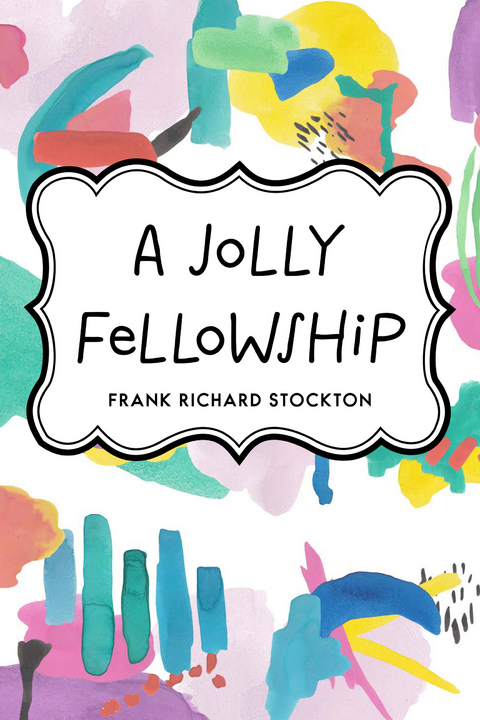
Jolly Fellowship (eBook)
301 Seiten
Krill Press (Verlag)
978-1-5312-0198-2 (ISBN)
Frank Richard Stockton was a popular 19th century American author who remains best known for writing a series of acclaimed children's fairy tales. His books are still read across the world today.
CHAPTER I.: WE MAKE A START.
I WAS SITTING ON THE deck of a Savannah steam-ship, which was lying at a dock in the East River, New York. I was waiting for young Rectus, and had already waited some time; which surprised me, because Rectus was, as a general thing, a very prompt fellow, who seldom kept people waiting. But it was probably impossible for him to regulate his own movements this time, for his father and mother were coming with him, to see him off.
I had no one there to see me off, but I did not care for that. I was sixteen years old, and felt quite like a man; whereas Rectus was only fourteen, and couldn’t possibly feel like a man—unless his looks very much belied his feelings. My father and mother and sister lived in a small town some thirty miles from New York, and that was a very good reason for their not coming to the city just to see me sail away in a steam-ship. They took a good leave of me, though, before I left home.
I shall never forget how I first became acquainted with Rectus. About a couple of years before, he was a new boy in the academy at Willisville. One Saturday, a lot of us went down to the river to swim. Our favorite place was near an old wharf, which ran out into deep water, and a fellow could take a good dive there, when the tide was high. There were some of the smaller boys along that day, but they didn’t dive any, and if they even swam, it was in shallow water near the shore, by the side of the wharf. But I think most of them spent their time wading about.
I was a good swimmer, and could dive very well. I was learning to swim under water, but had not done very much in that line at the time I speak of. We were nearly ready to come out, when I took a dive from a post on the end of the wharf, and then turned, under water, to swim in shore. I intended to try to keep under until I got into water shallow enough for me to touch bottom, and walk ashore. After half a dozen strokes, I felt for the bottom and my feet touched it. Then I raised my head, but I didn’t raise it out of the water. It struck something hard.
In an instant I knew what had happened. There was a big mud-scow lying by the side of the wharf, and I had got under that! It was a great flat thing, ever so long and very wide. I knew I must get from under it as quickly as I could. Indeed, I could hardly hold my breath now. I waded along with my head bent down, but I didn’t reach the side of it. Then I turned the other way, but my hands, which I held up, still touched nothing but the hard, slimy bottom of the scow. I must have been wading up and down the length of the thing. I was bewildered. I couldn’t think which way to turn. I could only think of one thing. I would be drowned in less than a minute. Scott would be head of the class. My mother, and little Helen—but I can’t tell what my thoughts were then. They were dreadful. But just as I was thinking of Helen and mother, I saw through the water some white things, not far from me. I knew by their looks that they were a boy’s legs.
I staggered toward them, and in a moment my hands went out of water, just at the side of the scow. I stood up, and my head with half my body came up into the air.
What a breath I drew! But I felt so weak and shaky that I had to take hold of the side of the scow, and stand there for a while before I waded ashore. The boy who was standing by me was Rectus. He did not have that name then, and I didn’t know him.
“It must be pretty hard to stay under water so long,” he said.
“Hard!” I answered, as soon as I could get my breath; “I should think so. Why, I came near being drowned!”
“Is that so?” said he; “I didn’t know that. I saw you go down, and have been watching for you to come up. But I didn’t expect you to come from under the scow.”
How glad I was that he had been standing there watching for me to come up! If he had not been there, or if his legs had been green or the color of water, I believe I should have drowned.
I always liked the boy after that, though, of course, there was no particular reason for it. He was a boarder. His parents lived in New York. Samuel Colbert was his real name, and the title of Rectus he obtained at school by being so good. He scarcely ever did anything wrong, which was rather surprising to the rest of us, because he was not sickly or anything of that kind. After a while, we got into the way of calling him Rectus, and as he didn’t seem to mind it, the name stuck to him. The boys generally liked him, and he got on quite well in the school,—in every way except in his studies. He was not a smart boy, and did not pretend to be.
I went right through the academy, from the lowest to the highest class, and when I left, the professor, as we called our principal, said that I was ready to go to college, and urged me very much to do so. But I was not in any hurry, and my parents agreed with me that, after four years of school-life, I had better wait a while before beginning a new course. All this disturbed the professor very much, but he insisted on my keeping up my studies, so as not to get rusty, and he came up to our house very often, for the purpose of seeing what I was doing in the study line, and how I was doing it.
I thought over things a good deal for myself, and a few months after I left the academy I made up my mind to travel a little. I talked about it at home, and it was generally thought to be a good idea, although my sister was in favor of it only in case I took her with me. Otherwise she opposed it. But there were a great many reasons why I could not take her. She was only eleven.
I had some money of my own, which I thought I would rather spend in travel than in any other way, and, as it was not a large sum, and as my father could not afford to add anything to it, my journey could not be very extensive. Indeed, I only contemplated going to Florida and perhaps a few other Southern States, and then—if it could be done—a visit to some of the West India islands, and, as it was winter-time, that would be a very good trip. My father did not seem to be afraid to trust me to go alone. He and the professor talked it over, and they thought that I would take good enough care of myself. The professor would have much preferred to see me go to college, but, as I was not to do that, he thought travelling much better for me than staying at home, although I made no promise about taking my books along. But it was pretty well settled that I was to go to college in the fall, and this consoled him a little.
The person who first suggested this travelling plan was our old physician, Dr. Mathews. I don’t know exactly what he said about it, but I knew he thought I had been studying too hard, and needed to “let up” for a while. And I’m sure, too, that he was quite positive that I would have no let up as long as I staid in the same town with the professor.
Nearly a year before this time, Rectus had left the academy. He had never reached the higher classes,—in fact, he didn’t seem to get on well at all. He studied well enough, but he didn’t take hold of things properly, and I believe he really did not care to go through the school. But he was such a quiet fellow that we could not make much out of him. His father was very rich, and we all thought that Rectus was taken away to be brought up as a partner in the firm. But we really knew nothing about it: for, as I found out afterward, Rectus spent all his time, after he left school, in studying music.
Soon after my trip was all agreed upon and settled, father had to go to New York, and there he saw Mr. Colbert, and of course told him of my plans. That afternoon, old Colbert came to my father’s hotel, and proposed to him that I should take his son with me. He had always heard, he said, that I was a sensible fellow, and fit to be trusted, and he would be very glad to have his boy travel with me. And he furthermore said that if I had the care of Samuel—for of course he didn’t call his son Rectus—he would pay me a salary. He had evidently read about young English fellows travelling on the continent with their tutors, and I suppose he wanted me to be his son’s tutor, or something like it.
When father told me what Mr. Colbert had proposed, I agreed instantly. I liked Rectus, and the salary would help immensely. I wrote to New York that very night, accepting the proposition.
When my friends in the town, and those at the school, heard that Rectus and I were going off together, they thought it an uncommonly good joke, and they crowded up to our house to see me about it.
“Two such good young men as you and Rectus travelling together ought to have a beneficial influence upon whole communities,” said Harry Alden; and Scott remarked that if there should be a bad storm at sea, he would advise us two to throw everybody else overboard to the whales, for the other people would be sure to be the wicked ones. I am happy to say that I got a twist on Scott’s ear that made him howl, and then mother came in and invited them all to come and take supper with me, the Tuesday before I started. We invited Rectus to come up from the city, but he did not make his appearance. However, we got on first-rate without him, and had a splendid time. There was never a woman who knew just how to make boys have a good time, like my mother.
I had been a long while on the steamer waiting for Rectus. She was to sail at three o’clock, and it was then after two. The...
| Erscheint lt. Verlag | 13.2.2016 |
|---|---|
| Sprache | englisch |
| Themenwelt | Kinder- / Jugendbuch ► Jugendbücher ab 12 Jahre |
| ISBN-10 | 1-5312-0198-9 / 1531201989 |
| ISBN-13 | 978-1-5312-0198-2 / 9781531201982 |
| Informationen gemäß Produktsicherheitsverordnung (GPSR) | |
| Haben Sie eine Frage zum Produkt? |
 EPUB (Adobe DRM)
Kopierschutz: Adobe-DRM
Adobe-DRM ist ein Kopierschutz, der das eBook vor Mißbrauch schützen soll. Dabei wird das eBook bereits beim Download auf Ihre persönliche Adobe-ID autorisiert. Lesen können Sie das eBook dann nur auf den Geräten, welche ebenfalls auf Ihre Adobe-ID registriert sind.
Details zum Adobe-DRM
Dateiformat: EPUB (Electronic Publication)
EPUB ist ein offener Standard für eBooks und eignet sich besonders zur Darstellung von Belletristik und Sachbüchern. Der Fließtext wird dynamisch an die Display- und Schriftgröße angepasst. Auch für mobile Lesegeräte ist EPUB daher gut geeignet.
Systemvoraussetzungen:
PC/Mac: Mit einem PC oder Mac können Sie dieses eBook lesen. Sie benötigen eine
eReader: Dieses eBook kann mit (fast) allen eBook-Readern gelesen werden. Mit dem amazon-Kindle ist es aber nicht kompatibel.
Smartphone/Tablet: Egal ob Apple oder Android, dieses eBook können Sie lesen. Sie benötigen eine
Geräteliste und zusätzliche Hinweise
Buying eBooks from abroad
For tax law reasons we can sell eBooks just within Germany and Switzerland. Regrettably we cannot fulfill eBook-orders from other countries.
aus dem Bereich