


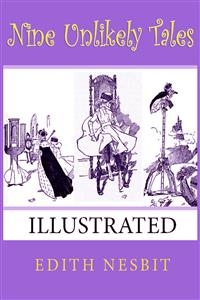
Nine Unlikely Tales (eBook)
100 Seiten
eKitap Projesi (Verlag)
978-605-9496-88-9 (ISBN)
MATILDA'S ears were red and shiny. So were her cheeks. Her hands were red too. This was because Pridmore had washed her. It was not the usual washing, which makes you clean and comfortable, but the 'thorough good wash,' which makes you burn and smart till you wish you could be like the poor little savages who do not know anything, and run about bare in the sun, and only go into the water when they are hot.
Matilda wished she could have been born in a savage tribe instead of at Brixton. 'Little savages,' she said, 'don't have their ears washed thoroughly, and they don't have new dresses that are prickly in the insides round their arms, and cut them round the neck. Do they, Pridmore?'
ABOUT AUTHOR:
Edith Nesbit (married name Edith Bland; 15 August 1858 - 4 May 1924) was an English author and poet; she published her books for children under the name of E. Nesbit. She wrote or collaborated on over 60 books of fiction for children, several of which have been adapted for film and television. She was also a political activist and co-founded the Fabian Society, a socialist organisation later connected to the Labour Party.
Edith Nesbit was born in Kennington, Surrey, the daughter of agricultural chemist and schoolmaster John Collis Nesbit. The death of her father when she was four and the continuing ill health of her sister meant that Nesbit had a transitory childhood, her family moving across Europe in search of healthy climates only to return to England for financial reasons. Nesbit therefore spent her childhood attaining an education from whatever sources were available - local grammars, the occasional boarding school but mainly through reading.
MATILDA'S ears were red and shiny. So were her cheeks. Her hands were red too. This was because Pridmore had washed her. It was not the usual washing, which makes you clean and comfortable, but the "e;thorough good wash,"e; which makes you burn and smart till you wish you could be like the poor little savages who do not know anything, and run about bare in the sun, and only go into the water when they are hot.Matilda wished she could have been born in a savage tribe instead of at Brixton. "e;Little savages,"e; she said, "e;don't have their ears washed thoroughly, and they don't have new dresses that are prickly in the insides round their arms, and cut them round the neck. Do they, Pridmore?"e;
WHEREYOUWANTOGOTO OR THE BOUNCIBLE BALL
IT is very hard, when you have been accustomed to go to the seaside every summer ever since you were quite little, to be made to stay in London just because an aunt and an uncle choose to want to come and stay at your house to see the Royal Academy and go to the summer sales.
Selim and Thomasina felt that it was very hard indeed. And aunt and uncle were not the nice kind, either. If it had been Aunt Emma, who dressed dolls and told fairy-tales—or Uncle Reggie, who took you to the Crystal Palace, and gave you five bob at a time, and never even asked what you spent it on, it would have been different. But it was Uncle Thomas and Aunt Selina.
Aunt Selina was all beady, and sat bolt upright, and told you to mind what you were told, and Selim had been named after her—as near as they could get. And Uncle Thomas was the one Thomasina had been named after: he was deaf, and he always told you what the moral of everything was, and the housemaid said he was “near.”
“I know he is, worse luck,” said Thomasina.
“I mean, miss,” explained the housemaid, “he’s none too free with his chink.”
Selim groaned. “He never gave me but a shilling in his life,” said he, “and that turned out to be bad when I tried to change it at the ginger-beer shop.”
The children could not understand why this aunt and uncle were allowed to interfere with everything as they did: and they quite made up their minds that when they were grown up they would never allow an aunt or an uncle to cross their doorsteps. They never thought—poor, dear little things—that some day they would grow up to be aunts and uncles in their turn, or, at least, one of each.
It was very hot in London that year: the pavement was like hot pie, and the asphalt was like hot pudding, and there was a curious wind that collected dust and straw and dirty paper, and then got tired of its collection, and threw it away in respectable people’s areas and front gardens. The blind in the nursery had never been fixed up since the day when the children took it down to make a drop-scene for a play they were going to write and never did. So the hot afternoon sun came burning in through the window, and the children got hotter and hotter, and crosser and crosser, till at last Selim slapped Thomasina’s arms till she cried, and Thomasina kicked Selim’s legs till he screamed.
Then they sat down in different corners of the nursery and cried, and called each other names, and said they wished they were dead. This is very naughty indeed, as, of course, you know; but you must remember how hot it was.
When they had called each other all the names they could think of, Thomasina said, suddenly, “All right, Silly,” (that was Selim’s pet name)—“cheer up.”
“It’s too hot to cheer up,” said Selim, gloomily.
“We’ve been very naughty,” said Thomasina, rubbing her eyes with the paint rag, “but it’s all the heat. I heard Aunt Selina telling mother the weather wore her nerves to fiddle-strings. That just meant she was cross.”
“Then it’s not our fault,” said Selim. “People say be good and you’ll be happy. Uncle Reggy says, ‘Be happy, and perhaps you’ll be good.’ I could be good if I was happy.”
“So could I,” said Thomasina.
“What would make you happy?” said a thick, wheezy voice from the toy cupboard, and out rolled the big green and red india-rubber ball that Aunt Emma had sent them last week. They had not played with it much, because the garden was so hot and sunny—and when they wanted to play with it in the street, on the shady side, Aunt Selina had said it was not like respectable children, so they weren’t allowed.
Now the Ball rolled out very slowly—and the bright light on its new paint seemed to make it wink at them. You will think that they were surprised to hear a ball speak. Not at all. As you grow up, and more and more strange things happen to you, you will find that the more astonishing a thing is the less it surprises you. (I wonder why this is. Think it over, and write and tell me what you think.)
Selim stood up, and said, “Halloa”; but that was only out of politeness. Thomasina answered the Ball’s question.
“We want to be at the seaside—and no aunts—and none of the things we don’t like—and no uncles, of course,” she said.
“Well,” said the Ball, “if you think you can be good, why not set me bouncing?”
“We’re not allowed in here,” said Thomasina, “because of the crinkly ornaments people give me on my birthdays.”
“Well, the street then,” said the Ball; “the nice shady side.”
“It’s not like respectable children,” said Selim sadly.
The Ball laughed. If you have never heard an india-rubber ball laugh you won’t understand. It’s the sort of quicker, quicker, quicker, softer, softer, softer chuckle of a bounce that it gives when it’s settling down when you’re tired of bouncing it.
“The garden, then,” it said.
“I don’t mind, if you’ll go on talking,” said Selim kindly.
So they took the Ball down into the garden and began to bounce it in the sun, on the dry, yellowy grass of the lawn.
“Come on,” said the Ball. “You do like me!”
“What?” said the children.
“Why, do like I do—bounce!” said the Ball. “That’s right—higher, higher, higher!”
For then and there the two children had begun bouncing as if their feet were india-rubber balls, and you have no idea what a delicious sensation that gives you.
“Higher, higher,” cried the green and red ball, bouncing excitedly. “Now, follow me, higher, higher.” And off it bounced down the blackened gravel of the path, and the children bounced after it, shrieking with delight at the new feeling. They bounced over the wall—all three of them—and the children looked back just in time to see Uncle Thomas tapping at the window, and saying, “Don’t.”
You have not the least idea how glorious it is to feel full of bouncibleness; so that, instead of dragging one foot after the other, as you do when you feel tired or naughty, you bounce along, and every time your feet touch the ground you bounce higher, and all without taking any trouble or tiring yourself. You have, perhaps, heard of the Greek gentleman who got new strength every time he fell down. His name was Antæus, and I believe he was an india-rubber ball, green on one side where he touched the earth, and red on the other where he felt the sun. But enough of classical research.
Thomasina and Selim bounced away, following the Bouncible Ball. They went over fences and walls, and through parched, dry gardens and burning-hot streets; they passed the region where fields of cabbages and rows of yellow brick cottages mark the division between London and the suburbs. They bounced through the suburbs, dusty and neat, with geraniums in the front gardens, and all the blinds pulled half-way down; and then the lamp-posts in the road got fewer and fewer, and the fields got greener and the hedges thicker—it was real, true country—with lanes instead of roads; and down the lanes the green and red Ball went bouncing, bouncing, bouncing, and the children after it. Thomasina, in her white, starched frock, very prickly round the neck, and Selim, in his every-day sailor-suit, a little tight under the arms. His Sunday one was a size larger. No one seemed to notice them, but they noticed and pitied the children who were being “taken for a walk” in the gritty suburban roads.
“Where are we going?” they asked the Ball, and it answered, with a sparkling green and red smile—
“To the most delightful place in the world.”
“What’s it called?” asked Selim.
“It’s called Whereyouwantogoto,” the Ball answered, and on they went. It was a wonderful journey—up and down, looking through the hedges and over them, looking in at the doors of cottages, and then in at the top windows, up and down—bounce—bounce—bounce.
And at last they came to the sea. And the Bouncing Ball said, “Here you are! Now be good, for there’s nothing here but the things that make people happy.” And with that he curled himself up like a ball in the shadow of a wet sea-weedy rock, and went to sleep, for he was tired out with his long journey. The children stopped bouncing, and looked about them.
“Oh, Tommy;” said Selim.
THEY BOUNCED THROUGH THE SUBURBS.
“Oh, Silly!” said Thomasina. And well they might! In the place to which the Ball had brought them was all that your fancy can possibly paint, and a great deal more beside.
The children feel exactly as you do when you’ve had the long, hot, dirty train journey—and every one has been so cross about the boxes and the little brown...
| Erscheint lt. Verlag | 12.12.2024 |
|---|---|
| Sprache | englisch |
| Themenwelt | Kinder- / Jugendbuch ► Bilderbücher |
| Kinder- / Jugendbuch ► Gedichte / Lieder | |
| Schlagworte | Claude A. Shepperson • Edith Nesbit • h. r. millar • Nine Unlikely Tales • Unlikely Fairy Tales |
| ISBN-10 | 605-9496-88-1 / 6059496881 |
| ISBN-13 | 978-605-9496-88-9 / 9786059496889 |
| Informationen gemäß Produktsicherheitsverordnung (GPSR) | |
| Haben Sie eine Frage zum Produkt? |
 EPUB (Ohne DRM)
Digital Rights Management: ohne DRM
Dieses eBook enthält kein DRM oder Kopierschutz. Eine Weitergabe an Dritte ist jedoch rechtlich nicht zulässig, weil Sie beim Kauf nur die Rechte an der persönlichen Nutzung erwerben.
Dateiformat: EPUB (Electronic Publication)
EPUB ist ein offener Standard für eBooks und eignet sich besonders zur Darstellung von Belletristik und Sachbüchern. Der Fließtext wird dynamisch an die Display- und Schriftgröße angepasst. Auch für mobile Lesegeräte ist EPUB daher gut geeignet.
Systemvoraussetzungen:
PC/Mac: Mit einem PC oder Mac können Sie dieses eBook lesen. Sie benötigen dafür die kostenlose Software Adobe Digital Editions.
eReader: Dieses eBook kann mit (fast) allen eBook-Readern gelesen werden. Mit dem amazon-Kindle ist es aber nicht kompatibel.
Smartphone/Tablet: Egal ob Apple oder Android, dieses eBook können Sie lesen. Sie benötigen dafür eine kostenlose App.
Geräteliste und zusätzliche Hinweise
Buying eBooks from abroad
For tax law reasons we can sell eBooks just within Germany and Switzerland. Regrettably we cannot fulfill eBook-orders from other countries.
aus dem Bereich


