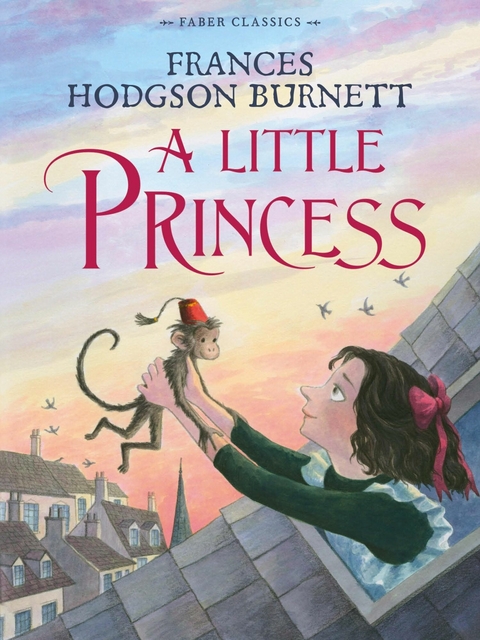
Little Princess (eBook)
352 Seiten
Faber & Faber (Verlag)
978-0-571-33112-3 (ISBN)
Frances Hodgson Burnett was born in Manchester in 1849 but moved to Tennessee in 1865 when her family fell on hard times. There she began writing stories to earn money and soon became a successful novelist, playwright and children's author of such well-loved works as Little Lord Fauntleroy,A Little Princess and The Secret Garden all of which have been adapted into successful films.
When Sara Crewe's beloved father dies, her fortunes at strict Miss Minchin's boarding school are reversed. Once, she had the finest toys and treasures - now, she is orphaned and penniless, and is forced to become a servant. But as Sara knows, being a princess has nothing to do with being rich. And as she will learn, there is nothing that bravery, imagination, kindness and friendship, cannot overcome. A beautiful classic that has captured the hearts of generations.
Frances Hodgson Burnett was born in Manchester in 1849 but moved to Tennessee in 1865 when her family fell on hard times. There she began writing stories to earn money and soon became a successful novelist, playwright and children's author of such well-loved works as Little Lord Fauntleroy, A Little Princess and The Secret Garden all of which have been adapted into successful films.
Once on a dark winter’s day, when the yellow fog hung so thick and heavy in the streets of London that the lamps were lighted and the shop windows blazed with gas as they do at night, an odd-looking little girl sat in a cab with her father, and was driven rather slowly through the big thoroughfares.
She sat with her feet tucked under her, and leaned against her father, who held her in his arm, as she stared out of the window at the passing people with a queer old-fashioned thoughtfulness in her big eyes.
She was such a little girl that one did not expect to see such a look on her small face. It would have been an old look for a child of twelve, and Sara Crewe was only seven. The fact was, however, that she was always dreaming and thinking odd things, and could not herself remember any time when she had not been thinking things about grown-up people and the world they belonged to. She felt as if she had lived a long, long time.
At this moment she was remembering the voyage she had just made from Bombay with her father, Captain Crewe. She was thinking of the big ship, of the lascars passing silently to and fro on it, of the children playing about on the hot deck, and of some young officers’ wives who used to try to make her talk to them and laughed at the things she said.
Principally, she was thinking of what a queer thing it was that at one time one was in India in the blazing sun, and then in the middle of the ocean, and then driving in a strange vehicle through strange streets where the day was as dark as the night. She found this so puzzling that she moved closer to her father.
‘Papa,’ she said in a low, mysterious little voice which was almost a whisper, ‘papa.’
‘What is it, darling?’ Captain Crewe answered, holding her closer and looking down into her face. ‘What is Sara thinking of?’
‘Is this the place?’ Sara whispered, cuddling still closer to him. ‘Is it, papa?’
‘Yes, little Sara, it is. We have reached it at last.’ And though she was only seven years old, she knew that he felt sad when he said it.
It seemed to her many years since he had begun to prepare her mind for ‘the place’, as she always called it. Her mother had died when she was born, so she had never known or missed her. Her young, handsome, rich, petting father seemed to be the only relation she had in the world. They had always played together and been fond of each other. She only knew he was rich because she had heard people say so when they thought she was not listening, and she had also heard them say that when she grew up she would be rich too. She did not know all that being rich meant. She had always lived in a beautiful bungalow, and had been used to seeing many servants who made salaams to her and called her ‘Missee Sahib’, and gave her her own way in everything. She had had toys and pets and an ayah who worshipped her, and she had gradually learned that people who were rich had these things. That, however, was all she knew about it.
During her short life only one thing had troubled her, and that thing was ‘the place’ she was to be taken to someday. The climate of India was very bad for children, and as soon as possible they were sent away from it – generally to England and to school. She had seen other children go away, and had heard their fathers and mothers talk about the letters they received from them. She had known that she would be obliged to go also, and though sometimes her father’s stories of the voyage and the new country had attracted her, she had been troubled by the thought that he could not stay with her.
‘Couldn’t you go to that place with me, papa?’ she had asked when she was five years old. ‘Couldn’t you go to school too? I would help you with your lessons.’
‘But you will not have to stay for a very long time, little Sara,’ he had always said. ‘You will go to a nice house where there will be a lot of little girls, and you will play together, and I will send you plenty of books, and you will grow so fast that it will seem scarcely a year before you are big enough and clever enough to come back and take care of papa.’
She had liked to think of that. To keep the house for her father; to ride with him and sit at the head of his table when he had dinner-parties; to talk to him and read his books – that would be what she would like most in the world, and if one must go away to ‘the place’ in England to attain it, she must make up her mind to go. She did not care very much for other little girls, but if she had plenty of books she could console herself. She liked books more than anything else, and was, in fact, always inventing stories of beautiful things, and telling them to herself. Sometimes she had told them to her father, and he had liked them as much as she did.
‘Well, papa,’ she said softly, ‘if we are here I suppose we must be resigned.’
He laughed at her old-fashioned speech and kissed her. He was really not at all resigned himself, though he knew he must keep that a secret. His quaint little Sara had been a great companion to him, and he felt he should be a lonely fellow when, on his return to India, he went into his bungalow knowing he need not expect to see the small figure in its white frock come forward to meet him. So he held her very closely in his arm as the cab rolled into the big, dull square in which stood the house which was their destination.
It was a big, dull, brick house, exactly like all the others in its row, but that on the front door there shone a brass plate on which was engraved in black letters:
MISS MINCHIN
Select Seminary for Young Ladies
‘Here we are, Sara,’ said Captain Crewe, making his voice sound as cheerful as possible. Then he lifted her out of the cab and they mounted the steps and rang the bell. Sara often thought afterwards that the house was somehow exactly like Miss Minchin. It was respectable and well-furnished, but everything in it was ugly; and the very armchairs seemed to have hard bones in them. In the hall everything was hard and polished – even the red cheeks of the moon face of the tall clock in the corner had a severe varnished look. The drawing-room into which they were ushered was covered by a carpet with a square pattern upon it, the chairs were square, and a heavy marble timepiece stood upon the heavy marble mantel.
As she sat down in one of the stiff mahogany chairs, Sara cast one of her quick looks about her.
‘I don’t like it, papa,’ she said. ‘But then I dare say soldiers – even brave ones – don’t really like going into battle.’
Captain Crewe laughed outright at this. He was young and full of fun, and he never tired of hearing Sara’s queer speeches.
‘Oh, little Sara,’ he said. ‘What shall I do when I have no one to say solemn things to me? No one else is quite as solemn as you are.’
‘But why do solemn things make you laugh so?’ enquired Sara.
‘Because you are such fun when you say them,’ he answered, laughing still more. And then suddenly he swept her into his arms and kissed her very hard, stopping laughing all at once and looking almost as if tears had come into his eyes.
It was just then that Miss Minchin entered the room. She was very like her house, Sara felt: tall and dull, and respectable and ugly. She had large, cold, fishy eyes, and a large, cold, fishy smile. It spread itself into a very large smile when she saw Sara and Captain Crewe. She had heard a great many desirable things of the young soldier from the lady who had recommended her school to him. Among other things, she had heard that he was a rich father who was willing to spend a great deal of money on his little daughter.
‘It will be a great privilege to have charge of such a beautiful and promising child, Captain Crewe,’ she said, taking Sara’s hand and stroking it. ‘Lady Meredith has told me of her unusual cleverness. A clever child is a great treasure in an establishment like mine.’
Sara stood quietly, with her eyes fixed upon Miss Minchin’s face. She was thinking something odd, as usual.
‘Why does she say I am a beautiful child?’ she was thinking. ‘I am not beautiful at all. Colonel Grange’s little girl, Isobel, is beautiful. She has dimples and rose-coloured cheeks, and long hair the colour of gold. I have short black hair and green eyes; besides which, I am a thin child and not fair in the least. I am one of the ugliest children I ever saw. She is beginning by telling a story.’
She was mistaken, however, in thinking she was an ugly child. She was not in the least like Isobel Grange, who had been the beauty of the regiment, but she had an odd charm of her own. She was a slim, supple creature, rather tall for her age, and had an intense, attractive little face. Her hair was heavy and quite black and only curled at the tips; her eyes were greenish grey, it is true, but they were big, wonderful eyes with long, black lashes, and though she herself did not like the colour of them, many other people did. Still she was very firm in her belief that she was an ugly little girl, and she was not at all elated by Miss Minchin’s flattery.
‘I should be telling a story if I said she was beautiful,’ she thought, ‘and I should know I was telling a story. I believe I am as ugly as she is – in my way. What did she say that for?’
After she had known Miss Minchin longer she learned why she had said it. She discovered that she said the same thing to each papa and mamma who brought a child to her school.
Sara stood near her father and listened...
| Erscheint lt. Verlag | 5.5.2016 |
|---|---|
| Verlagsort | London |
| Sprache | englisch |
| Themenwelt | Kinder- / Jugendbuch ► Jugendbücher ab 12 Jahre |
| Kinder- / Jugendbuch ► Kinderbücher bis 11 Jahre | |
| Schlagworte | children's classics • Cinderella • classics • Little Lord Fauntleroy • Miss Minchin • sara crewe • The Secret Garden |
| ISBN-10 | 0-571-33112-2 / 0571331122 |
| ISBN-13 | 978-0-571-33112-3 / 9780571331123 |
| Informationen gemäß Produktsicherheitsverordnung (GPSR) | |
| Haben Sie eine Frage zum Produkt? |
 EPUB (Adobe DRM)
Kopierschutz: Adobe-DRM
Adobe-DRM ist ein Kopierschutz, der das eBook vor Mißbrauch schützen soll. Dabei wird das eBook bereits beim Download auf Ihre persönliche Adobe-ID autorisiert. Lesen können Sie das eBook dann nur auf den Geräten, welche ebenfalls auf Ihre Adobe-ID registriert sind.
Details zum Adobe-DRM
Dateiformat: EPUB (Electronic Publication)
EPUB ist ein offener Standard für eBooks und eignet sich besonders zur Darstellung von Belletristik und Sachbüchern. Der Fließtext wird dynamisch an die Display- und Schriftgröße angepasst. Auch für mobile Lesegeräte ist EPUB daher gut geeignet.
Systemvoraussetzungen:
PC/Mac: Mit einem PC oder Mac können Sie dieses eBook lesen. Sie benötigen eine
eReader: Dieses eBook kann mit (fast) allen eBook-Readern gelesen werden. Mit dem amazon-Kindle ist es aber nicht kompatibel.
Smartphone/Tablet: Egal ob Apple oder Android, dieses eBook können Sie lesen. Sie benötigen eine
Geräteliste und zusätzliche Hinweise
Buying eBooks from abroad
For tax law reasons we can sell eBooks just within Germany and Switzerland. Regrettably we cannot fulfill eBook-orders from other countries.
aus dem Bereich