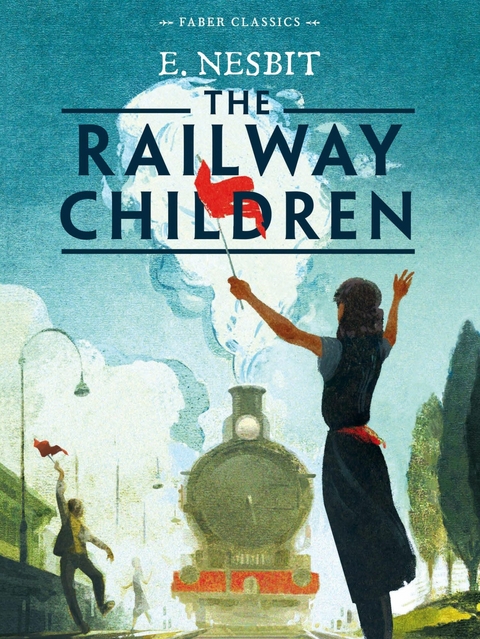
Railway Children (eBook)
352 Seiten
Faber & Faber (Verlag)
978-0-571-33151-2 (ISBN)
Edith Nesbit (15 August 1858 - 4 May 1924) was an English author and poet. She is famous for inspiring much of the children's adventure story genre. She wrote or collaborated on over sixty books of fiction for children, several of which have been adapted for film and television, including The Railway Children and Five Children and It and its sequels in the Psammead trilogy.
When Roberta, Peter and Phyllis's father is taken away and they move to a tiny cottage in the countryside, the only advantage is the nearby railway. Join them on their adventures as they befriend all those who work with the trains, prevent a railway disaster and try to discover the truth behind their father's disappearance. The Railway Children, a much-loved children's classic, was first published in 1906 and has never been out of print.
Edith Nesbit (15 August 1858 - 4 May 1924) was an English author and poet. She is remembered for her children's stories but she also wrote poems, plays, and novels. She is famous for inspiring much of the children's adventure story genre. She was also a political activist and co-founded the Fabian Society, a socialist organisation later connected to the Labour Party. She wrote or collaborated on over sixty books of fiction for children, several of which have been adapted for film and television, including The Railway Children and Five Children and It and its sequels in the Psammead trilogy.
They were not Railway Children to begin with. I don’t suppose they had ever thought about railways except as means of getting to Maskelyne and Cooke’s, the pantomime, Zoological Gardens, and Madame Tussaud’s. They were just ordinary suburban children, and they lived with their father and mother in an ordinary red-brick-fronted villa, with coloured glass in the front door, a tiled passage that was called a hall, a bathroom with hot and cold water, electric bells, French windows, and a good deal of white paint, and ‘every modern convenience’, as the house-agents say.
There were three of them. Roberta was the eldest. Of course, mothers never have favourites, but if their mother had had a favourite, it might have been Roberta. Next came Peter, who wished to be an engineer when he grew up; and the youngest was Phyllis, who meant extremely well.
Mother did not spend all her time in paying dull calls to dull ladies, and sitting dully at home waiting for dull ladies to pay calls to her. She was almost always there, ready to play with the children, and read to them, and help them to do their home-lessons. Besides this she used to write stories for them while they were at school, and read them aloud after tea, and she always made up funny pieces of poetry for their birthdays and for other great occasions, such as the christening of the new kittens, or the refurnishing of the doll’s house, or the time when they were getting over the mumps.
These three lucky children always had everything they needed: pretty clothes, good fires, a lovely nursery with heaps of toys, and a Mother Goose wallpaper. They had a kind and merry nursemaid, and a dog who was called James, and who was their very very own. They also had a father who was just perfect – never cross, never unjust, and always ready for a game – at least if at any time he was not ready, he always had an excellent reason for it, and explained the reason to the children so interestingly and funnily that they felt sure he couldn’t help himself.
You will think that they ought to have been very happy. And so they were, but they did not know how happy till the pretty life in the Red Villa was over and done with, and they had to live a very different life indeed.
The dreadful change came quite suddenly.
Peter had a birthday – his tenth. Among his other presents was a model engine more perfect than you could ever have dreamed of. The other presents were full of charm, but the engine was fuller of charm than any of the others were.
Its charm lasted in its full perfection for exactly three days. Then, owing either to Peter’s inexperience or Phyllis’s good intentions, which had been rather pressing, or to some other cause, the engine suddenly went off with a bang. James was so frightened that he went out and did not come back all day. All the Noah’s Ark people who were in the tender were broken to bits, but nothing else was hurt except the poor little engine and the feelings of Peter. The others said he cried over it – but of course boys of ten do not cry, however terrible the tragedies may be which darken their lot. He said that his eyes were red because he had a cold. This turned out to be true, though Peter did not know it was when he said it, and next day he had to go to bed and stay there. Mother began to be afraid that he might be sickening for measles, when suddenly he sat up in bed and said – ‘I hate gruel – I hate barley water – I hate bread and milk. I want to get up and have something real to eat.’
‘What would you like?’ Mother asked.
‘A pigeon pie,’ said Peter, eagerly, ‘a large pigeon pie. A very large one.’
So Mother asked the cook to make a large pigeon pie. The pie was made. And when the pie was made, it was cooked. And when it was cooked, Peter ate some of it. After that his cold was better. Mother made a piece of poetry to amuse him while the pie was being made. It began by saying what an unfortunate but worthy boy Peter was, and then it went on –
He had an engine that he loved
With all his heart and soul,
And if he had a wish on earth
It was to keep it whole.
One day – my friends, prepare your minds;
I’m coming to the worst –
Quite suddenly a screw went mad,
And then the boiler burst!
With gloomy face he picked it up
And took it to his mother,
Though even he could not suppose
That she could make another;
For those who perished on the line
He did not seem to care,
His engine being more to him
Than all the people there.
And now you see the reason why
Our Peter has been ill:
He soothes his soul with pigeon pie
His gnawing grief to kill.
He wraps himself in blankets warm
And sleeps in bed till late,
Determined thus to overcome
His miserable fate.
And if his eyes are rather red,
His cold must just excuse it:
Offer him pie; you may be sure
He never will refuse it.
Father had been away in the country for three or four days. All Peter’s hopes for the curing of his afflicted engine were now fixed on his father, for Father was most wonderfully clever with his fingers. He could mend all sorts of things. He had often acted as veterinary surgeon to the wooden rocking-horse; once he had saved its life when all human aid was despaired of, and the poor creature was given up for lost, and even the carpenter said he didn’t see his way to do anything. And it was Father who mended the doll’s cradle when no one else could; and with a little glue and some bits of wood and a penknife made all the Noah’s Ark beasts as strong on their pins as ever they were, if not stronger.
Peter with heroic unselfishness did not say anything about his engine till after Father had had his dinner and his after-dinner cigar. The unselfishness was Mother’s idea – but it was Peter who carried it out. And it needed a good deal of patience, too.
At last Mother said to Father, ‘Now, dear, if you’re quite rested, and quite comfy, we want to tell you about the great railway accident, and ask your advice.’
‘All right,’ said Father, ‘fire away!’
So then Peter told the sad tale, and fetched what was left of the engine.
‘Hum,’ said Father, when he had looked the engine over very carefully.
The children held their breaths.
‘Is there no hope?’ said Peter, in a low, unsteady voice.
‘Hope? Rather! Tons of it,’ said Father, cheerfully; ‘but it’ll want something besides hope – a bit of brazing, say, or some solder, and a new valve. I think we’d better keep it for a rainy day. In other words, I’ll give up Saturday afternoon to it, and you shall all help me.’
‘Can girls help to mend engines?’ Peter asked doubtfully.
‘Of course they can. Girls are just as clever as boys, and don’t you forget it! How would you like to be an engine-driver, Phil?’
‘My face would be always dirty, wouldn’t it?’ said Phyllis, in unenthusiastic tones, ‘and I expect I should break something.’
‘I should just love it,’ said Roberta – ‘do you think I could when I’m grown up, Daddy? Or even a stoker?’
‘You mean a fireman,’ said Daddy, pulling and twisting at the engine. ‘Well, if you still wish it, when you’re grown up, we’ll see about making you a fire-woman. I remember when I was a boy –’
Just then there was a knock at the front door.
‘Who on earth!’ said Father. ‘An Englishman’s house is his castle, of course, but I do wish they built semi-detached villas with moats and drawbridges.’
Ruth – she was the parlour-maid and had red hair – came in and said that two gentlemen wanted to see the master.
‘I’ve shown them into the library, sir,’ said she.
‘I expect it’s the subscription to the vicar’s testimonial,’ said Mother, ‘or else it’s the choir-holiday-fund. Get rid of him quickly, dear. It does break up an evening so, and it’s nearly the children’s bedtime.’
But Father did not seem to be able to get rid of the gentlemen at all quickly.
‘I wish we had got a moat and drawbridge,’ said Roberta; ‘then when we didn’t want people, we could just pull up the drawbridge and no one could get in. I expect Father will have forgotten about when he was a boy if they stay much longer.’
Mother tried to make the time pass by telling them a new fairy story about a princess with green eyes, but it was difficult because they could hear the voices of Father and the gentlemen in the library, and Father’s voice sounded louder and different to the voice he generally used to people who came about testimonials and holiday funds.
Then the library bell rang, and everyone heaved a breath of relief.
‘They’re going now,’ said Phyllis; ‘he’s rung to have them shown out.’
But instead of showing anybody out, Ruth showed herself in, and she looked queer, the children thought.
‘Please’m,’ she said, ‘the master wants you to just step into the study. He looks like the dead, mum; I think he’s had bad news. You’d best prepare yourself for the worst, ’m – p’raps it’s a death in the family or a bank busted or –’
‘That’ll do, Ruth,’ said Mother, gently; ‘you can go.’
Then Mother went into the library. There was...
| Erscheint lt. Verlag | 3.5.2016 |
|---|---|
| Verlagsort | London |
| Sprache | englisch |
| Themenwelt | Kinder- / Jugendbuch ► Jugendbücher ab 12 Jahre |
| Kinder- / Jugendbuch ► Kinderbücher bis 11 Jahre | |
| Schlagworte | adventure stories • children's classics • classics • five children and it • Old Gentleman • The Enchanted Castle • The Pheonix and the Carpet |
| ISBN-10 | 0-571-33151-3 / 0571331513 |
| ISBN-13 | 978-0-571-33151-2 / 9780571331512 |
| Informationen gemäß Produktsicherheitsverordnung (GPSR) | |
| Haben Sie eine Frage zum Produkt? |
 EPUB (Adobe DRM)
Kopierschutz: Adobe-DRM
Adobe-DRM ist ein Kopierschutz, der das eBook vor Mißbrauch schützen soll. Dabei wird das eBook bereits beim Download auf Ihre persönliche Adobe-ID autorisiert. Lesen können Sie das eBook dann nur auf den Geräten, welche ebenfalls auf Ihre Adobe-ID registriert sind.
Details zum Adobe-DRM
Dateiformat: EPUB (Electronic Publication)
EPUB ist ein offener Standard für eBooks und eignet sich besonders zur Darstellung von Belletristik und Sachbüchern. Der Fließtext wird dynamisch an die Display- und Schriftgröße angepasst. Auch für mobile Lesegeräte ist EPUB daher gut geeignet.
Systemvoraussetzungen:
PC/Mac: Mit einem PC oder Mac können Sie dieses eBook lesen. Sie benötigen eine
eReader: Dieses eBook kann mit (fast) allen eBook-Readern gelesen werden. Mit dem amazon-Kindle ist es aber nicht kompatibel.
Smartphone/Tablet: Egal ob Apple oder Android, dieses eBook können Sie lesen. Sie benötigen eine
Geräteliste und zusätzliche Hinweise
Buying eBooks from abroad
For tax law reasons we can sell eBooks just within Germany and Switzerland. Regrettably we cannot fulfill eBook-orders from other countries.
aus dem Bereich