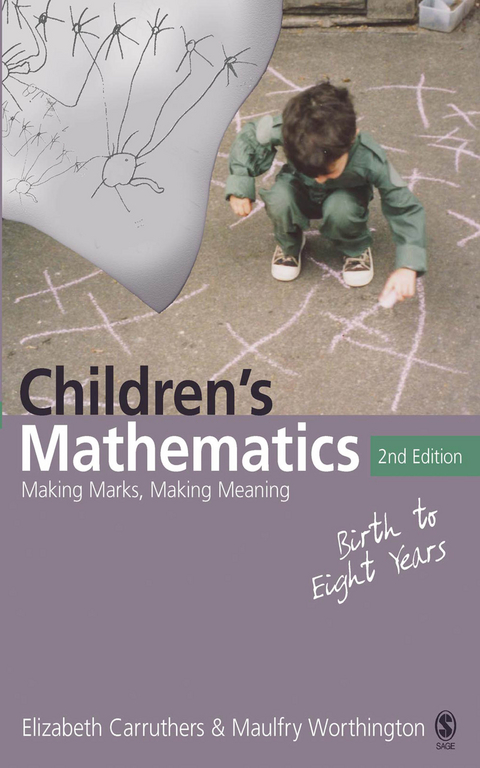
Children′s Mathematics (eBook)
280 Seiten
SAGE Publications Ltd (Verlag)
978-1-4462-2437-3 (ISBN)
Who Takes Notice of Children′s Own ′Written′ Mathematics?
Children′s Mathematical Graphics
International Findings
Studies That Relate To Mathematical Literacy
Enquiring into Children′s Mathematics
Making Marks, Making Meaning
Children Making Meaning with Marks
Different Literacies: Mathematical Literacy
Children Represent Their Mathematical Actions and Understanding On Paper
Learning Theories
Reading and Using Mathematical Graphics
Sociocultural Perspectives Contexts in Early Years Settings
Teachers′ Beliefs
Creativity in Mathematics
Summary
Mathematical Schemas
What Is a Schema?
Schemas and Mathematics
Schemas and Mark-Making
Observing Schemas in a School Setting
Mapping Patterns of Schema Exploration
Early Writing, Early Mathematics
The Significance of Emergent Writing
Young Children Explore Symbols
Early Writing and Early Mathematical Marks
Early (Emergent) Literacy Is Often Misunderstood
Conclusion
Bridging the Gap between Home and School Mathematics
Disconnections
Understanding Symbols
Mathematics as a Foreign Language
Becoming Binumerate
Teachers′ Difficulties
Conclusion
Making Sense of Children′s Mathematical Graphics
The Evolution of Children′s Early Marks
Categories of Children′s Mathematical Graphics
Common Forms of Graphical Marks
Early Development of Mathematical Meaning
Early Explorations with Marks
′The Beginning Is Everything′
Early Written Numerals
Numerals as Labels
Representations of Quantities and Counting
The Development of Early Written Number, Quantities and Counting
Understanding Children′s Developing Calculations
Practical Mathematics
The Fifth Dimension: Written Calculations
Representations of Early Operations
Counting Continuously
Narrative Actions
Supporting Children′s Own Mathematical Marks
Separating Sets
Exploring Symbols
Standard Symbolic Calculations with Small Numbers
Calculations with Larger Numbers Supported By Jottings
The Development of Children′s Mathematical Graphics: Becoming Binumerate
Conclusion
Environments That Support Children′s Mathematical Graphics
Rich Mathematical Environments for Learning
The Balance between Adult-Led and Child-Initiated Learning
Role-Play and Mark-Making
The Physical Environment
Practical Steps
Graphics Areas
Conclusion
Case Studies from Early Childhood Settings
The Birthday Cards
A Number Line
′No Entry′
Carl′s Garage
Children′s Centres: The Cambridge Learning Network Project
Spontaneous Dice Game
Young Children Think Division
A Zoo Visit
Mathematics and Literacy in Role-Play: The Library Van
Aaron and the Train
Multiplying Larger Numbers
Nectarines for a Picnic
Conclusion
Developing Children′s Written Methods
The Assessment of Children′s Mathematical Representations On Paper
The Problem with Worksheets
Assessing Samples of Children′s Own Mathematics
Examples of Assessment of Children′s Mathematics
The Pedagogy of Children′s Mathematical Graphics
Modelling Mathematics
Involving Parents and Families
Children′s First and Continuing Educators
The Home As a Rich Learning Environment
What Mathematics Do Young Children Do At Home?
What Mathematics Do Parents Notice At Home?
Parents Observe a Wealth of Mathematics
Helping Parents Recognise Children′s Mathematical Marks
Parents′ Questions about Children′s Mathematical Graphics
Conclusion
Children, Teachers and Possibilities
Inclusion
Children′s Questions
Teachers′ Questions
It′s All Very Well - But What About Test Scores?
Reflections
| Erscheint lt. Verlag | 7.8.2006 |
|---|---|
| Verlagsort | London |
| Sprache | englisch |
| Themenwelt | Kinder- / Jugendbuch ► Spielen / Lernen ► Lernen / Lernspiele |
| Schulbuch / Wörterbuch ► Schulbuch / Allgemeinbildende Schulen | |
| Sozialwissenschaften ► Pädagogik ► Vorschulpädagogik | |
| Schlagworte | children • early childhood • Early Years • Education • learning • Math • mathematical graphics • Numbers • Teach |
| ISBN-10 | 1-4462-2437-6 / 1446224376 |
| ISBN-13 | 978-1-4462-2437-3 / 9781446224373 |
| Informationen gemäß Produktsicherheitsverordnung (GPSR) | |
| Haben Sie eine Frage zum Produkt? |
 EPUB (Adobe DRM)
Kopierschutz: Adobe-DRM
Adobe-DRM ist ein Kopierschutz, der das eBook vor Mißbrauch schützen soll. Dabei wird das eBook bereits beim Download auf Ihre persönliche Adobe-ID autorisiert. Lesen können Sie das eBook dann nur auf den Geräten, welche ebenfalls auf Ihre Adobe-ID registriert sind.
Details zum Adobe-DRM
Dateiformat: EPUB (Electronic Publication)
EPUB ist ein offener Standard für eBooks und eignet sich besonders zur Darstellung von Belletristik und Sachbüchern. Der Fließtext wird dynamisch an die Display- und Schriftgröße angepasst. Auch für mobile Lesegeräte ist EPUB daher gut geeignet.
Systemvoraussetzungen:
PC/Mac: Mit einem PC oder Mac können Sie dieses eBook lesen. Sie benötigen eine
eReader: Dieses eBook kann mit (fast) allen eBook-Readern gelesen werden. Mit dem amazon-Kindle ist es aber nicht kompatibel.
Smartphone/Tablet: Egal ob Apple oder Android, dieses eBook können Sie lesen. Sie benötigen eine
Geräteliste und zusätzliche Hinweise
Buying eBooks from abroad
For tax law reasons we can sell eBooks just within Germany and Switzerland. Regrettably we cannot fulfill eBook-orders from other countries.
aus dem Bereich