


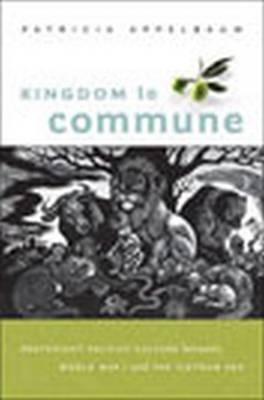
Kingdom to Commune
Protestant Pacifist Culture between World War I and the Vietnam Era
Seiten
2009
|
New edition
The University of North Carolina Press (Verlag)
978-0-8078-3267-7 (ISBN)
The University of North Carolina Press (Verlag)
978-0-8078-3267-7 (ISBN)
- Titel ist leider vergriffen;
keine Neuauflage - Artikel merken
American religious pacifism is usually explained in terms of its practitioners' ethical and philosophical commitments. This book argues that Protestant pacifism, which constituted the religious center of the large-scale peace movement in the United States after World War I, developed in the broader context of American religious currents.
American religious pacifism is usually explained in terms of its practitioners' ethical and philosophical commitments. Patricia Appelbaum argues that Protestant pacifism, which constituted the religious center of the large-scale peace movement in the United States after World War I, is best understood as a culture that developed dynamically in the broader context of American religious, historical, and social currents.Exploring piety, practice, and material religion, Appelbaum describes a surprisingly complex culture of Protestant pacifism expressed through social networks, iconography, vernacular theology, individual spiritual practice, storytelling, identity rituals, and cooperative living. Between World War I and the Vietnam War, she contends, a paradigm shift took place in the Protestant pacifist movement. Pacifism moved from a mainstream position to a sectarian and marginal one, from an embrace of modernity to skepticism about it, and from a Christian center to a purely pacifist one, with an informal, flexible theology.The book begins and ends with biographical profiles of two very different pacifists, Harold Gray and Marjorie Swann. Their stories distill the changing religious culture of American pacifism revealed in Kingdom to Commune.
American religious pacifism is usually explained in terms of its practitioners' ethical and philosophical commitments. Patricia Appelbaum argues that Protestant pacifism, which constituted the religious center of the large-scale peace movement in the United States after World War I, is best understood as a culture that developed dynamically in the broader context of American religious, historical, and social currents.Exploring piety, practice, and material religion, Appelbaum describes a surprisingly complex culture of Protestant pacifism expressed through social networks, iconography, vernacular theology, individual spiritual practice, storytelling, identity rituals, and cooperative living. Between World War I and the Vietnam War, she contends, a paradigm shift took place in the Protestant pacifist movement. Pacifism moved from a mainstream position to a sectarian and marginal one, from an embrace of modernity to skepticism about it, and from a Christian center to a purely pacifist one, with an informal, flexible theology.The book begins and ends with biographical profiles of two very different pacifists, Harold Gray and Marjorie Swann. Their stories distill the changing religious culture of American pacifism revealed in Kingdom to Commune.
Patricia Appelbaum is an independent scholar living in Amherst, Massachusetts.
| Erscheint lt. Verlag | 30.3.2009 |
|---|---|
| Verlagsort | Chapel Hill |
| Sprache | englisch |
| Maße | 156 x 235 mm |
| Gewicht | 639 g |
| Themenwelt | Geisteswissenschaften ► Geschichte ► Regional- / Ländergeschichte |
| Geschichte ► Teilgebiete der Geschichte ► Religionsgeschichte | |
| Religion / Theologie ► Christentum ► Kirchengeschichte | |
| Religion / Theologie ► Christentum ► Moraltheologie / Sozialethik | |
| ISBN-10 | 0-8078-3267-7 / 0807832677 |
| ISBN-13 | 978-0-8078-3267-7 / 9780807832677 |
| Zustand | Neuware |
| Informationen gemäß Produktsicherheitsverordnung (GPSR) | |
| Haben Sie eine Frage zum Produkt? |
Mehr entdecken
aus dem Bereich


aus dem Bereich
von der Antike bis zur Gegenwart
Buch | Softcover (2025)
C.H.Beck (Verlag)
CHF 16,80


