Michel Thomas Method
John Murray Learning (Verlag)
9780340983935 (ISBN)
- Titel ist leider vergriffen;
keine Neuauflage - Artikel merken
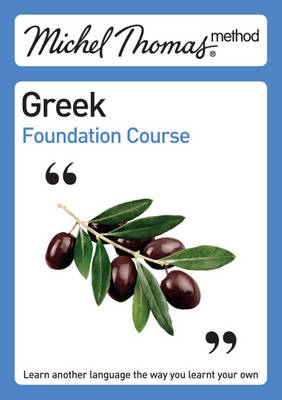
Learn another language the way you learnt your own You learnt your own language naturally and enjoyably: now you can learn Greek in the same way. You'll stick with it because you'll love it Use the unique method perfected over fifty years by the celebrated psychologist and linguist Michel Thomas. This method works with your brain, helping you to build up your Greek in manageable, enjoyable steps by thinking out the answers for yourself. You learn through listening and speaking without the pressure of writing or memorising. You pick up the language naturally and unforgettably. The NEW Greek Foundation Course An eight-hour, 100% audio method for learning Greek. Join teacher Hara Garoufalia and two students in a live lesson and within the first hour you will be able to construct simple phrases. You will learn the language with the students, hearing both their successes and their mistakes to keep you motivated and involved throughout the course. By the end, you will have the confidence to understand and speak Greek.
Join the millions of people worldwide who have learnt a new language with the Michel Thomas Method Contents: 8 CDs plus booklet with Greek phrases in Greek script and Roman transliteration, with English translation
Until May 2008 Hara Garoufalia-Middle taught Greek at both the University of Westminster and the City Literary Institute. Now she concentrates on teaching classes at the City Lit, as well as writing. Howard Middle is a consultant and project manager in the field of English as a Foreign Language. He was National Manager for Trinity College London's ESOL exams in Greece until mid 2009 and remains a consultant for this exam board.
thelo = I want; exo = I have; 'you' form of the verbs; ego/esis = I/you; form a question by upward inflexion; saying 'yes', 'no', 'not' (no auxiliary in Greek); question words 'what? why? where?; 'please' and 'thank you'; useful regular verbs in the present: ksero = I know; katalaveno - I understand; perimeno = I am waiting for; agorazo = I buy; no continuous form in Greek; personal pronouns (I, you etc) not always needed with verb; general 'it'; position before the verb; konda = near, makriya = far; se + to = sto = in/at; etho/eki = here/there; ine = is; neuter gender; 'a' and 'the' for neuter words; some common neuter food items and places; signomi - sorry, excuse me; kati = something; conjunctions: and, but, because ime/iste/ine = I am, you are, he/she/it is; introduction of feminine gender; 'a'/'the' for feminine words; some common feminine food/drink items; neuter and feminine pronouns; revision of common regular verbs; he/she/it form of regular verbs; aftos/afti = he/she; alla = but; kano = I make/do, plus you and he/she/it forms; verbs ending in stressed -ao: pao = I go; milao = I speak; milao ellinika = I speak Greek; (poli) kala = (very) well; gallika/ispanika = French, Spanish; ligo = a little; anglika = English'; pinao = I'm hungry; thipsao = I'm thirsty; ponao = I hurt/ache; moo = my: comes after the word, and doesn't change with gender; to stomaxi/thonti moo ponai = my stomach/tooth aches; pothi = foot; introduction of the future with the particle 'tha'; avrio = tomorrow; tora = now afto = this; me/you object pronoun; single phrase for 'tag' questions: etsi then ine (is it not so); endaksi = OK; ime apo = I am from (England); intro of masculine gender and common endings; I am (English) - with masc/feminine ending; countries/nationalities; here is + name = introductions; question word 'who'?; common irregular verbs: see, drink, eat, arrive, leave, in present tense; kathe = each/every (doesn't change); kathe mera = every day; some common adjectives in singular, showing neut/fem/masc agreement; Introduction of simple past of verb to be; xthes = yesterday; 'we' form of verb to be and some known verbs; pronoun mas = 'us'; introduction of adjectives and agreement with nouns in singular; pronouns: me, you, him, her, us, them; moo aresi = I like (it pleases me) + singular subject; panda/pote/sixna = always/never/often; double negative in Greek: I don't have nothing = I don't have anything; noris/arga = early/late; Modals: explanation that there is no infinitive ('to + verb' form) in modern Greek, and action verb form agrees with subject: should/must: verb 'prepi' + particle 'na' plus special form of verb; can: verb boro + particle 'na' plus special form of verb; want to: verb thelo + particle 'na' plus special form of verb; verbs that change form after 'tha' and 'na' 'we' form of verbs. Masculine noun and adjective endings, masculine form of 'the' and 'a'.
| Erscheint lt. Verlag | 1.10.2009 |
|---|---|
| Reihe/Serie | Michel Thomas Method |
| Sprache | englisch |
| Maße | 139 x 197 mm |
| Gewicht | 560 g |
| Themenwelt | Schulbuch / Wörterbuch ► Erwachsenenbildung |
| Schulbuch / Wörterbuch ► Wörterbuch / Fremdsprachen | |
| Geisteswissenschaften ► Sprach- / Literaturwissenschaft ► Sprachwissenschaft | |
| ISBN-13 | 9780340983935 / 9780340983935 |
| Zustand | Neuware |
| Informationen gemäß Produktsicherheitsverordnung (GPSR) | |
| Haben Sie eine Frage zum Produkt? |
aus dem Bereich