


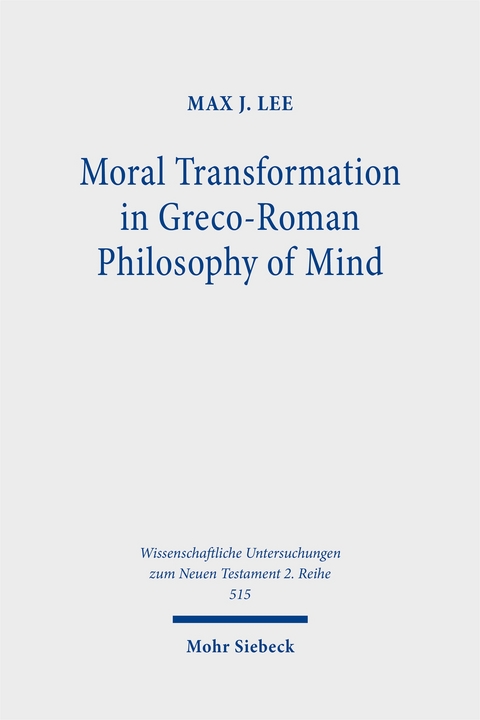
Moral Transformation in Greco-Roman Philosophy of Mind
Mapping the Moral Milieu of the Apostle Paul and his Diaspora Jewish Contemporaries
Seiten
2020
Mohr Siebeck (Verlag)
978-3-16-149660-8 (ISBN)
Mohr Siebeck (Verlag)
978-3-16-149660-8 (ISBN)
Max J. Lee untersucht die Philosophien des Platonismus und Stoizismus während der griechisch-römischen Ära und deren Konkurrenzprogramme daraufhin, wie man die Persönlichkeit eines Menschen vom Laster zur Tugend wandelt. Er zeigt, dass emotionale Kontrolle, ethisches Handeln und Gewohnheit, Charakteranlage, Rat und Gottheit alle zur Moralbildung einer Person beitragen.
Max J. Lee provides a synoptic picture of the moral traditions - especially those of Platonism and Stoicism - which shaped the intellectual and cultural environment of Greco-Roman antiquity. He describes each philosophical school's respective teachings on diverse moral topoi such as emotional control, ethical action and habit, character formation, training, mentorship, and deity. He then organizes each school's tenets into systemic models of moral transformation. For Platonism, the author analyzes the works of Plato, Plutarch, Alcinous and Galen; and for Stoicism, Zeno, Chrysippus, Musonius Rufus, Seneca, and Epictetus, among others. He also constructs a taxonomy of six interaction types to gauge how rival religio-philosophical sects, including Diaspora Judaism and Pauline Christianity, appropriated moral traditions from their Greco-Roman environment to articulate their own system of ethics.
Max J. Lee provides a synoptic picture of the moral traditions - especially those of Platonism and Stoicism - which shaped the intellectual and cultural environment of Greco-Roman antiquity. He describes each philosophical school's respective teachings on diverse moral topoi such as emotional control, ethical action and habit, character formation, training, mentorship, and deity. He then organizes each school's tenets into systemic models of moral transformation. For Platonism, the author analyzes the works of Plato, Plutarch, Alcinous and Galen; and for Stoicism, Zeno, Chrysippus, Musonius Rufus, Seneca, and Epictetus, among others. He also constructs a taxonomy of six interaction types to gauge how rival religio-philosophical sects, including Diaspora Judaism and Pauline Christianity, appropriated moral traditions from their Greco-Roman environment to articulate their own system of ethics.
Born 1968; 2002 PhD in Theology; 2002-03 Assistant (Adjunct) Professor of Religious Studies, Westmont College, Santa Barbara, CA; 2003-06 Visiting Assistant Professor of New Testament, Wheaton College, Wheaton, IL; 2006-08 Assistant Professor of New Testament; since 2008 Associate Professor of New Testament, North Park Theological Seminary, Chicago, IL.
| Erscheint lt. Verlag | 15.4.2020 |
|---|---|
| Reihe/Serie | Wissenschaftliche Untersuchungen zum Neuen Testament 2. Reihe |
| Verlagsort | Tübingen |
| Sprache | englisch |
| Maße | 156 x 233 mm |
| Gewicht | 1028 g |
| Themenwelt | Religion / Theologie ► Christentum ► Bibelausgaben / Bibelkommentare |
| Geisteswissenschaften ► Religion / Theologie ► Judentum | |
| Geisteswissenschaften ► Sprach- / Literaturwissenschaft ► Literaturwissenschaft | |
| Schlagworte | Ancient • Ancient Ethical Theory • Ancient Philosophy • Apostle • Classical • Classical Studies • Diaspora • ethics • Judaism • Middle Platonism • Moral • Paul • Philology • Stoicism |
| ISBN-10 | 3-16-149660-4 / 3161496604 |
| ISBN-13 | 978-3-16-149660-8 / 9783161496608 |
| Zustand | Neuware |
| Informationen gemäß Produktsicherheitsverordnung (GPSR) | |
| Haben Sie eine Frage zum Produkt? |
Mehr entdecken
aus dem Bereich

aus dem Bereich
Buch | Softcover (2021)
De Gruyter (Verlag)
CHF 44,90


