


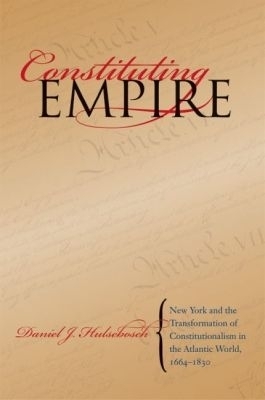
Constituting Empire
New York and the Transformation of Constitutionalism in the Atlantic World, 1664-1830
Seiten
2008
|
New edition
The University of North Carolina Press (Verlag)
978-0-8078-5920-9 (ISBN)
The University of North Carolina Press (Verlag)
978-0-8078-5920-9 (ISBN)
Captures the paradox at the heart of American constitutional history. This title argues that the revolutionary transformation did not, therefore, consist of a conception of the constitution as a set of restrictions on the power of the state.
In his paradigm-shifting analysis, Daniel J. Hulsebosch captures the essential paradox at the heart of American constitutional history: the Revolution, which brought political independence and substituted the people for the British crown as the source of legitimate authority, also led to the establishment of newly powerful constitutions and a new postcolonial genre of constitutional law that would have been the envy of the British imperial agents who had struggled to govern the colonies before the Revolution.The revolutionary transformation did not, therefore, consist of a new conception of the constitution as a set of restrictions on the power of the state, Hulsebosch argues. Instead, it entailed a search for new ways of framing, empowering, and limiting official power. Hulsebosch demonstrates that these constitutional experiments were informed by imperial experience and continued well into the nineteenth century, as New York moved from the periphery of the British Atlantic empire to the center of a new continental empire.
In his paradigm-shifting analysis, Daniel J. Hulsebosch captures the essential paradox at the heart of American constitutional history: the Revolution, which brought political independence and substituted the people for the British crown as the source of legitimate authority, also led to the establishment of newly powerful constitutions and a new postcolonial genre of constitutional law that would have been the envy of the British imperial agents who had struggled to govern the colonies before the Revolution.The revolutionary transformation did not, therefore, consist of a new conception of the constitution as a set of restrictions on the power of the state, Hulsebosch argues. Instead, it entailed a search for new ways of framing, empowering, and limiting official power. Hulsebosch demonstrates that these constitutional experiments were informed by imperial experience and continued well into the nineteenth century, as New York moved from the periphery of the British Atlantic empire to the center of a new continental empire.
DANIEL J. HULSEBOSCH is professor of law and history at New York University School of Law.
| Erscheint lt. Verlag | 1.10.2008 |
|---|---|
| Reihe/Serie | Studies in Legal History |
| Verlagsort | Chapel Hill |
| Sprache | englisch |
| Maße | 149 x 226 mm |
| Gewicht | 485 g |
| Themenwelt | Schulbuch / Wörterbuch ► Lexikon / Chroniken |
| Geisteswissenschaften ► Geschichte ► Regional- / Ländergeschichte | |
| Recht / Steuern ► EU / Internationales Recht | |
| Recht / Steuern ► Öffentliches Recht | |
| ISBN-10 | 0-8078-5920-6 / 0807859206 |
| ISBN-13 | 978-0-8078-5920-9 / 9780807859209 |
| Zustand | Neuware |
| Informationen gemäß Produktsicherheitsverordnung (GPSR) | |
| Haben Sie eine Frage zum Produkt? |
Mehr entdecken
aus dem Bereich



aus dem Bereich
die Geschichte meiner Urgroßmutter
Buch | Hardcover (2025)
C.H.Beck (Verlag)
CHF 32,15


