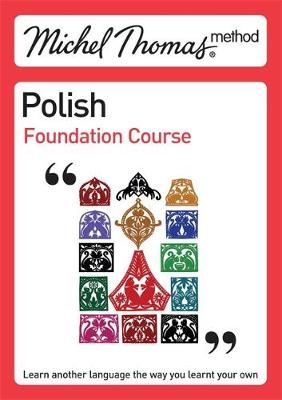
Michel Thomas Method
John Murray Learning (Verlag)
978-0-340-97517-6 (ISBN)
- Titel ist leider vergriffen;
keine Neuauflage - Artikel merken
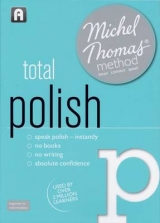
Learn another language the way you learnt your own You learnt your own language naturally and enjoyably: now you can learn Polish in the same way. You'll stick with it because you'll love it Use the unique method perfected over fifty years by the celebrated psychologist and linguist Michel Thomas. This method works with your brain, helping you to build up your Polish in manageable, enjoyable steps by thinking out the answers for yourself. You learn through listening and speaking without the pressure of writing or memorising. You pick up the language naturally and unforgettably. The NEW Polish Foundation Course An eight-hour, 100% audio method for learning Polish. Join teacher Jolanta Cecula and two students in a live lesson and within the first hour you will be able to construct simple phrases. You will learn the language with the students, hearing both their successes and their mistakes to keep you motivated and involved throughout the course. By the end, you will have the confidence to understand and speak Polish.
Join the millions of people worldwide who have learnt a new language with the Michel Thomas Method Contents: 8 CDs plus booklet with Polish phrases in English translation
Jolanta Cecula taught Polish at Kings College London and is an Affiliate of the Chartered Institute of Linguists.
Introduction. How to use this course. Similarities between English and Polish. To jest opera = 'this (is) (an / the) opera' - no word for 'is', 'a' or 'the' in Polish Explanation of stress in Polish Form a question by inflexion: raising intonation Saying 'yes', 'no', 'not' 'Czy' - question word to which the expected answer is yes / no Question words 'what?', 'who?' Pan/pani = formal 'you' 'I have' - mam; 'I don't have' - nie mam Making words plural (more than one) 'Here' = tutaj, 'there' - tam 'I am' = jestem Adjectives: ciekawy 'interesting' Jestem ciekawy/ciekawa - 'I wonder' -cja in Polish is '-tion' in English Question word gdzie = 'where?' Adverbs: blisko 'close'; daleko 'far' Mozna = 'possible' so 'I / you / he/ one etc. can / may'; saying 'please' and 'thank you' Using infinitives (the 'to' form of the verb) after mozna = 'possible': mozna kupic? = 'Possible to buy?' Nie mozna = 'not possible' so 'I / you / he/ one etc. shouldn't, I / you / he/ one etc. am / are / is not allowed' Using infinitives after nie mozna = 'not possible': nie mozna kupic = 'not allowed to buy' Wiedziec = 'to know'; rozumiec = 'to understand'; umiec='can, be able to'; dowiedziec sie= 'to find out'; Soft consonants in Polish 'I' form of verbs 'Nothing' and double negatives Chciec = 'to want'; lubic = 'to like'; musiec = 'must'; moc = 'can, be able to, may'; mowic = 'to speak'; myslec = 'to think' 'To be' = byc; 'To have' = miec (Ja) (nie) chce = I (don't) want (it); jesc = 'to eat', pic = 'to drink'; robic = 'to do' 'You', 's/he', 'it', form of verbs Asking politely 'Me', 'you' as object of verb ('I understand you') Question word 'how?' Pracowac = 'to work' (-e track of -owac verbs - approx. 25 % of all Polish verbs) Trzeba = 'necessary', 'one needs' Using infinitives (the 'to' form of the verb) after trzeba = 'necessary', 'one needs': trzeba pracowac = 'one needs to work' Czytac = 'to work' (-m track of verbs - approx. 25 % of all Polish verbs) Masculine, feminine, neuter and plural endings for adjectives (adjectives used before the word they describe) Mowic = 'to speak'; chciec = 'to want'; powiedziec = 'to, say, tell' (Ja) bede = 'I will (be)'; (ja) bede jesc = 'I will eat'; Pan/pani bedzi = 'you will (be)' Question word kiedy? 'when?' 'He / she, it' and form of verbs; 'we' and form of verbs Reflexive verbs e.g. uczyc sie = 'to learn'; explanation of 'sie' Question word dlaczego = 'why?' Possessive adjective 'my' in masculine, feminine, plural and neuter forms Past tense of verbs: 'I / he / she / we / you / they knew / thought' Past tense of 'to be' ('was, were'); past tense of 'have'('had); Zapomniec = 'to forget' Verb forms for 'they'
| Erscheint lt. Verlag | 1.12.2008 |
|---|---|
| Reihe/Serie | Michel Thomas Method |
| Sprache | englisch |
| Maße | 169 x 197 mm |
| Gewicht | 565 g |
| Themenwelt | Schulbuch / Wörterbuch ► Erwachsenenbildung |
| Schulbuch / Wörterbuch ► Wörterbuch / Fremdsprachen | |
| Geisteswissenschaften ► Sprach- / Literaturwissenschaft ► Sprachwissenschaft | |
| ISBN-10 | 0-340-97517-2 / 0340975172 |
| ISBN-13 | 978-0-340-97517-6 / 9780340975176 |
| Zustand | Neuware |
| Informationen gemäß Produktsicherheitsverordnung (GPSR) | |
| Haben Sie eine Frage zum Produkt? |
aus dem Bereich