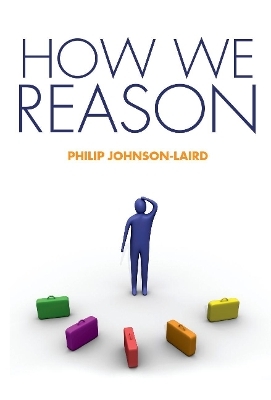
How We Reason
Oxford University Press (Verlag)
9780199551330 (ISBN)
Good reasoning can lead to success; bad reasoning can lead to catastrophe. Yet, it's not obvious how we reason, and why we make mistakes - so much of our mental life goes on outside our awareness. In recent years huge strides have been made into developing a scientific understanding of reasoning. This book by one of the pioneers of the field, Philip Johnson-Laird, looks at the mental processes that underlie our reasoning. It provides the most accessible account yet of the science of reasoning.
We can all reason from our childhood onwards - but how? 'How We Reason' outlines a bold approach to understanding reasoning. According to this approach, we don't rely on the laws of logic or probability - we reason by thinking about what's possible, we reason by seeing what is common to the possibilities. As the book shows, this approach can answer many of the questions about how we reason, and what causes mistakes in our reasoning that can lead to disasters such as Chernobyl. It shows why our irrational fears may become psychological illnesses, why terrorists develop 'crazy' ideologies, and how we can act in order to improve our reasoning. The book ends by looking at the role of reasoning in three extraordinary case histories: the Wright brothers' use of analogies in inventing their flyer, the cryptanalysts' deductions in breaking the German's Enigma code in World War II, and Dr. John Snow's inductive reasoning in discovering how cholera spread from one person to another.
Accessible, stimulating, and controversial, 'How We Reason' presents a bold new approach to understanding one of the most intriguing facets of being human.
Phil Johnson-Laird was born in Yorkshire, England, in 1936. He left school at the age of 15 and spent ten years in a variety of occupations until he went to University College, London to read psychology. He later gained his Ph.D. there under the supervision of Peter Wason, and he joined the faculty in 1966. In 1971, he was a visiting member of the Institute of Advanced Study, Princeton, where he began a collaboration with George A. Miller. Subsequently, he held positions at the University of Sussex (1973-1981) and at the Medical Research Council's Applied Psychology Unit (1981-1989) in Cambridge, where he was also a Fellow of Darwin College. He returned to Princeton in 1989 to be a member of the faculty at the University, where he is the Stuart Professor of Psychology. His research concerns thinking, emotions, creativity, and music.
PART I - THE WORLD IN OUR CONSCIOUS MINDS; PART II - THE WORLD IN OUR UNCONSCIOUS MINDS; PART III - HOW WE MAKE DEDUCTIONS; PART IV - HOW WE MAKE INDUCTIONS; PART V - WHAT MAKES US RATIONAL; PART VI - HOW WE DEVELOP OUR ABILITY TO REASON; PART VII - KNOWLEDGE, BELIEFS, AND PROBLEMS; PART VIII - EXPERT REASONING IN TECHNOLOGY, LOGIC, AND SCIENCE
| Erscheint lt. Verlag | 23.10.2008 |
|---|---|
| Zusatzinfo | 18 figures; 12 black and white photos |
| Verlagsort | Oxford |
| Sprache | englisch |
| Maße | 155 x 234 mm |
| Gewicht | 922 g |
| Themenwelt | Geisteswissenschaften ► Philosophie |
| Geisteswissenschaften ► Psychologie ► Allgemeine Psychologie | |
| Geisteswissenschaften ► Psychologie ► Test in der Psychologie | |
| Geisteswissenschaften ► Psychologie ► Verhaltenstherapie | |
| ISBN-13 | 9780199551330 / 9780199551330 |
| Zustand | Neuware |
| Informationen gemäß Produktsicherheitsverordnung (GPSR) | |
| Haben Sie eine Frage zum Produkt? |
aus dem Bereich