


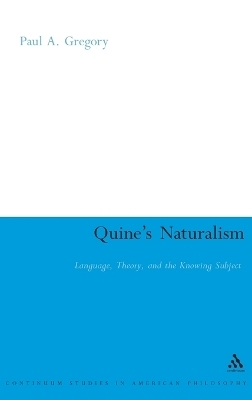
Quine's Naturalism
Language, Theory and the Knowing Subject
Seiten
2008
Continuum International Publishing Group Ltd. (Verlag)
978-0-8264-9099-5 (ISBN)
Continuum International Publishing Group Ltd. (Verlag)
978-0-8264-9099-5 (ISBN)
W V Quine was the most important naturalistic philosopher of the twentieth century and a major impetus for the resurgence of the view that empirical science is our best avenue to knowledge. This book examines Quine's naturalism.
This is a new and highly original monograph examining Quine's naturalism, an issue central to the work of this hugely influential analytic philosopher.W. V. Quine was the most important naturalistic philosopher of the twentieth century and a major impetus for the recent resurgence of the view that empirical science is our best avenue to knowledge. His views, however, have not been well understood. Critics charge that Quine's naturalized epistemology is circular and that it cannot be normative. Yet, such criticisms stem from a cluster of fundamental traditional assumptions regarding language, theory, and the knowing subject - the very presuppositions that Quine is at pains to reject. Through investigation of Quine's views regarding language, knowledge, and reality, the author offers a new interpretation of Quine's naturalism. The naturalism/anti-naturalism debate can be advanced only by acknowledging and critiquing the substantial theoretical commitments implicit in the traditional view. Gregory argues that the responses to the circularity and non-normativity objections do just that.
His analysis further reveals that Quine's departure from the tradition penetrates the conception of the knowing subject, and he thus offers a new and engaging defence of Quine's naturalism.
This is a new and highly original monograph examining Quine's naturalism, an issue central to the work of this hugely influential analytic philosopher.W. V. Quine was the most important naturalistic philosopher of the twentieth century and a major impetus for the recent resurgence of the view that empirical science is our best avenue to knowledge. His views, however, have not been well understood. Critics charge that Quine's naturalized epistemology is circular and that it cannot be normative. Yet, such criticisms stem from a cluster of fundamental traditional assumptions regarding language, theory, and the knowing subject - the very presuppositions that Quine is at pains to reject. Through investigation of Quine's views regarding language, knowledge, and reality, the author offers a new interpretation of Quine's naturalism. The naturalism/anti-naturalism debate can be advanced only by acknowledging and critiquing the substantial theoretical commitments implicit in the traditional view. Gregory argues that the responses to the circularity and non-normativity objections do just that.
His analysis further reveals that Quine's departure from the tradition penetrates the conception of the knowing subject, and he thus offers a new and engaging defence of Quine's naturalism.
Paul A. Gregory is Assistant Professor in Philosophy at Washington and Lee University, Virginia, USA.
1. Introduction; 2. "Epistemology Naturalized" and Naturalized Epistemology; 3. Language, Theory, and Beginning In Mediis Rebus; 4. Circularity, Reciprocal Containment, and Beginning In Mediis; Rebus; 5. Normativity; 6. Ontology and Objectivity; 7. Scientism and the Core of Quine's Naturalism; 8. Changing the Subject.
| Erscheint lt. Verlag | 8.8.2008 |
|---|---|
| Reihe/Serie | Continuum Studies in American Philosophy |
| Verlagsort | London |
| Sprache | englisch |
| Maße | 156 x 234 mm |
| Themenwelt | Geisteswissenschaften ► Philosophie ► Philosophie der Neuzeit |
| ISBN-10 | 0-8264-9099-9 / 0826490999 |
| ISBN-13 | 978-0-8264-9099-5 / 9780826490995 |
| Zustand | Neuware |
| Informationen gemäß Produktsicherheitsverordnung (GPSR) | |
| Haben Sie eine Frage zum Produkt? |
Mehr entdecken
aus dem Bereich

aus dem Bereich
ein Dialog mit Simone Weil
Buch | Softcover (2025)
Matthes & Seitz Berlin (Verlag)
CHF 19,55


