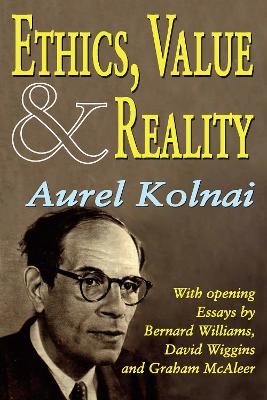
Ethics, Value, and Reality
Routledge (Verlag)
978-1-4128-0740-1 (ISBN)
- Titel nicht im Sortiment
- Artikel merken
For Kolnai, ethical life cannot be adequately understood except by reference to moral emphasis, and thus, Kolnai can be thought of as a liberal conservative. He acknowledges myriad values, moral and non-moral, and accepts that all can have some claim upon us. Low values as much as high values have a legitimate claim. His is a tolerant conservatism though not for a moment does he forgo the necessity of judgment: a readily graspable hierarchy keeps the respective demands of values in proportion. Kolnai welcomes the call to seriousness, which is the hallmark of existentialism.
The ground of Kolnai's thought is the idea of emotion as cognitive. He saw the typical analytical philosopher's fascination with simplicity of explanation not only thoroughly refuted by the gains in understanding wrought by phenomenological method, with its deference to the richness of phenomena, but sensed in the monistic inclination he dreaded a harbinger of totalitarianism. Never denying his emotionalism, he nonetheless made his points well enough by adopting an analytical approach to philosophy and ethics. This is a major work crossing moral and political philosophy.
Aurel Kolnai (1900-1973) was Visiting Lecturer in Ethics at Bedford College at the University of London from 1959 until his death. He was best known for his moral philosophy. It combined elements of ethics with a unique phenomenological method. His methods contributed greatly to the fields of moral theory particularly in regards to responsibility and free will, right and wrong, the role of moral emotions, and the universality of ethical norms. Bernard Williams (1929-2003) was Deutsch Professor of Philosophy at the University of California, Berkeley. David Wiggins is Emeritus Wyckeham Professor of Logic at Oxford University. Graham McAleer is professor of philosophy and co-chair of the Catholic Social Thought Committee at Loyola College in Maryland.
1: Erroneous Conscience; 2: The Sovereignty of the Object: Notes on Truth and Intellectual Humility; 3: Deliberation is of Ends; 4: Morality and Practice I: The Ambiguity of Good; 5: Morality and Practice II: The Moral Emphasis; 6: Existence and Ethics; 7: Moral Consensus; 8: The Concept of Hierarchy; 9: Aesthetic and Moral Experience; 10: Forgiveness
| Verlagsort | New York |
|---|---|
| Sprache | englisch |
| Maße | 152 x 229 mm |
| Gewicht | 453 g |
| Themenwelt | Geisteswissenschaften ► Philosophie ► Ethik |
| ISBN-10 | 1-4128-0740-9 / 1412807409 |
| ISBN-13 | 978-1-4128-0740-1 / 9781412807401 |
| Zustand | Neuware |
| Informationen gemäß Produktsicherheitsverordnung (GPSR) | |
| Haben Sie eine Frage zum Produkt? |
aus dem Bereich